EPR System in Slovenia
Spis treści
So why is EPR such a big deal in Slovenia? At its core, EPR is about making sure the companies that place products and packaging on the market also take responsibility for what happens to the waste those products create. It follows a very clear idea: you introduce it, you help deal with it. For online sellers, this means that packaging, electronics, batteries, and even certain plastic products all trigger obligations the moment they enter the Slovenian market. Unlike some EU countries where very small producers are given a pass, Slovenia has removed virtually all thresholds. It doesn’t matter whether you ship one box or a thousand — you’re expected to register, report, and pay into the system. This “zero-tolerance” approach often surprises newer sellers because it feels stricter than what they’re used to elsewhere in the EU.
The last couple of years have also brought significant legal changes. Slovenia reworked parts of its packaging and waste legislation, clarified who counts as a “producer,” and reinforced rules for foreign sellers targeting Slovenian consumers. At the same time, discussions about restructuring the country’s Producer Responsibility Organization landscape — basically the organizations that handle recycling obligations — created a bit of uncertainty. While a shift toward a single, centralized PRO was proposed, it hasn’t fully materialized, and multiple PROs still operate in parallel. Add to that the temporary confusion surrounding battery reporting in early 2025 due to new EU-wide rules, and you get a regulatory environment that can feel like a moving target, especially for smaller online businesses.
This guide is written for people exactly in that situation. If you’re a young entrepreneur from the EU, maybe running a small DTC brand, a Shopify store, or even a marketplace shop on Amazon, Etsy, eBay, Allegro, or ManoMano, this is for you. If you’re a non-EU seller shipping directly to Slovenian customers and wondering whether you need an Authorized Representative, this is for you too. And if you work with dropshipping suppliers, you’ll find clarity here about which obligations fall on you and which fall on the importer or producer.
The goal is simple: to give you a friendly, straightforward, and genuinely useful explanation of what EPR in Slovenia actually means for your everyday business. No legal jargon, no vague statements — just clear guidance so you know what’s required, what’s changing, and how to stay compliant without losing sleep (or sales).

What Is EPR and How Does It Work in Slovenia?
Extended Producer Responsibility, or simply EPR, is a policy idea built around a pretty straightforward principle: if you put products and packaging on a market, you also help deal with the waste they eventually become. Instead of local authorities paying for everything, producers are expected to contribute financially — and in some cases organisationally — to recycling, collection and proper disposal. For e-commerce sellers, this basically means that your responsibility doesn’t end when you tape up a parcel and hand it to the courier. In Slovenia, the moment your product or its packaging enters the country, you are part of the system that makes sure the waste from that product is handled responsibly.
In practice, you’re not expected to start managing recycling trucks or waste bins yourself. Almost everyone, especially small online sellers, joins a producer responsibility organisation (PRO). These organisations take over the actual waste management obligations on your behalf, and you pay fees based on the amount and type of materials you place on the Slovenian market. It’s the standard model across Europe, but Slovenia applies it with particular strictness.
Slovenia’s legal framework follows the classic polluter pays principle. The “polluter” here isn’t a negative label — it’s simply the party placing a product on the Slovenian market. Sometimes that’s the manufacturer, but in e-commerce it’s often the online seller, especially when you sell directly to Slovenian consumers from another EU country. In B2B supply chains, the producer can also be a local importer or brand owner, so it’s not always automatically the webshop. But if you’re running a typical cross-border online store, Slovenia is very clear about this: if you ship it, you’re usually responsible for it.
A closer look at the “polluter pays” system
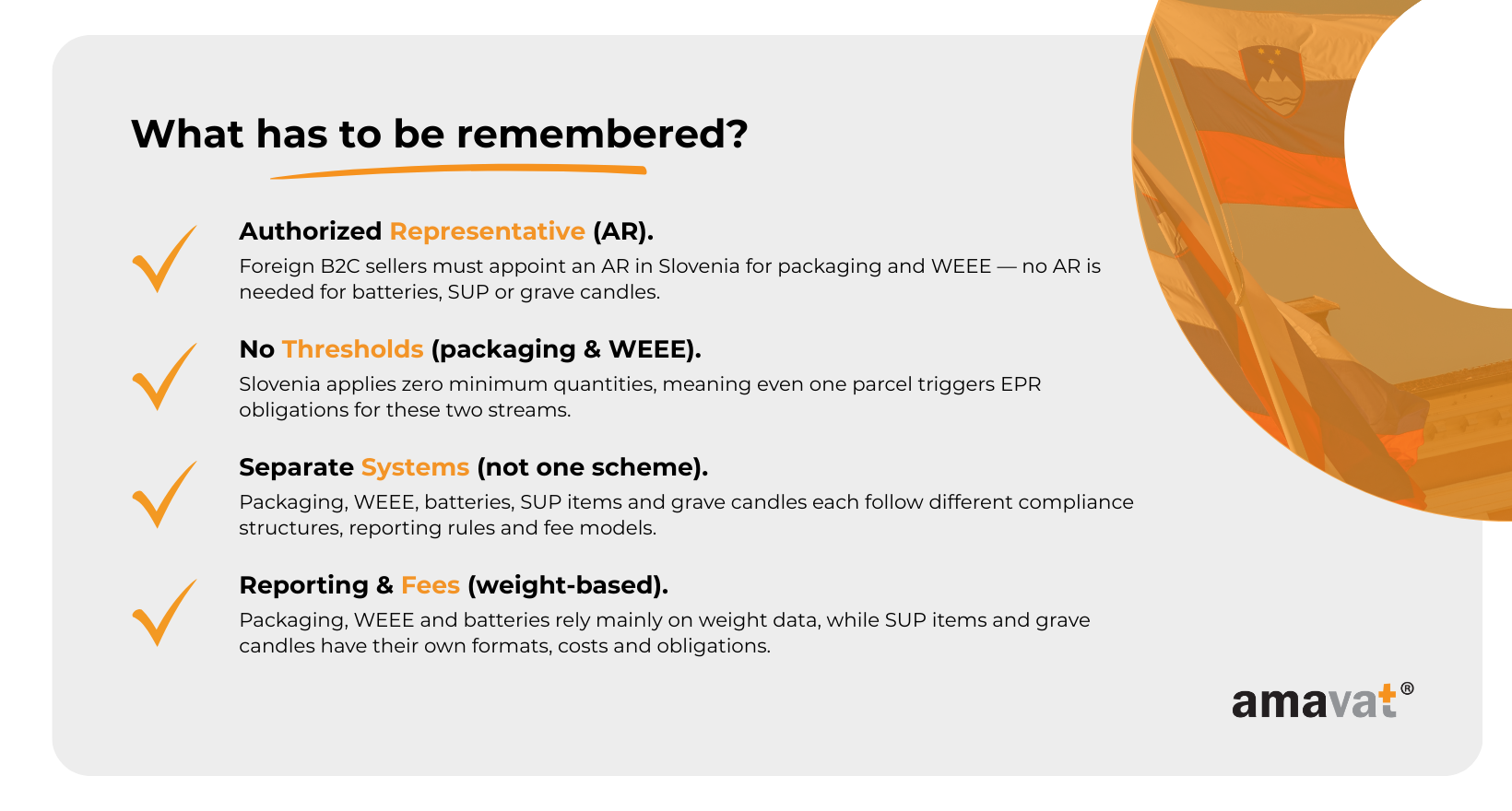
Slovenia doesn’t use quantity-based exemptions for packaging, electronics or batteries. This is important because many young EU entrepreneurs come from markets where you only have to register once you pass a certain threshold. Slovenia doesn’t do that. Even very small volumes — yes, even a few parcels a month — can trigger EPR obligations. What can differ is the way you fulfil your obligations (for example, via a simplified or lump-sum model for low volumes), but you’re still in the system.
This strict approach is meant to ensure fairness: every business that creates waste contributes to managing it, not just the large ones. For e-commerce sellers, this can feel like a big responsibility at first, but once you understand which products are regulated, the process becomes much more predictable.
The main waste streams covered in Slovenia
Slovenia’s EPR rules apply to several specific categories of products and materials. These categories define what you need to register, report and pay fees for. For small online sellers, the majority of obligations usually come from packaging, followed by electronics and batteries. But Slovenia also includes a couple of more unusual streams that may or may not be relevant to your shop.
Packaging
If you sell online, packaging is unavoidable — and Slovenia treats all packaging as subject to EPR. This applies to mailing boxes, envelopes, tape, product packaging, glass jars, plastic wrappers, paper inserts, labels and basically anything that protects or presents your product. There’s no special exemption for “eco packaging”; if it enters the Slovenian market, it must be reported.
What does vary are the fees. Different materials (paper, plastic, glass, metal, wood) have different cost levels. Slovenia hasn’t gone deep into “eco-modulation” yet — meaning a super-recyclable cardboard box doesn’t get a dramatically different rate compared to a standard one — but the material category still matters. The important part is that all packaging must be declared, no matter the quantity or sustainability claims.
WEEE (electronics)
Electronics fall under the EU-wide WEEE system, which Slovenia implements strictly. Most products with a plug, cable or battery will fall into this category. That means everything from laptops and chargers to electric shavers, kitchen gadgets, LED lights, toys with built-in electronics and even smaller accessories can trigger WEEE obligations.
Many sellers underestimate this category because they don’t see themselves as “electronics brands”. But if your product has an electrical component, it probably applies. And since Slovenia has no small-volume exemptions, selling even a handful of electronic devices per year can require registration.
Batteries, including embedded batteries
Batteries are regulated separately from WEEE, even though there is some overlap. Slovenia (and the broader EU under the new Battery Regulation) treats standalone batteries and embedded batteries as distinct reporting categories. This means that if you sell a device with a built-in battery — think smartwatches, speakers, drones, grooming devices or kids’ toys — that battery must be reported as part of your obligations.
Embedded batteries are one of the most overlooked areas for new sellers, especially dropshippers, because the battery isn’t visible or removable. But Slovenia treats them the same as any other battery placed on the market.
Single-use plastics (SUP)
Slovenia enforces the EU’s Single-Use Plastics Directive, which means certain products come with extra obligations beyond normal packaging rules. These include specific types of plastic cups, some food containers, lightweight plastic carrier bags, certain wet wipes and tobacco products with plastic filters.
Not every plastic item qualifies as SUP. The category is defined quite precisely in EU law. But if you sell products that fall under these specific definitions, you’ll face additional marking, reporting or fee requirements on top of packaging EPR.
Grave candles
This category is unique to Slovenia and tends to confuse foreign sellers. Grave or cemetery candles (often used during holidays like All Saints’ Day) are consumed in extremely high volumes, which led the country to create a dedicated EPR stream for them. Regular decorative candles don’t normally fall under this category, but if you sell candles designed and marketed specifically as grave candles, they are subject to separate obligations.
For most e-commerce shops, this stream won’t be relevant. But if your catalogue includes memorial products, it’s worth checking whether the items fall under Slovenia’s official definition.
Do E-Commerce Sellers Need to Comply?
If you’re running a cross-border online shop, one of the first things you’ll want to figure out is whether you yourself need to register for EPR in Slovenia or whether the responsibility sits with someone else. Slovenia’s rules are very clear about who counts as a “producer,” and in e-commerce this is usually the seller rather than the manufacturer or the marketplace. That means that for most small online brands, Slovenia’s EPR rules do apply — but the exact obligations depend on who you sell to and how your products enter the country.
Foreign Sellers (Distance Sellers – B2C)
If you sell directly to Slovenian consumers from abroad, Slovenia considers you a distance seller, and in that situation you cannot register for EPR on your own. The law requires you to appoint an Authorized Representative, a legal entity established in Slovenia, which acts as your official contact point for compliance. This requirement applies only to packaging and electrical and electronic equipment (EEE/WEEE). These are the two waste streams where Slovenian law explicitly mandates a local representative for foreign sellers. Other categories — such as batteries, single-use plastics or grave candles — do not legally require an AR appointment.
The logic behind requiring an Authorized Representative is simple: if you are selling from another country, the Slovenian authorities need a local entity they can communicate with for registration, reporting, audits or enforcement. Your AR is the one who submits your data, keeps your records in order and ensures you remain compliant. Without one, you simply cannot complete the registration process for packaging or EEE.
This applies to almost every type of cross-border B2C online selling model. If you ship products directly to Slovenian consumers via Amazon, Etsy, eBay, Shopify, WooCommerce or any similar setup, the EPR obligations sit with you — not the marketplace — because you are the one placing the product on the Slovenian market. The only time a marketplace becomes the “producer” under Slovenian law is if the marketplace itself is the contractual seller of the product, such as listings explicitly sold by Amazon. This is relatively rare, but legally important to mention because in those specific cases, the obligations shift to the platform rather than the third-party seller.
If you run a dropshipping business, the same principle applies: if the sale contract with the Slovenian customer is between you and the buyer, you are the producer in the legal sense, even if you never physically touch the product. The requirement is triggered by your role in the transaction, not by logistics.

B2B Sellers
Things work differently if your business sells exclusively to other companies in Slovenia. In B2B supply chains, the “producer” is usually the Slovenian importer or distributor who first makes the product available on the Slovenian market. In those situations, foreign B2B sellers normally do not need to register for EPR in Slovenia and do not need an Authorized Representative.
However, this doesn’t mean you won’t be involved at all. Your Slovenian partners might still ask you for information about the packaging or product composition so they can fulfil their own obligations accurately. Some contracts even formalise this, requiring the foreign supplier to provide packaging weights, material breakdowns or product specifications. So even if you’re not legally the producer, you’re still part of the compliance chain.
One important nuance: if your business mixes B2B and B2C sales into Slovenia — even just occasionally — then the B2C part automatically triggers the requirement to comply and to appoint an Authorized Representative for packaging and EEE. Slovenia doesn’t apply thresholds or volume-based exemptions, so even a single direct sale to a consumer counts.
In short, whether you need to comply depends on your sales model. Foreign B2C distance sellers always need to fulfil EPR obligations for packaging and electronics and must appoint an Authorized Representative. Foreign B2B-only sellers generally do not, but they may still need to support their Slovenian partners with accurate data. Understanding this distinction early on makes navigating Slovenia’s system much easier, especially as your business starts to scale.
No Thresholds: Even Small Webshops Must Register
If you’ve sold in other EU markets before, you may be used to the idea that very small online shops get some breathing room when it comes to EPR. Slovenia used to follow a similar approach: under the old rules, only businesses placing more than 15,000 kilograms of packaging on the market each year had to register. That threshold is now gone. When Slovenia updated its packaging legislation, the 15-tonne exemption was scrapped entirely, and the country moved to a far stricter zero-threshold model.
Under the current system, obligations for packaging and electrical and electronic equipment (EEE) start the moment you place anything on the Slovenian market. It doesn’t matter whether you ship a hundred parcels a week or just a single package every now and then — once your packaging or electronic products enter Slovenia, you are in the system. There is no minimum quantity, no grace zone and no “too small to matter” category. Even one parcel or one product can create a reporting obligation if it contains packaging or falls under the EEE classification.
This strict approach often catches smaller sellers off guard, but it fits Slovenia’s broader environmental strategy: every business that generates waste contributes from the start. Batteries do have their own EPR framework, but the formal “zero threshold” concept applies specifically to packaging and EEE, which are the two categories where Slovenia enforces this rule most clearly and consistently.
That said, Slovenia does recognise that not all producers operate at the same scale. While you are legally required to register regardless of your volume, the way you comply can look very different depending on how much packaging you place on the market. Many Producer Responsibility Organisations offer simplified, lump-sum fee structures for small-volume sellers, usually aimed at businesses placing up to around 1,000 kilograms of packaging per year. These simplified models aren’t mandated by law and the exact limits vary between PROs, but they provide an easier, more predictable way for small shops to stay compliant without dealing with complex material-by-material calculations.
For young entrepreneurs, this often makes compliance much less intimidating than it seems at first glance. Once you’ve signed up with a PRO and, if you are a foreign B2C seller, appointed an Authorized Representative for packaging and EEE, the ongoing obligations become manageable. Reporting still matters, but with low volumes and simplified schemes, the paperwork is usually pretty light.
The key takeaway is simple: in Slovenia, even the smallest online shops must register for packaging and EEE EPR. Waiting until you “grow big enough” isn’t an option because the law doesn’t use size or sales volume as a threshold. Register early, choose a PRO that suits your volume and business model, and the rest becomes far easier to handle — especially as marketplaces begin to demand proof of compliance before allowing you to sell to Slovenian customers.
How to Register for EPR in Slovenia
Registering for EPR in Slovenia becomes far easier once you understand that not all EPR categories follow the same registration path. Packaging and electronic equipment (EEE) have the most formal and structured process — including the requirement for a local Authorized Representative for foreign B2C sellers, mandatory PRO membership, and ARSO registration. Other categories such as batteries, single-use plastics (SUP) or grave candles have their own rules, but they do not follow the same step-by-step procedure. Keeping this difference in mind helps you avoid confusion as you move through the registration journey.
Step 1: Determine if Your Products Fall Under EPR
Your first task is simply understanding whether your products trigger any EPR obligations. Slovenia regulates several waste streams, and each one works a little differently.
For most e-commerce sellers, packaging is the primary category. Anything you ship — boxes, envelopes, fillers, tape, labels, wrappers and product packaging — is considered packaging placed on the Slovenian market. Slovenia treats packaging by material type (paper, plastic, glass, metal, wood), and each type must be reported separately once you’re registered.
If you sell gadgets, tools, lights, beauty devices or anything that runs on electricity, you also fall under electrical and electronic equipment (EEE). Slovenia follows EU-wide WEEE classification, so most products with a plug, cable or battery will count.
Batteries, whether sold standalone or embedded inside a product, also represent a regulated category. However, batteries have their own compliance pathway. They do not require a Slovenian Authorized Representative, and their registration and reporting processes are not identical to those used for packaging or EEE.
Slovenia also enforces the EU rules on single-use plastics (SUP). Not every plastic item is SUP — the category covers specific items such as certain single-use cups, selected food containers, some wet wipes and similar products. SUP obligations vary by product type and sometimes involve fees or reporting, but they do not follow the same PRO-based registration process as packaging and EEE.
Finally, there is the unique category of grave candles, which Slovenia regulates separately due to their high consumption. Only candles specifically designed or marketed for cemetery use fall into this stream. Like batteries and SUP, grave candles follow their own compliance path and do not require an Authorized Representative.
Once you know which of these categories your products belong to, you can determine which specific registration steps apply to you — and importantly, which do not.
Step 2: Appoint an Authorized Representative (Foreign Sellers Only)
If you are a foreign B2C distance seller — meaning you sell directly to Slovenian consumers from another country — you must appoint a Slovenian Authorized Representative (AR). This requirement applies only to packaging and electrical and electronic equipment (EEE). These are the two categories where the law explicitly states that foreign sellers cannot register on their own.
Your Authorized Representative (us, for example!) becomes your official compliance contact in Slovenia. They handle your EPR registration, communicate with the authorities, submit your reports and ensure your data remains accurate. Essentially, they act as your local legal presence for packaging and EEE.
If you sell only B2B into Slovenia, you do not need an Authorized Representative because the Slovenian importer becomes the “producer” in the legal sense. But if you sell even one parcel directly to a Slovenian consumer, the AR requirement activates for packaging and EEE.
It’s also worth noting that marketplaces like Amazon, Etsy or Shopify do not usually take on the producer role. They only become the legal “producer” if they are the contractual seller of the product themselves (for example, items sold directly by Amazon). For third-party listings, it’s the seller — meaning you — who carries the EPR obligations.
Step 3: Join a PRO (Producer Responsibility Organization)
Once you’ve determined that your products fall under packaging and/or EEE — and once you’ve appointed an Authorized Representative if you are a foreign B2C seller — the next step is to join a Producer Responsibility Organization.
This step applies specifically to packaging and EEE. These two categories require PRO membership to fulfil your collection and recycling obligations. Batteries, SUP products and grave candles use other mechanisms and are not obligated to follow the same PRO-based system.
PROs take over the operational side of EPR for packaging and electronics. Instead of organising collection and recycling yourself, you pay fees to a PRO, and they manage the entire system on your behalf. This is why joining one is mandatory — it’s the only way to fulfil your obligations properly.
In Slovenia, the main PROs for packaging and EEE include:
Slopak – one of the longest-running schemes.
Interzero – a major international organisation active across the EU.
Recikel – another established option.
There are several additional licensed schemes, but all of them focus on packaging and/or EEE. Not every PRO covers every waste stream, and these organisations do not manage batteries, SUP, or grave candle obligations.
Slovenia has debated a transition to a single-PRO model, but the reform is not implemented. For now, Slovenia remains a multi-PRO system, meaning you can choose the organisation that fits your business.
Once you select a PRO, they will walk you through the necessary packaging/EEE registration steps with the Slovenian Environment Agency (ARSO). This ARSO process applies only to packaging and electrical equipment — not to all EPR categories.
Step 4: Register With ARSO (Slovenian Environment Agency)
Once you’ve signed the necessary contracts for packaging and, if relevant, WEEE, the final step in the setup process is getting registered with ARSO, the Slovenian Environment Agency. This is the authority that maintains the official national registry for producers obligated under the packaging decree and the WEEE (electrical and electronic equipment) decree. Registration confirms that you’re officially recognised as a producer in Slovenia for these specific categories.
Before anything is filed with ARSO, it’s important to understand that you may actually need two separate PRO contracts — one for packaging and another for WEEE — because not all Producer Responsibility Organisations in Slovenia cover both waste streams. Many packaging PROs focus exclusively on packaging, while WEEE is often handled by specialised schemes. So depending on your product range, you might be working with one PRO or two.
The practical side of ARSO registration is usually taken care of for you. If you’re a domestic producer, your PRO submits the required information to ARSO on your behalf. If you’re a foreign B2C distance seller, your Authorized Representative handles the submission instead, because they are the legal entity representing you in Slovenia. Only one party submits data — either the PRO (for domestic producers) or the AR (for foreign producers) — so you don’t deal with duplicate reporting.
Once the registration is processed, you appear in ARSO’s official records for the relevant waste stream. From this point onward, your ongoing obligations mainly involve reporting your packaging and/or WEEE quantities and paying the corresponding PRO fees. ARSO doesn’t expect continuous updates directly from you; instead, it relies on the reporting submitted through your PRO or your AR, depending on your setup.
It’s also important to note that this ARSO registration applies only to packaging and EEE regulated under the WEEE rules. Other EPR categories — such as batteries, SUP products or grave candles — follow completely different compliance mechanisms and do not require ARSO registration.
Once ARSO has you on record, your initial setup for packaging and WEEE compliance is complete. After that, it’s all about accurate reporting and keeping track of what you place on the market each quarter or year — something that becomes second nature once you’ve been through a reporting cycle or two.
Reporting Requirements
Once you’re registered for the relevant EPR categories, your next responsibility is keeping up with the reporting cycle. Slovenia’s reporting framework may feel formal at first, but once you get used to the rhythm — especially for packaging and WEEE — it becomes a predictable part of your operations. The key is understanding that each waste stream follows its own reporting rules, and not all categories behave like packaging and EEE.
Frequency
Slovenia uses a split reporting model, where packaging and WEEE follow the most structured schedule, while other EPR streams operate on completely separate timelines.
If you are registered for packaging or electrical and electronic equipment (EEE), you’ll report to your PRO (or PROs, if packaging and WEEE are handled by different organisations) on a quarterly basis. These quarterly submissions reflect the amount of packaging or EEE you placed on the Slovenian market during that period. If you’re a foreign B2C seller, your Authorized Representative usually submits the reports using your data; domestic producers work directly with their PRO.
In addition to quarterly reporting, there is also annual reporting to ARSO for packaging and WEEE. This is a consolidated summary of the previous year’s activity, and the deadline for submission is March 31. Only one entity submits this report on your behalf — either your AR (if you’re a foreign producer) or your PRO (if you’re based in Slovenia). You never file with ARSO directly, and the AR and PRO do not both submit the same data.
Other EPR streams — batteries, SUP items, and grave candles — do not follow the quarterly + annual structure used for packaging and WEEE. They have their own reporting cycles, sometimes annual-only, sometimes based on different national requirements, and they are not tied to the packaging/EEE PRO systems.
Data You Must Report
The type of data you report depends entirely on the waste stream you operate in.
For packaging, you’ll report the weight of packaging you placed on the Slovenian market, broken down by material: paper/cardboard, plastics, glass, metals, wood and so on. Slovenia tracks weight carefully, and separating the materials correctly is essential for accurate fees.
If you sell EEE, you’ll report the weight of products placed on the market, grouped according to Slovenia’s implementation of the EU WEEE categories. Your PRO (or AR) will typically guide you on which product category applies to each item, since Slovenian law follows the common EU definitions.
For batteries, the reporting is again based on weight, not unit counts. Batteries must be reported according to the correct battery stream — portable, industrial or automotive — and this applies to both standalone batteries and embedded batteries inside devices. If your product contains multiple batteries of different types, each one needs to be included under the correct category.
With single-use plastics (SUP), the obligations vary depending on the exact SUP product type. Some SUP categories involve producer-financed obligations or environmental contributions, while others fall under EU-mandated consumption-reduction rules and are not part of an EPR system at all. For this reason, SUP reporting does not go through packaging PROs, and PROs generally do not manage SUP compliance. Any reporting or fee requirements are handled through separate national mechanisms, and the specific obligations depend heavily on the product classification.
Finally, if you place grave candles on the Slovenian market, these also follow a dedicated compliance system. Reporting requirements are typically annual and handled in a waste-stream-specific format, separate from packaging and WEEE.
In short, your reporting data will always be based on weight for packaging, WEEE and batteries — with batteries requiring correct categorisation into portable, industrial or automotive — while SUP and grave candle reporting follow their own pathways depending on the product type.

2025 Special Case: Temporary Suspension of Battery Reporting
A notable development for battery producers occurred in early 2025. Due to the transition toward the new EU Batteries Regulation, Slovenia temporarily paused portable battery reporting while aligning its national legislation with the new EU requirements. This created a short window in which producers still had to remain registered, but the standard reporting submissions for portable batteries were temporarily on hold.
It’s important to highlight that this pause did not apply equally to all battery categories. Industrial or automotive battery systems were less affected and continued operating under their respective compliance mechanisms.
If your business sells products containing portable batteries — whether standalone or embedded — it’s essential to confirm with your battery compliance provider whether full reporting obligations resumed for the second half of 2025. Different schemes communicated updates at different times, so checking for current guidance is the safest way to stay compliant.
Labeling Obligations
Labeling plays a surprisingly important role in EPR compliance, even though the rules are not as overwhelming as many new sellers fear. Slovenia follows a mixture of EU-wide requirements and national consumer-protection rules. For most small online shops, this comes down to understanding a few key principles: what must be labeled, what is optional, which information needs to be in Slovenian, and which plastic products fall under mandatory SUP markings. Once you get the distinctions right, labeling becomes a straightforward part of ensuring that your products can move smoothly into the Slovenian market.
Packaging Material Codes
Across Europe, it’s very common to see alphanumeric material codes printed on packaging, such as PAP 20 for cardboard or PET 1 for plastic. These codes come from the EU’s Decision 97/129/EC and help consumers identify the packaging material for recycling. However, their presence often leads sellers to assume they’re required everywhere. In Slovenia, they are not. Slovenia follows the EU system but does not legally mandate these codes, which means you can use them if you want to help consumers sort waste more easily, but you’re not breaking any rules if your packaging doesn’t include them. Many businesses use them voluntarily because they look professional and make recycling simpler, but the choice is yours.
Language Requirements
Slovenia has clear expectations when it comes to consumer information, but the rules apply only to what consumers genuinely need for safe use or correct handling of a product. Mandatory information such as safety warnings, essential usage instructions for electronics, or disposal guidance that ensures proper treatment of waste must be provided in the Slovenian language. You don’t need to translate entire manuals for simple products or rewrite marketing descriptions and optional product information. The goal is simply to ensure that someone in Slovenia can use the product safely and responsibly without language barriers. If you sell anything that includes legally required warnings or safety-critical instructions, you must provide those parts in Slovenian, but the rest of your documentation can remain in your standard languages.
SUP Markings
The Single-Use Plastics (SUP) rules are among the most misunderstood parts of EU product labeling, mostly because sellers often assume they apply to all items made of plastic. In reality, the mandatory markings apply only to a very limited, precisely defined group of products that are regulated under EU Implementing Regulation 2020/2151. The familiar “turtle” icon is not a general plastic symbol; it appears only on wet wipes, sanitary products such as tampons or sanitary towels, and tobacco products with filters. Beverage cups also require SUP markings, but they use a different symbol entirely. Most plastic packaging, plastic-based containers, or everyday plastic accessories do not require any SUP label at all.
When a product does fall under one of these SUP categories, the marking must follow strict rules regarding appearance, contrast, and positioning. It can be printed directly on the product or applied as a sticker, and stickers are fully allowed as long as they are durable, visible and meet the formatting standards. For many e-commerce sellers, SUP labeling will only come into play if they sell one of the specific regulated items. If your store doesn’t deal with wet wipes, feminine hygiene products, tobacco filters or beverage cups, SUP labeling will likely never appear on your compliance checklist.
Fees, Payments, and Cost Structure
Fees are often the part of EPR that small online sellers worry about most, but once you understand how the different waste streams work, the entire system becomes far easier to manage. Slovenia does not operate a single unified EPR fee structure; instead, each waste stream follows its own rules and often its own dedicated compliance organisation. The result is a system where packaging and WEEE behave quite predictably, while batteries, SUP items and grave candles use different fee models that depend heavily on the exact product type. Even though the details can look complex from the outside, everything ultimately comes down to how much material you place on the Slovenian market and which categories your products fall into.
How PROs Calculate Eco-Fees
For packaging, the fee is based primarily on the weight of each material type you introduce into Slovenia. Cardboard, plastics, metals, glass and composite materials each carry different rates, and those rates are set individually by each Producer Responsibility Organisation. Slovenia does not use a national price list, so you may see meaningful differences between PROs. Some offer lower fees for lightweight or easily recyclable packaging, while others price materials more evenly. Because Slovenia still operates a multi-PRO system, each organisation is free to structure its own per-kilogram rates, which is why choosing the right PRO can make a real difference for small online shops.
For electrical and electronic equipment, the fee calculation depends on a combination of weight and product category. Slovenia bases its categories on the national WEEE decree, which is derived from the EU framework but not always identical to the most recent EU grouping. Different types of electronics fall under different cost structures, and within those structures, the total weight of the product determines the final fee. Some WEEE schemes also use internal subcategories or differentiate products by complexity, which means similar items can sometimes have slightly different costs depending on how the PRO classifies them.
For batteries, the structure is different again. Battery fees are typically based on the weight of batteries placed on the market, broken down into the three EU battery categories: portable, industrial and automotive. Embedded batteries count, and the compliance scheme must allocate them to the appropriate category. Battery fees are not tied to packaging or WEEE PROs and run through separate compliance systems. Because of the ongoing transition under the new EU Batteries Regulation, these fees can evolve more quickly than packaging or WEEE rates, so staying in touch with your battery compliance provider is essential.
For single-use plastics, Slovenia does not use a weight-based fee model at all. SUP products follow the EU rules that differentiate between items requiring environmental markings, items requiring extended producer responsibility fees, and items that fall primarily under consumption-reduction obligations. When fees apply, they are usually based on unit counts rather than kilograms, and the national mechanism for SUP cost recovery operates separately from packaging and WEEE PROs. That means your packaging PRO will not handle SUP reporting or billing, and you must follow the dedicated procedures for the specific SUP categories relevant to your products.
For grave candles, Slovenia uses yet another system. Grave candles fall under their own specialised compliance scheme due to their unique consumption patterns and waste characteristics. Their fees do not follow packaging or WEEE rates, nor do they use weight-based banding in the same way. Instead, the costs are determined by the dedicated PRO for grave candles, which sets its own structure and reporting expectations. If you sell these products, you enter a separate branch of Slovenia’s EPR system with its own obligations.
Notes on Lump-Sum Models for Micro-Producers
Some packaging PROs in Slovenia offer simplified or lump-sum models for small producers, often aimed at businesses placing relatively low volumes of packaging on the market each year. These models are not defined in law and are not guaranteed across all PROs. Each organisation sets its own criteria, and the commonly cited “under 1,000 kilograms” figure is simply a typical benchmark rather than an official rule. Lump-sum options apply to packaging only — not WEEE, not batteries, not SUP items and not grave candles. Sellers using these models still must be registered, but their reporting obligations may be simplified. Instead of submitting detailed quarterly breakdowns, some PROs allow a single annual declaration or a reduced reporting format designed for low-volume sellers. This can dramatically lower the administrative workload for micro-brands or occasional exporters, even though the underlying legal obligation remains the same.
What Typically Drives Cost Changes
The biggest driver of cost is simply the volume and composition of the materials you place on the Slovenian market. Heavier packaging means higher packaging fees; electronics with more components fall into more demanding WEEE categories; and products containing portable batteries will generate additional obligations within the battery system. Even modest design choices can influence your costs over time. Switching from plastic to paper-based packaging can reduce your overall fees, while eliminating unnecessary layers of packaging or redesigning product boxes can lead to measurable long-term savings. In the case of SUP products, cost changes depend on whether an item triggers EPR fees, information obligations or consumption-reduction rules. For grave candles, costs depend on the pricing policy of the dedicated compliance scheme.
As your product range evolves or your number of shipments increases, your EPR fees naturally rise, but many sellers find the system predictable once they understand the main drivers. With consistent record-keeping and a PRO suited to your scale, the financial side of EPR compliance in Slovenia becomes a manageable, budgetable part of doing business rather than an unpredictable administrative burden.
Penalties, Marketplace Restrictions & Enforcement
Slovenia treats EPR as an essential part of its environmental policy, and that means non-compliance is taken seriously, even when it involves small online shops. The financial penalties are only one part of the picture, but it’s still worth understanding how they work because fines can escalate depending on the type of violation and who is held responsible. The widely quoted figure of four thousand euros reflects only part of the system. In reality, Slovenian law distinguishes between the company itself and the responsible individual within that company. A legal entity — meaning the company — can face significantly higher penalties, often running from several thousand euros into the tens of thousands depending on the decree involved, while the responsible person (such as a director) may face fines up to roughly four thousand euros. The exact amount depends on whether the issue concerns packaging, WEEE or another regulated stream, and whether the violation is seen as minor, repeated or deliberate.
For foreign distance sellers, enforcement often centres on two key obligations within the packaging and WEEE systems: having a valid compliance contract with the appropriate PRO and, where required, appointing a Slovenian Authorized Representative. These two obligations apply only to packaging and electrical and electronic equipment. They do not apply to batteries, SUP items or grave candles, which follow their own compliance paths. This distinction matters because inspectors and authorities will request different evidence depending on the type of product you sell. If you are placing packaging or WEEE on the market as a foreign B2C seller, then proof of your PRO contract and your AR appointment will be the first documents requested. But if you deal in batteries, SUP items or grave candles, the authorities will look for compliance through the appropriate battery scheme, SUP mechanism or the dedicated grave-candle system rather than expecting the packaging-style PRO and AR documents.
Although government inspections do happen — and have become more active in the last few years — the nature of these checks is usually administrative rather than dramatic. Inspectors might ask for registration confirmations, PRO contracts or evidence of reporting in the case of packaging and WEEE. For batteries, they might request documentation from the relevant battery compliance system. For SUP products, they may focus on whether mandatory markings or obligations associated with specific product types were fulfilled. Each waste stream has its own pattern of documentation, so enforcement reflects the structure of that specific system rather than a single universal checklist.
Marketplace pressure is another dimension of enforcement, but it works differently in Slovenia compared to countries like Germany or France. Slovenia does not have a marketplace-liability law that forces platforms to verify producer numbers before allowing sellers to list products. This means Amazon, Etsy or eBay are not legally required to police Slovenian EPR compliance in the way they must for certain other Member States. However, marketplaces increasingly apply EU-wide policies that require sellers to prove they are compliant wherever the marketplace perceives there may be regulatory risk. As a result, some platforms may ask for EPR proof even when the specific country does not impose marketplace duties. When this happens, it is driven by internal platform policy rather than Slovenian legislation, but the practical effect for sellers is similar: if you cannot provide the necessary documents, a marketplace may delay listings or request additional verification before allowing sales to continue.
In practice, Slovenian enforcement is firm but predictable. Authorities generally focus on ensuring that producers meet their obligations rather than punishing honest mistakes. Most businesses that correct issues promptly face minimal consequences. However, ignoring registration requirements, failing to appoint an Authorized Representative when one is required for packaging or WEEE, or repeatedly missing reports can escalate the situation quickly. For small online sellers, the simplest safeguard is to get the right registrations in place early and maintain clean, consistent reporting for the waste streams relevant to your products. Once those foundations are set, navigating Slovenia’s EPR environment becomes far more straightforward.

Practical Checklist for E-Commerce Sellers
Here is the revised checklist with all factual corrections included and the tone kept clear, friendly and concise. Since this section is meant to be a true checklist, the list format remains intentional and appropriate.
- Do I sell B2C to Slovenia?
If you do, you may have direct EPR obligations for packaging and for any electrical and electronic equipment (EEE) that actually falls within the official WEEE categories. Not every product with a cable or accessory qualifies, so only electronics that meet the WEEE definitions create EEE obligations. - Do I need an Authorized Representative?
A Slovenian Authorized Representative is required only for foreign B2C sellers placing packaging or WEEE-scope EEE on the Slovenian market. Batteries, SUP items and grave candles do not require an AR under Slovenian law. - Have I chosen and contracted the correct PRO or compliance system?
Packaging and WEEE require contracts with the appropriate PROs, and depending on your product range you may need two separate organisations. Batteries must be handled through the correct battery system based on battery type — portable, industrial or automotive — and embedded batteries must be classified accordingly. SUP items do not use PROs; only certain SUP categories require fees or specific labelling obligations, and others involve no financial contributions at all. Grave candles rely on their own dedicated PRO, separate from packaging or WEEE schemes. - Have I ensured all required labeling is in place?
Mandatory consumer or safety information that is necessary for proper use or disposal must appear in Slovenian, while non-essential manuals or marketing text do not require translation. SUP markings must be applied if your products fall into one of the EU-regulated SUP categories, and these markings may be printed directly onto the product or added as compliant stickers that meet the durability and visibility rules. - Am I ready for reporting?
For packaging and WEEE, quarterly reporting is standard and usually coordinated through your PRO or Authorized Representative. Battery reporting uses a different schedule, is handled through the battery system rather than a packaging PRO, and is based on weight per battery type rather than units. SUP and grave-candle reporting follow their own formats and timelines, depending on the requirements of each stream.
Conclusion
Selling into Slovenia comes with a learning curve, and the country’s EPR framework can feel more complex than what many young online sellers are used to in other parts of the EU. Between packaging rules, WEEE definitions, battery categories, SUP requirements and even the unusual case of grave candles, the system isn’t something you can navigate purely on instinct. Each waste stream has its own processes, its own terminology and, in many cases, its own compliance partners. That’s why the most important step is simply understanding which obligations apply to your specific products before you start shipping. Once you’ve mapped that out, everything else — from PRO contracts to reporting — becomes far easier to manage.
What really matters is starting early. Slovenia’s approach leaves little room for “I’ll deal with it later,” especially if you’re a foreign B2C seller who needs an Authorized Representative for packaging and WEEE. Early compliance prevents unpleasant surprises like fines, delayed listings or marketplace requests you can’t answer. And, just as importantly, it removes the stress of scrambling to correct something after the authorities or a platform reaches out. Most small sellers find that once they complete the initial setup, the system settles into a regular rhythm: a predictable mix of quarterly reporting for packaging and WEEE, occasional checks for batteries or SUP items, and simple internal routines to keep weight records organised.
Despite its detailed rules, Slovenia is not a hostile market for new e-commerce brands. It’s simply a market that expects transparency and equal responsibility from all producers, big or small. With the right registrations, a reliable PRO, and a bit of clarity about which waste streams you’re involved in, compliance becomes just another operational task — no more intimidating than bookkeeping or VAT filings. For sellers who get things in place early, Slovenia offers a stable, predictable environment to grow, and EPR becomes something you manage comfortably rather than something you fear.