EPR System in Sweden
Spis treści
Sweden takes this principle seriously. In fact, it has one of the oldest and most developed EPR frameworks in Europe. The country introduced producer responsibility for packaging back in the 1990s, long before it became a standard across the EU. Over the years, Sweden has refined its setup, tightened its rules, and built a recycling system that relies heavily on producers doing their part. That’s why, when people talk about strict or mature EPR systems, Sweden always comes up. It’s predictable, well-structured, and honestly, not very forgiving if you skip your obligations.
For e-commerce sellers, this matters more than ever. Whether you run a tiny Etsy shop from Germany or ship beauty products from Spain, the moment your packages land on Swedish doorsteps, you’re considered a “producer” under Swedish law. It doesn’t matter if you don’t have a warehouse there, or if you only sell a few dozen items a year. Sweden doesn’t use thresholds to let small sellers slip under the radar. If you place packaged goods on the Swedish market, you’re in. And the rules apply to everyone equally — local stores, EU-based online shops, and even sellers outside the EU that ship directly to Swedish consumers.
You’re probably wondering what exactly you’re responsible for, how complicated it is, and how much it costs. That’s exactly what this guide will help you with. You’ll learn what Sweden’s EPR system actually requires, who needs to register, what the reporting process looks like, how the fees work, and what happens if you ignore the rules. You’ll also get clarity on how single-use plastic regulations fit into all this, what the future EU-wide changes might bring, and what practical steps small online shops should take to stay compliant without losing sleep over it.
By the time you reach the end, you’ll know how Sweden’s system works, how to avoid penalties, and how to set up your business so EPR compliance becomes just another part of your routine — not something that keeps you awake at night.
What Is EPR in Sweden?
The Swedish Take on the “Polluter Pays” Principle
To understand how Sweden handles EPR, it helps to start with the idea behind it. Sweden takes the classic “polluter pays” principle and applies it directly to packaging. If your business puts packaging on the Swedish market — a box, a bottle, a mailer bag, or a takeaway cup — you’re not only responsible for selling the product inside it. You’re also responsible for the entire life cycle of that packaging, including what happens when your customer throws it away. The point is simple: companies creating the waste should also cover the cost of dealing with it, instead of passing that job to taxpayers.
This isn’t just a theory written in law books. Sweden has been refining its EPR framework since the 1990s, making it one of the most established systems in Europe. Today, the country treats producer responsibility as a real financial obligation. Producers fund collection, sorting, reporting, and recycling. And since 2024, they also finance the municipal collection service that now handles all household packaging waste. This shift toward municipal control has created a more consistent national system — one of the biggest EPR reforms in Sweden in decades. If your packaging becomes waste in Sweden, you’re paying your portion of the cost to manage it.
How Sweden Defines Packaging
To make sure everything is covered, Swedish law splits packaging into a few categories. Consumer packaging includes anything that ends up in households — boxes, jars, mailers, shipping packaging. Grouping packaging is used to bundle multiple products together. Transport packaging includes outer cartons, stretch film, and materials used to move products in bulk. Service packaging covers items handed over directly to customers, like takeaway containers or disposable cups. If a material protects, delivers, or contains a product, chances are it counts as packaging.
The types of materials included in Swedish EPR are the usual suspects: paper and cardboard, plastic, metal, glass, and composite materials such as drink cartons. In some cases, certain biodegradable food-service packaging can be included as well, depending on material composition. Wood can sometimes be used as packaging — crates, wooden supports — but it isn’t treated as a main reporting category, and most e-commerce sellers will never need to report it. When you submit your data, you’ll be reporting in the standard material groups Sweden expects.
Why Sweden Cares About the Details
One thing that catches many online sellers off guard is how detailed the reporting is. You don’t simply say, “I use packaging.” You report how many kilograms of each material type you place on the Swedish market. Every box, every bottle, every plastic wrapper, every shipping label — they all add up. Sweden wants precise data so it can plan recycling capacity, understand waste flows, and improve the national waste system over time.
Behind all this is a clear environmental mission. The goal is to reduce unnecessary waste, improve recycling, and encourage businesses to make smarter packaging choices. Because fees depend on how recyclable your materials are, the system pushes companies toward lighter, cleaner, more circular packaging. When thousands of businesses shift even slightly — using lighter boxes, cleaner material combinations, fewer plastics — the result is less waste, higher recycling rates, and lower CO₂ emissions.
So while Sweden’s EPR approach can feel strict, especially if you’re a small e-commerce brand shipping a few dozen parcels a month, the intention isn’t to make your life difficult. The system is designed to support a circular economy where packaging isn’t just thrown away but kept in circulation. And with the EU tightening packaging rules across the board, Sweden isn’t the outlier — it’s just a few steps ahead of everyone else.
Who Must Comply?
How Sweden Defines a “Producer”
Sweden uses a broad definition of what counts as a producer, and for many e-commerce sellers it’s wider than expected. A producer can be a company manufacturing packaging inside Sweden, but it can just as easily be a business importing packaged goods, a company importing empty packaging, or a seller who packages products in Sweden before selling them. And for online sellers, there’s one category that matters most: a distance seller sending packaged products directly to Swedish consumers is also a producer, even if the company has no physical presence in Sweden at all.
If your packaging ends up in a Swedish household bin, the law considers you responsible for it. That part hasn’t changed. But here’s where things get more nuanced — and much more relevant for small businesses: Sweden does not treat all producers equally. One of the most important details in Swedish EPR law is that companies with an annual turnover of 1,000,000 SEK or less are exempt from the main producer responsibility obligations. This means a very small business selling only a handful of products is not required to go through the full EPR process, even if it technically “places packaging on the market.” Below this turnover level, you still need to follow general environmental rules, but you are not subject to the core EPR duties that apply to larger producers.
So while Sweden’s definition of “producer” is broad, the obligations that come with it depend not only on packaging quantities but also on company size. This is an important distinction for small e-commerce sellers who often assume they need to register even when they fall below the turnover threshold. The rule is simple: if your turnover does not exceed one million SEK, you do not fall under the full packaging producer responsibility system.

Distance Sellers and Marketplaces
For anyone running an online shop, the distance seller rule remains the biggest trigger for EPR obligations. If you’re based in another EU country, or even outside the EU entirely, and you ship packaged goods directly to Swedish customers, you are considered a producer under Swedish law — as long as your turnover is above the one-million-SEK lineup.
This applies regardless of whether you use fulfilment services like Amazon FBA or another 3PL. Fulfilment providers don’t take on your EPR obligations for you. You remain responsible for registering, reporting, and paying fees unless you fall under the turnover exemption.
Sweden doesn’t currently require marketplaces to verify EPR compliance in the way Germany or France do, but the trend is clear: big platforms like Amazon and Zalando are gradually introducing their own checks. Even if the law doesn’t force them to, they prefer removing the risk by asking sellers to show relevant documents. So while it isn’t a legal requirement in Sweden today, it’s becoming a practical one if you sell on major platforms.
Local vs. Foreign Sellers
One thing Sweden does consistently is treat domestic and foreign sellers the same. A Swedish furniture brand and a small Dutch jewellery shop shipping to Sweden have identical obligations once they cross the one-million-SEK turnover threshold. The same applies to companies outside the EU. If they sell packaged products to Swedish consumers, they are considered producers under Swedish packaging law.
The only difference lies in representation requirements, and even there the system is evolving. Sweden does not currently require foreign distance sellers to appoint an authorised representative for packaging. But with the EU’s upcoming Packaging and Packaging Waste Regulation, every non-resident producer in the EU will eventually have to appoint a local representative in each market where they sell. This isn’t in force yet, but it is on the horizon, and sellers should be aware of it.
The Real Thresholds: Turnover, 500 kg, and 1 Ton
Once you understand the turnover exemption, the other thresholds make a lot more sense. Sweden uses a layered system designed to keep things fair and manageable for small companies.
If your turnover is below 1,000,000 SEK, you’re exempt from the main packaging producer responsibility obligations. You don’t join a PRO, you don’t submit annual packaging reports, and you don’t pay supervisory fees. You’re still expected to handle packaging responsibly, but you’re not part of the formal EPR framework.
If your turnover is above this threshold but you place less than 500 kg of packaging per year on the Swedish market, you fall under simplified reporting rules. You still need to be part of the system, but the paperwork is lighter because the environmental impact is relatively small.
And if you place less than 1,000 kg per year, you don’t need to pay the annual supervisory fee to the Swedish Environmental Protection Agency. You’re still a producer, still responsible for reporting, and still obligated to join a producer responsibility organisation, but your fixed costs are reduced.
These three levels — turnover limit, 500-kg simplified reporting, and 1-ton supervisory fee exemption — work together to make the system less demanding for small online sellers while keeping larger producers accountable.
Why This Matters for Young E-Commerce Entrepreneurs
For many newer entrepreneurs, especially those running small EU-based online shops, these thresholds make a big difference. Without understanding them, it’s easy to assume that even the smallest seller must register immediately. In reality, Sweden’s rules are strict where they need to be but still recognise that micro-businesses shouldn’t carry the same administrative load as companies shipping pallets of goods every week.
The key takeaway is simple: Sweden’s EPR system does apply to e-commerce — but not everyone is pulled into the deep end. Once you know which category you fall into, compliance becomes much easier to plan, budget, and manage. And as EU-wide rules continue to tighten, learning how Sweden structures these obligations gives you a head start in understanding what the future of packaging regulation will look like across the rest of the European market.
How to Register for EPR in Sweden
Registering with the Swedish EPA (Naturvårdsverket)
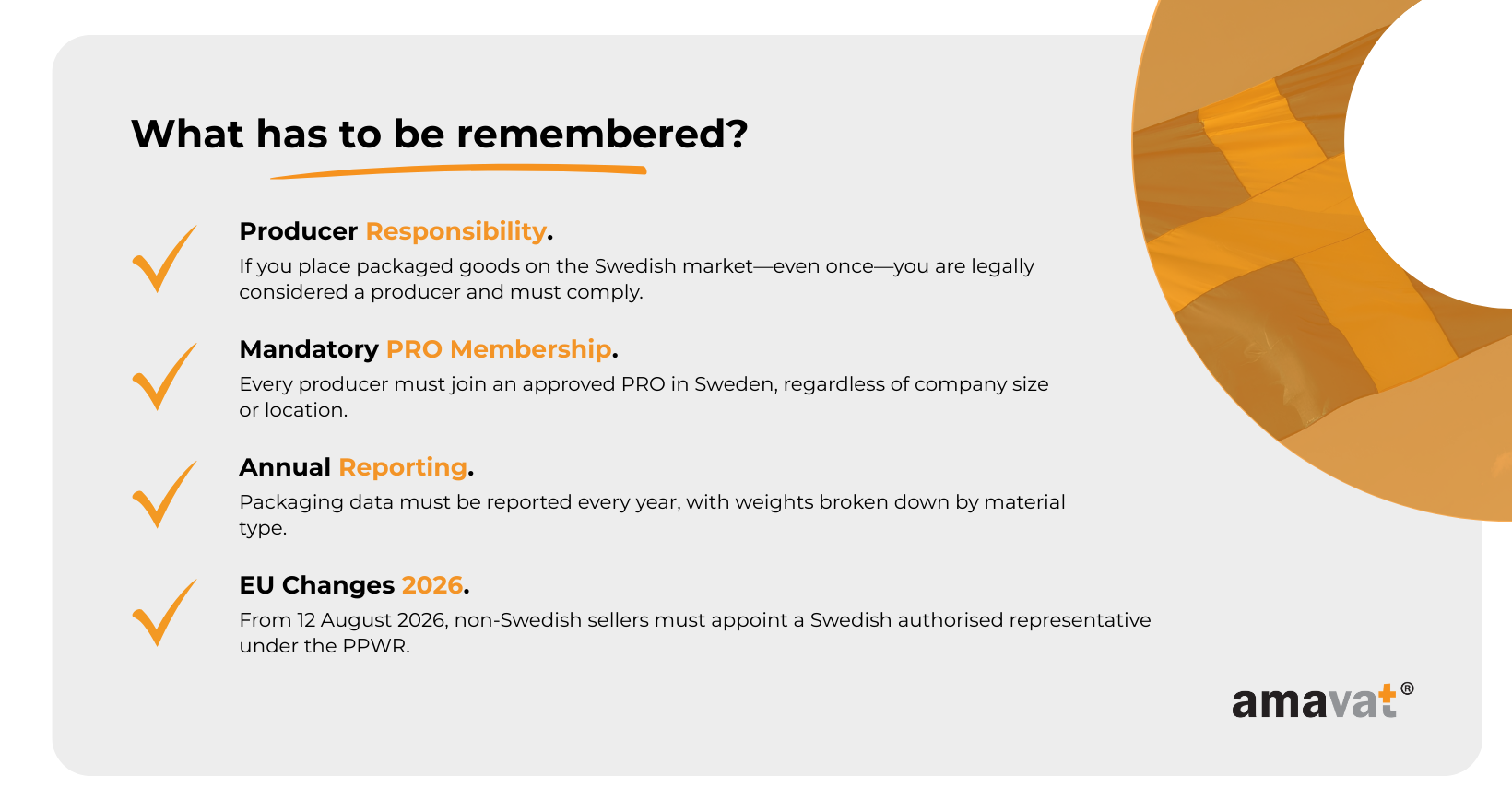
Once you’ve confirmed that you qualify as a producer under Swedish rules — meaning you professionally manufacture, import, fill, or distance-sell packaged products to end users in Sweden — the first step is registering your responsibility with Naturvårdsverket, the Swedish Environmental Protection Agency. There’s no minimum turnover or volume threshold for becoming a producer. If you place packaging on the Swedish market in a professional context, the law considers you in scope.
Registration is usually handled online through Naturvårdsverket’s e-service. You can complete it yourself, but many companies simply let their producer responsibility organisation (PRO) register them as part of their onboarding. Both options are allowed.
The EPA will ask for your company details, including your name, address, contact information, your corporate ID or VAT number (if you’re based outside Sweden), and which PRO you have hired. You’ll also need to specify in what capacity you qualify as a producer — for example, as an importer of packaged goods, a filler, or a distance seller. At this stage, you’re not providing packaging weights or material breakdowns; that comes later when you start reporting actual annual volumes.
You must already have chosen a PRO before completing the registration, because Naturvårdsverket requires you to state which organisation you’ve hired. Some PROs even complete the entire EPA registration for new members, so the order often goes: join a PRO first, then finalise the registration.
When your registration is approved, Naturvårdsverket can issue proof that your company is in the producer register. Many marketplaces and logistics partners may ask for this confirmation, especially as EPR checks are becoming more common across the EU.
Joining an Approved PRO (NPA or TMR)
Every packaging producer in Sweden — regardless of size, origin, or sales volume — must be affiliated with an approved Producer Responsibility Organisation. There are currently two: Näringslivets Producentansvar (NPA) and TMResponsibility (TMR). These organisations handle the operational and financial side of your packaging responsibility, including managing reporting flows and coordinating recycling costs.
In practice, most companies start by comparing the two PROs. The main things sellers look at are the material-based fee tables, the user-friendliness of reporting tools, and the level of support available for small or foreign producers. Since fees depend on the packaging materials you use — cardboard, plastic, metal, glass, composites — the structure can vary depending on your packaging mix.
After choosing a PRO, you sign their membership agreement. Many businesses join a PRO before they even complete the EPA registration, because PROs often help guide new producers through the process. Legally, joining a PRO isn’t optional if you qualify as a producer. Whether you’re based in Sweden, elsewhere in the EU, or entirely outside the EU, you must have a PRO unless you fall under very specific exemptions, such as packaging that is exclusively reusable in a closed-loop system.
Once you’re a member, the PRO becomes your main point of contact for reporting your packaging volumes and paying the recycling fees that finance Sweden’s packaging system. Even though municipalities now handle the physical collection of household packaging, PROs still manage producers’ financial and reporting obligations.
Using an Authorised Representative: Current Rules and What Will Change
For packaging EPR as it stands today, Sweden does not require foreign distance sellers to appoint an authorised representative (AR). If your business is not established in Sweden, you can still register directly with Naturvårdsverket using your VAT number. Appointing a representative is optional. If you choose not to appoint one, you remain responsible for all EPR tasks yourself — registering, reporting, and paying fees.
But the situation is about to change. Under the new EU Packaging and Packaging Waste Regulation (PPWR), all producers placing packaging on the market in a Member State where they are not established must appoint a local authorised representative. This is a binding requirement and removes any national flexibility.
The key date to know is 12 August 2026. From that day onward, any company that is not established in Sweden but sells packaged goods — including shipping packaging — to Swedish consumers will have to appoint a Swedish authorised representative. The representative becomes the legally responsible party for ensuring that all your packaging obligations in Sweden are fulfilled, from EPA registration to reporting and payments.
For small e-commerce sellers, this is worth planning for early. Today, you can manage everything yourself. But by mid-2026, a representative will be mandatory for cross-border sales. If Sweden is a growing market for your brand, it’s a good idea to factor this into your long-term compliance planning so the transition is smooth when the new EU rules come into force.
Reporting Requirements
How Reporting Works in Practice
Once you’re registered and connected to a producer responsibility organisation, the next step is reporting the amount of packaging your business places on the Swedish market each year. This part of the system is all about data — Sweden wants to know how much packaging enters the country and what materials it’s made of so the national recycling system can function properly.
Legally, producers report once per calendar year. This annual report is what Naturvårdsverket requires. The report can be submitted in two ways: either directly through Naturvårdsverket’s e-service or, much more commonly, through your PRO. Most companies choose the PRO route because PROs already gather all the packaging data needed to calculate recycling fees, and they’re set up to submit this information to the EPA in the correct format.
Even though the official report is annual, many PROs offer the option — sometimes even the recommendation — to report monthly or quarterly internally within their own systems. This isn’t because the law requires it, but because it helps PROs manage ongoing recycling fees and makes life easier for companies that deal with large or variable volumes. For small e-commerce sellers, simpler annual reporting is usually more than enough. The key point is that the legally required submission to Naturvårdsverket happens once a year, and you or your PRO make sure it arrives on time.
What Information Needs to Be Reported
The core of Swedish packaging reporting is straightforward: it’s all based on kilograms. You need to report how much packaging you placed on the Swedish market during the previous year, broken down by material type. Sweden has defined categories that apply to all producers, and these typically include cardboard and paper, plastic, metal, glass, and composite materials like drink cartons.
Every producer, regardless of size, reports by material type. Some packaging categories — especially those covered by separate rules, like certain single-use plastic products or beverage bottles — may require additional details, but this depends on what kind of packaging you use rather than how much of it you supply. Most small e-commerce sellers don’t handle these special categories, so the reporting stays quite simple: you weigh your packaging, sort it into material types, and report the totals.
If your business is very small, your PRO may offer simplified reporting. You still need to provide your kilograms per material type, but you won’t be expected to break everything down into the more complex fractions required of large producers. The idea is to keep the system fair but manageable: everyone contributes data, but not everyone needs to provide the same level of detail.
How and Where Reports Are Submitted
In reality, almost everyone reports through their producer responsibility organisation. NPA and TMR both have online portals where you log in, enter your packaging data, and confirm it. They then handle the administrative part: submitting the official annual report to Naturvårdsverket and calculating the recycling fees you owe.
If you prefer handling it yourself, Naturvårdsverket does allow direct reporting through their own e-service. This tends to be used by larger companies or businesses with dedicated compliance staff. For small e-commerce sellers, letting your PRO manage the process is usually the easiest, since they guide you through what you need to provide and make sure your data is formatted correctly.
Foreign producers follow the same steps as Swedish companies. You use your VAT number instead of a Swedish company ID, but the reporting process is identical. Sweden doesn’t distinguish between domestic and foreign producers when it comes to how reports are filed — once you’re in the system, everyone follows the same structure.
Reporting can seem intimidating the first time you do it, mostly because you have to get into the habit of knowing what your packaging weighs. But once you set up a simple method for tracking your materials, the annual reporting ritual becomes part of the rhythm of running your business. Sweden’s goal isn’t to overwhelm entrepreneurs; it’s to make sure the recycling system has the data it needs to function fairly. And when you stay organised, the process becomes routine surprisingly quickly.
Fees E-Commerce Must Pay
EPA Enforcement Fee
Once you’re officially in the Swedish system as a packaging producer, one of the state-level costs you may face is the annual enforcement fee charged by Naturvårdsverket. This fee supports supervision of the system, maintenance of the producer register, and general enforcement work around packaging regulations.
The key rule is simple:
You pay this fee if you place one tonne or more of packaging per year on the Swedish market. That’s one tonne in total, across all material types combined. If your total packaging stays below that amount, you’re normally exempt from this specific fee — although you still need to register, report, and be affiliated with a PRO.
The only exception is for companies placing certain single-use plastic products on the market. If your business supplies SUP products that fall under the EU Single-Use Plastics Directive categories, the supervisory fee applies regardless of whether your packaging total hits the one-tonne level. Sweden treats SUP differently because the environmental burden is higher and more visible, and the state wants a clear mechanism to fund oversight.
For most e-commerce sellers shipping typical parcels — cardboard boxes, mailers, and small plastics — the amount of packaging they place on the Swedish market is unlikely to reach one tonne unless their business is scaling fast. But it’s still worth monitoring, because passing the threshold brings you into a different cost tier under the enforcement system.

PRO Packaging Fees (Material-Based Costs and Design Incentives)
The main cost of compliance for most e-commerce brands doesn’t come from the state but from their producer responsibility organisation. When you join NPA or TMR, you agree to pay packaging fees based on the amounts and material types you put on the Swedish market each year.
Everything revolves around kilograms. You report how many kilograms of each material type you supplied, and your PRO applies its fee schedule. These schedules differ slightly between NPA and TMR, but the structure is consistent across Sweden: every material has a price per kilogram, and some materials are more expensive to handle than others.
Cardboard tends to be relatively inexpensive because it’s easy to sort and recycle. Plastics often cost more, especially if they’re complex, multi-layered, or not easily recyclable. Metals, glass, and composite materials each have their own cost profiles.
Over the past few years, Sweden has steadily moved toward modulated fees — meaning fees that reflect the recyclability of your packaging. Mono-material, well-designed packaging is rewarded with lower costs. Multi-material packaging, black plastics, or anything that causes sorting problems usually costs more. The system is designed to nudge companies toward smarter design choices, and it works: businesses that redesign their packaging to be simpler and more recyclable often see their PRO charges drop over time.
Most PROs also have minimum annual fees. For small or early-stage e-commerce sellers, this minimum can be the main portion of their cost, especially if their Swedish order volumes are still small. It’s worth checking these minimums before choosing a PRO, as they can make a noticeable difference for businesses just beginning to sell in Sweden.
Littering Fees for Single-Use Plastics
Certain single-use plastic products come with an additional set of fees — commonly referred to as littering fees. These are part of Sweden’s implementation of the EU Single-Use Plastics Directive and are designed to cover the cost of cleaning up litter in public areas, not recycling.
These fees apply to specific categories of single-use plastic items, most commonly:
- single-use plastic food containers
- single-use plastic cups
- some types of single-use plastic carrier bags
- certain personal/hygiene items like wet wipes
- tobacco filters containing plastic
- balloons (for producers supplying them to consumers).
The fees generally have two components: a fixed annual fee and a variable fee based on the number of units (or relevant weight) you place on the market each year.
Some food packaging such as wrappers, pouches, or containers may fall under the SUP rules if plastic is the main structural component, but this depends on the exact design of the packaging rather than its product category. It’s not that “all snack wrappers” automatically count — it’s that some might, depending on their material composition.
SUP littering fees do not automatically apply to standard beverage containers, as those are usually handled through Sweden’s deposit-return system and traditional EPR schemes. The SUP categories are very specifically defined, and the littering fee only applies to the items explicitly covered by the directive.
For most e-commerce sellers shipping typical goods (clothing, beauty products, electronics, home goods), SUP fees won’t apply at all. But if you sell takeaway food, beverage products without a deposit system, or anything relying heavily on disposable plastic food packaging, you need to check whether your product lines fall under the SUP categories.
2024–2025: Municipal Takeover and the New Cost Structure
The biggest recent shift in Sweden’s packaging system happened on 1 January 2024, when municipalities officially took over responsibility for collecting household packaging waste. Before this change, collection was more intertwined with the producer organisations; now, municipalities run the physical system — the bins, the trucks, and the local recycling infrastructure.
Producers still pay for everything, just through a different structure. Instead of funding collection directly, producers now compensate municipalities through a national cost model. This system takes several factors into account, including the material type and how recyclable it is. The idea is simple: materials that are easier and cheaper for municipalities to collect and recycle result in lower fees for producers. Hard-to-recycle or resource-intensive materials cost more.
Part of the purpose of this reform is to create a more standardised nationwide system, including an expansion of curbside collection (known in Sweden as fastighetsnära insamling). This means that producers indirectly support a more coherent, accessible recycling infrastructure for households. Over time, this should increase recycling rates and make the whole system more efficient.
In the early stages of implementation, there have already been adjustments. Some PROs have even refunded surpluses to members when collected fees exceeded the actual compensation costs owed to municipalities — a sign of the system finding its new equilibrium. As data improves and municipalities adjust their methods, the cost model should become more predictable.
For e-commerce businesses, the practical takeaway is that Sweden’s fee structure is becoming increasingly linked to real environmental performance. Producers aren’t simply paying a “green tax.” They’re funding a system where packaging design, material choices, and recyclability directly influence the bottom line. The better your packaging design, the lower your long-term costs — and Sweden has built the mechanism to make that financially visible.
Single-Use Plastic Rules (Critical for E-Commerce Packaging)
Single-use plastics are one of the strictest parts of Sweden’s packaging system, and even if your business mostly ships products in cardboard, you might still use small elements that fall under these rules. Sweden applies the EU Single-Use Plastics Directive very tightly, and in several areas it adds its own national ambitions. If your products come in disposable plastic packaging — especially food, beverages, cosmetics or everyday consumables — this is where you need to pay extra attention.
Banned SUP Products
Sweden follows the EU ban on certain single-use plastic items, and the material that disappears completely from the market is expanded polystyrene, or EPS. Any form of EPS food container, EPS beverage cup or EPS lid is prohibited in Sweden. Anything made entirely of EPS for single-use food or drink purposes cannot be sold to Swedish consumers, even if the quantities are tiny. This applies equally to domestic companies, EU sellers, and non-EU distance sellers.
One point that often causes confusion is the status of paper cups that contain a plastic lining. Even if the lining makes up more than fifteen percent of the cup, these cups are not banned. They remain legal but are regulated under the SUP rules, which means they require proper labeling and fall under consumption-reduction measures. They are part of the transition away from unnecessary plastic, but they are not prohibited products.
Attached Caps and Lids Requirements (2024)
Since July 2024, certain beverage containers must have their plastic caps or lids permanently attached during normal use. This rule applies to bottles and drink cartons that use plastic closures, as the goal is to keep caps from becoming stray litter. Glass bottles, metal cans, and medical or specialised dietary packaging are not covered by this rule.
If your products arrive in PET bottles or composite drink packaging and you sell them to Swedish consumers, you must make sure the closures are compliant. Even small imported batches count. If the caps detach, the product is not allowed on the Swedish market and you risk sanction fees.

Recycled Plastic Content Requirements (2025 → 2030)
Sweden follows the EU’s timeline for recycled content in plastic beverage bottles. From January 2025 onwards, all PET bottles up to three litres must contain an average of at least twenty-five percent recycled plastic. The percentage is calculated across everything you place on the market in a calendar year, not bottle by bottle. By 2030, the requirement increases to thirty percent for all single-use plastic beverage bottles up to three litres.
Larger bottles and bottles intended for medical or dietary use are outside this rule. However, most everyday consumer bottles are inside it, and if you import any products packaged this way, Sweden expects you to verify that the manufacturer meets the recycled-content obligation. Simply assuming the producer complies is not enough; distance sellers are expected to check.
Consumption-Reduction Targets
At EU level, Member States must reduce the consumption of certain single-use plastic items, particularly cups and food containers. The EU does not set a fixed percentage, but Sweden has chosen to adopt more ambitious national goals. As part of its waste-prevention strategy, Sweden aims to cut the consumption of single-use plastic cups and food containers by roughly half by 2026. This is not a hard legal obligation on individual businesses, but it is a clear policy direction that shapes future regulations, fee structures, and marketplace expectations.
Looking towards 2030, Sweden is aligned with broader EU ambitions to reduce plastic litter and increase recycled content in packaging. For companies that rely heavily on disposable service packaging, this means the pressure to switch to smarter, simpler or reusable packaging will only grow stronger over time.
Labeling Rules (Language and Placement)
Some single-use plastic items require mandatory environmental labeling. The labels warn against littering, explain correct disposal and help consumers recognise items containing plastic. Sweden uses the EU’s standardised design, but the text must appear in Swedish. This applies to items such as single-use cups, certain food containers, wet wipes containing plastic, tobacco filters and balloons supplied to consumers.
If you import these products, the labeling must already be correct when they enter the market. Labels added as stickers are acceptable only if they are permanent, applied before sale and follow the full EU design requirements. Marketplaces are increasingly checking for SUP-compliant labeling, which means non-compliant products may be blocked before reaching consumers.
E-Commerce & Marketplace Responsibilities
E-commerce sellers sometimes assume that because they operate through a marketplace, the platform somehow takes over their packaging responsibility. In Sweden, that isn’t the case. The law is very clear about who the “producer” is, and it always points to the business that places the packaged product on the Swedish market. That means the seller, whether they are established in Sweden or not, carries the responsibility for registration, reporting and paying packaging fees. Marketplaces can guide you, and increasingly they check whether sellers are compliant, but they never step into the legal role of producer.
How Marketplaces Are Beginning to Verify EPR
Sweden does not legally require marketplaces to block non-compliant sellers. Unlike Germany or France, there is no statutory obligation for platforms to demand EPR numbers before you can list products. Even so, platforms have started to tighten their internal checks. Large international marketplaces already operate EPR verification workflows in several EU countries, and these systems are gradually spreading to Sweden. Some Nordic platforms are connecting to EU-wide compliance APIs and shared verification tools because the infrastructure is slowly becoming standardised across Europe. That means Swedish EPR is moving toward the same digital transparency that sellers already experience in Germany or France, even though Sweden has not yet made marketplace enforcement mandatory.
For now, Sweden’s verification environment is a kind of soft screening. Sellers are only occasionally asked to provide proof of registration or show evidence of PRO membership. Requests tend to focus on high-volume cross-border sellers or categories with known environmental risks. But the direction is clear: platforms are preparing for the moment when EPR checks in Sweden will no longer be optional.
What Amazon and Other Marketplaces Currently Require
Amazon does not currently block listings for missing Swedish packaging EPR registration. Sellers can offer products to Swedish consumers without uploading a Swedish EPR number, and Amazon’s discontinued EPR “takeover services” do not replace producer obligations. However, Amazon does occasionally request documentation from sellers, especially if they appear to be active distance sellers or if their fulfilment volumes suggest a recurring Swedish market presence. Other platforms such as Zalando, CDON or Allegro Nordic behave in similar ways. None of them currently enforce EPR in Sweden the way they must in Germany and France, but all of them have the capability to switch to mandatory checks quickly once EU law changes.
There is an important point to make about Amazon FBA and fulfilment setups in general. Even when Amazon stores and ships your products, the seller remains the producer under Swedish law. The decisive factor is not who physically touches or sends the parcel, but who controls the decision to place the packaged product on the Swedish market. When your FBA inventory is shipped to a Swedish customer, it is still you — not Amazon — who is legally placing that packaging on the Swedish market. This point often surprises sellers, but it is central to understanding your obligations.
Seller Liability in FBA and Third-Party Fulfilment
From Sweden’s perspective, fulfilment arrangements do not change the legal structure of producer responsibility. Whether you use Amazon FBA, a 3PL warehouse in another EU country, a dropshipping service or your own small storage space at home, the same rule applies: if you are the business sending the packaged product to the Swedish consumer, then you are the producer. The warehouse, the courier, the marketplace and the fulfilment service are all outside the responsibility chain. They may help you manage logistics, but they are never responsible for reporting your packaging or paying Swedish EPR fees.
This also means you are expected to keep documentation showing that your packaging complies with Swedish rules, including SUP labeling, attached caps for certain beverage containers, and recycled-content requirements for PET bottles. Marketplaces may ask you for this information before listing or during account reviews, but even if they never ask, the legal duty remains yours.
Expected Changes with the EU PPWR in 2026
The landscape will shift significantly once the new EU Packaging and Packaging Waste Regulation becomes fully applicable. One of the most important changes arrives on 12 August 2026, when any producer that is not established in a particular Member State will be required to appoint an authorised representative in that country. For Sweden, this means that non-Swedish sellers shipping to Swedish consumers will have to appoint a Swedish authorised representative. There will no longer be an option to register directly on your own if you are not established in Sweden.
Once this requirement enters into force, marketplaces will almost certainly adopt a stricter verification model. They will need to ensure that every producer selling in their Swedish storefront has both a valid EPR registration and a formally appointed Swedish authorised representative. In practice, this will make Sweden function much more like Germany or France when it comes to marketplace compliance checks. In other words, “no EPR, no selling” will likely become the standard across the entire EU, not just in a few countries.
For e-commerce sellers, the message is simple: the groundwork you lay now will save you a lot of stress later. Sweden may not enforce marketplace verification today, but the shift is coming, and once PPWR goes live, the change will be sudden. Sellers who already understand their obligations, have joined a PRO and have their documentation in order will glide through that transition while others scramble to catch up.
Penalties & Sanctions
Sweden enforces packaging rules in a way that is predictable, transparent and notably strict. The country applies a system of fixed environmental sanction fees, which means that once a violation is confirmed, the fee is charged regardless of whether the mistake was intentional. This “strict liability” approach is designed to keep the system fair and uniform, especially when it comes to distance sellers who might otherwise slip between regulatory cracks. If you sell into Sweden, even occasionally, it’s important to understand how these sanctions work and how quickly they can apply if your registration, reporting or packaging design falls behind.
Environmental Sanction Fees
Sweden sets fixed administrative fees for specific breaches of packaging and SUP legislation, and the amounts are defined in the sanction-fee regulations that apply across producer responsibility areas. The fee for failing to register with Naturvårdsverket is typically ten thousand kronor. The same amount applies if you fail to submit the required annual packaging report. These two represent the most common compliance mistakes for cross-border sellers, often because businesses assume that reporting can be skipped in low-volume years. It cannot.
Not being affiliated with an approved producer responsibility organisation is also a sanctionable breach. The common fee for this violation in the packaging stream is ten thousand kronor. Higher penalties do exist in other producer-responsibility fields, and the law allows escalation for aggravated or repeated violations, but the standard amount for first-time non-affiliation in packaging is aligned with the ten-thousand-kronor level.
Incorrect or missing single-use-plastic labeling carries its own fixed fee, again set at ten thousand kronor, and the same amount applies to beverage containers that do not meet attached-cap requirements after the 2024 implementation date. These are straightforward design obligations, and Sweden treats them as black-and-white compliance issues.
When it comes to banned SUP products, the fees increase as the volume increases, because placing prohibited items on the market has a more visible environmental impact. Sweden does use volume-based tiers for these violations, and the sanctions rise from a lower band for small quantities to significantly higher amounts for large-scale breaches. The exact thresholds vary depending on the product category and the specific legal article violated, but the structure is consistent: small quantities result in a modest fixed fee, larger quantities lead to progressively higher charges, and very large-scale distribution can trigger the highest tier of sanctions. The important takeaway is that even a small number of banned SUP products can lead to penalties, and larger volumes quickly become expensive.
Injunctions and Additional Fines
Environmental sanction fees are only part of the enforcement picture. Naturvårdsverket can also issue injunctions requiring a business to correct the underlying problem. These injunctions come with deadlines, and if they are not met, the company can face additional fines known as “vite.” These fines are not fixed amounts; they are set in proportion to the problem and can be raised if the business continues to ignore the order. In serious cases, Sweden can require a producer to stop placing certain products or packaging types on the market altogether until compliance is restored. For cross-border sellers, this can create immediate consequences, because marketplaces may act on these notices if the seller fails to take corrective action.
How the Enforcement Process Works
The enforcement process follows a clear administrative sequence. It usually begins with a notification explaining the suspected breach and the fee that may apply. This gives you an opportunity to respond. If you can demonstrate that the issue was already resolved, or if you provide evidence showing that the suspected violation did not occur, the authority may close the matter. If the explanation is not accepted, Naturvårdsverket issues a formal decision confirming the sanction and setting a payment deadline. Payments go to Kammarkollegiet, the Swedish Legal, Financial and Administrative Services Agency, which handles all state-level administrative fees.
Businesses have the right to appeal the decision within a short timeframe, generally three weeks. Importantly, appealing does not pause your responsibility to fix the underlying problem. Sweden separates the penalty from the obligation. Even if you dispute the fee, you must still complete the missing registration, submit the overdue report or correct the packaging issue by the deadline.
Exemptions and Mitigating Circumstances
Although Sweden uses strict liability, there are limited circumstances in which Naturvårdsverket can waive or reduce a sanction fee. These exemptions apply only when a company can show that the violation resulted from factors beyond its control, such as severe illness, an unforeseeable technical failure or another genuine force-majeure event. The threshold is high. Ordinary administrative mistakes, misunderstandings of the law or delays caused by suppliers are not normally considered valid reasons for exemption. Sweden expects producers to act proactively, and the system rewards quick correction rather than excuses.
For e-commerce sellers, especially those selling from outside Sweden, the best approach is simply to stay organised. The sanctions are predictable, the deadlines are clear and the rules do not change suddenly without warning. If your registration, PRO membership and reporting are kept up to date, the risk of penalties becomes very low. Most problems arise from companies that delay compliance or assume that small volumes won’t matter. In Sweden’s system, they do.
Timeline of Key Dates
Looking at Sweden’s packaging rules year by year makes it much easier to understand how the system is shifting. Instead of a single big change, the decade is full of small and not-so-small steps that build on each other. For an e-commerce business, this timeline is basically a preview of what you’re going to need to prepare for, both in Sweden and across the EU.
From 2023: The New Packaging Regulation
Sweden’s modern packaging framework effectively began on 1 January 2023, when the new packaging ordinance came into force. It clarified the definition of a producer, refreshed the rules around reporting and record-keeping, and set the stage for the bigger structural changes that follow in later years. Not every part of the ordinance became active on day one; some obligations were phased in or tied to later milestones. But 2023 is still the point where Sweden’s rules shift from the older 1990s structure into the updated, EU-aligned model that everyone now has to follow. If you started selling into Sweden before 2023, this is the moment when your responsibilities changed; if you began afterwards, this is the baseline you’ve been working under from day one.
From 2024: Municipal Takeover and a Clearer Enforcement System
The start of 2024 marks another major turning point. On 1 January, Swedish municipalities officially took over the responsibility for collecting household packaging waste. For producers, this didn’t remove obligations — it changed where the money flows. Instead of financing collection directly through the older producer-run system, companies now fund municipal collection through a national compensation model. For households, this should eventually mean more consistent, more convenient collection. For businesses, especially those selling from abroad, it means the system has better visibility into who is placing packaging on the market.
This is also the moment when enforcement becomes more structured. Environmental sanction fees are no longer something you only hear about in industry newsletters; they become a real part of the compliance landscape. With municipalities collecting data and authorities working within a more stable regulatory framework, it becomes much harder for non-compliant producers to go unnoticed. Even if you’re a small cross-border seller, 2024 is the year when you need to assume Sweden can see your activity.
From 2025: Recycled Content Rules Become Real
By 2025, plastics take centre stage. PET beverage bottles up to three litres must, on average, contain at least twenty-five percent recycled plastic. This requirement applies across your entire range for the year, meaning you cannot compensate for non-compliant packaging with a single “green” line. If you import PET-packaged goods — anything from drinks to cosmetics to household cleaners — you’ll need documentation from your suppliers showing their compliance. Sweden expects distance sellers to be able to verify and demonstrate this.
By 2025, SUP rules also feel less like “new additions” and more like normal parts of doing business. Attached caps, mandatory SUP labeling and the litter-cleanup fees connected to certain single-use plastics are simply part of the baseline. If your packaging still follows pre-directive designs, this is the moment to modernise it before the EU raises the bar again.
From 2026: The PPWR Transition and the New Authorised Representative Requirement
The next cornerstone date is 12 August 2026, when the new EU Packaging and Packaging Waste Regulation (PPWR) moves from transitional status into practical reality. One of the most important rules is the requirement for producers who are not established in a particular Member State to appoint an authorised representative there. For Sweden, that means any non-Swedish company selling packaged goods — including shipping packaging — to Swedish consumers will need a Swedish authorised representative acting as their official compliance point.
This doesn’t eliminate your own responsibility, but it changes how it is managed. You won’t simply register directly with the Swedish EPA on your own; your authorised representative becomes your formal interface. This is also the moment when marketplaces are likely to move from soft, optional verification to more systematic checks. The German and French models have already shown how quickly platforms can shift when EU rules push them in that direction. Once PPWR is active, it’s realistic to expect Swedish marketplace storefronts to begin requiring proof of EPR compliance and authorised representation before listings can go live.
Towards 2027: Nationwide Door-to-Door Collection
The ordinance that began in 2023 also includes a major service reform coming into effect no later than 1 January 2027. By that date, every municipality in Sweden must offer property-close, door-to-door collection of household packaging. This means regular curbside pickup, sorted by material type, for all households. The intention is to make recycling more convenient while also improving the quality and cleanliness of collected materials.
For producers, the effect is indirect but important. A more consistent national collection system produces cleaner data and higher recycling expectations. If your packaging is difficult to sort, contains unnecessary composites or contaminates recycling streams, the pressure to improve it will increase. Sweden’s fee structures are steadily moving toward rewarding recyclable designs and penalising problematic ones, and the national rollout of curbside collection accelerates that shift.

By 2030: A More Circular Packaging System
When you look toward the end of the decade, you can see the direction the entire regulatory structure has been pointing toward. By 2030, recycled content requirements for beverage bottles increase to thirty percent for all single-use plastic bottles up to three litres. EU policy goals for reducing plastic packaging waste, cutting litter and pushing recyclability are fully embedded in national law. By this stage, Sweden expects packaging to be designed for reuse, recycling and circularity by default, not as a branding value-add.
For businesses, 2030 isn’t a sudden deadline; it’s the endpoint of a long, clear progression. The expectation is that every producer — large or small, domestic or cross-border — will already have adapted by then. The decade is essentially a runway that gives you time to shift toward lighter, simpler, more recyclable and more circular packaging choices.
What This Means for Your Planning
If you zoom out, you can see the logic of the timeline. The 2023 ordinance set the rules. The 2024 municipal takeover and enforcement improvements made them visible. The 2025 plastics requirements raised the environmental bar. The 2026 PPWR rules change how cross-border sellers manage compliance. The 2027 curbside mandate standardises the national system. And the 2030 circularity goals lock in the long-term direction.
For a young e-commerce brand, this means you should treat compliance as part of how your business evolves, not as an occasional admin chore. Gradually updating your packaging, building relationships with suppliers who can meet recycled-content and SUP requirements, keeping clean reporting data and preparing to work with an authorised representative are all practical, steady steps. Each one makes the next milestone easier, and by the time 2030 arrives, you’ll already be operating in the system Sweden and the EU have been building toward all along.
Conclusion
Reaching the end of this guide, you’ve probably realised that Sweden’s packaging rules aren’t just another administrative chore. They’re a full system — one that comes with clear expectations, a long-term direction and a level of enforcement that many e-commerce sellers underestimate. Compliance here isn’t something you do because you’re afraid of a random audit; it’s something you do because it’s woven into how the Swedish market functions. If your packaging ends up in a Swedish household, the country expects you to take responsibility for it in a very real, very structured way.
Why Compliance Matters More Than Ever
The point of all of these rules — from registration, to PRO membership, to plastics reform, to the upcoming authorised-representative requirement — is to make sure that packaging waste is handled properly, financed fairly and designed with the environment in mind. Sweden approaches this with a kind of seriousness that younger markets are only just beginning to adopt. It’s not about making life harder for businesses; it’s about creating a system where packaging becomes more circular every year. If you understand that context, the rules start to feel less like obstacles and more like tools for building a responsible, future-proof operation.
And if you’re selling online, especially from another country, compliance is also a practical business decision. Sweden’s enforcement may be strict, but it’s predictable. That means no surprises if you follow the rules — and very predictable consequences if you don’t. For small brands entering Sweden for the first time, getting compliant early is the easiest way to avoid stress later. For growing brands, it’s the only realistic way to scale without being blocked by a marketplace, questioned by a partner or contacted by the authorities.
Sweden as a High-Enforcement Market
Among EU countries, Sweden sits firmly on the “high-enforcement” end of the spectrum. Not because it hands out penalties randomly, but because it actually monitors what enters its market. Municipalities, PROs and the EPA exchange data. Packaging rules tie directly into national recycling goals. SUP rules are actively checked. And once the EU’s PPWR kicks in, the system becomes even more coordinated — especially for cross-border sellers.
For a small or medium-sized e-commerce brand, this means you can’t rely on staying invisible. If you place packaging on the Swedish market, you’re expected to be part of the system that handles it. The upside is that once you’re compliant, the rules are fair, stable and transparent. There’s no guesswork, and Sweden rarely changes the goalposts without giving businesses time to adjust.
Final Advice for E-Commerce Teams Planning Market Entry or Scaling
If you’re considering entering Sweden or planning to grow your presence there, the smartest move is simply to start early. Get your PRO membership set up. Keep your packaging data clean and organised. Make sure your designs follow SUP rules and recyclability expectations. And if you’re an international seller, be ready for the moment when authorised representatives become mandatory in 2026. Treat these steps as part of your business infrastructure, not as one-off tasks you deal with once a year.
Sweden rewards companies that take responsibility up front. It becomes easier to work with marketplaces, easier to answer documentation requests, easier to scale and easier to roll with future EU changes. And while the rules can feel demanding at first, they ultimately push your business in the same direction the entire European market is heading toward: packaging that is lighter, cleaner, easier to recycle and far more aligned with the realities of modern e-commerce.
If you’re organised, curious and willing to adapt, Sweden isn’t a difficult market — it’s simply a structured one. And once you understand the structure, operating there becomes not just manageable, but surprisingly straightforward.