EPR System in Malta
Spis treści
In Malta, this responsibility is organised through EPR – Extended Producer Responsibility. EPR is the framework that governs how producers are held responsible for the packaging and certain products they place on the Maltese market. The system is supervised by the Environment and Resources Authority (ERA), which manages important aspects of producer registration and compliance. For any entrepreneur expanding online sales internationally and shipping products to customers in Malta, EPR is a legal obligation that cannot be ignored.
It is important to emphasise that these rules are not invented by individual countries. They are rooted in EU waste legislation, which seeks to establish common environmental standards across the Union. Since August 2026, packaging is also governed by the directly applicable EU Packaging and Packaging Waste Regulation. The goal remains straightforward: businesses that earn money by selling products in packaging should help finance what happens to that packaging once it becomes waste. This is meant to ensure that less waste ends up in landfills and more materials are kept in circulation.
For an online seller who ships parcels abroad, understanding these rules is absolutely crucial. Every parcel delivered to a customer in Malta brings packaging into the Maltese market, although the legal responsibility depends on who is classified as the producer and how the goods are supplied. Even if your company has no registered office there, selling directly to Maltese customers may bring you within the Maltese EPR system. Failing to meet applicable registration, representation or reporting requirements can expose a business to enforcement action, which can be particularly painful for small companies.
At the same time, it is worth looking at these regulations not only as a legal burden but also as part of building a competitive advantage. Customers across the EU increasingly pay attention to whether companies operate in line with sustainability principles. Complying with EPR rules in Malta is not just about avoiding sanctions; it is also a way to show that your business takes environmental responsibility seriously.
This article will walk you step by step through how the EPR system works in Malta and what obligations a small e-commerce company must meet to operate legally. With this knowledge, you will gain a clear picture of the entire process and avoid unnecessary administrative or financial problems.

Who Is Required to Register
Businesses Placing Packaged Products on the Market
The largest group covered by Malta’s EPR system consists of companies that place packaging or packaged products on the Maltese market. The definition of a “producer” is broad and includes manufacturers, importers and certain businesses selling through distance commerce. For a small online store shipping goods directly to end users in Malta, those deliveries can make the seller responsible for the packaging under Maltese and EU rules, even if the business operates entirely from abroad. The precise obligations depend on the supply chain and the type of customer.
Cross-Border Sales and Local Representation
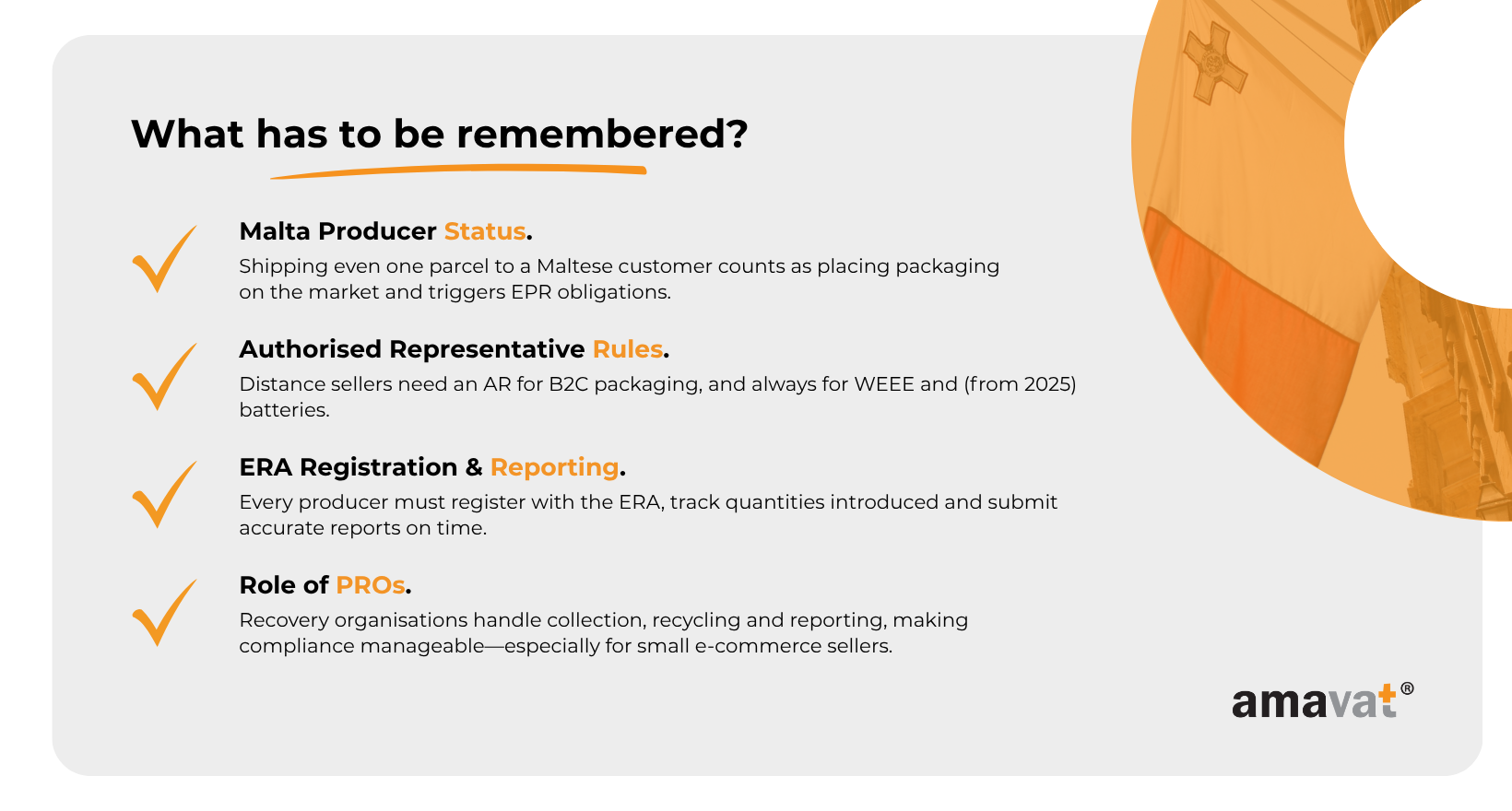
Cross-border sales rules are particularly important. A business with no registered office in Malta may need to appoint an authorised representative, but the answer is not identical for every product category or commercial arrangement. For packaging, Malta’s national rules address foreign distance sellers supplying consumers, while Regulation (EU) 2025/40 also covers direct supplies to professional end users. A sale to a business that uses the products is therefore not necessarily treated in the same way as a sale to a distributor that resells them. Electrical equipment and batteries have their own representation requirements, which must be assessed separately.
Small Volumes of Packaging
The regulations include certain simplifications for companies that place very small quantities of packaging on the Maltese market. Businesses placing less than 100 kilograms of packaging annually may use a dedicated declaration instead of the standard national registration and recovery-organisation route. However, this does not mean they are exempt from every obligation, particularly now that the EU Packaging and Packaging Waste Regulation applies directly. The ERA declaration is also time-limited: the authority automatically terminates that registration three calendar years after receiving the form, even if the business has continued selling. Producers must therefore monitor their status and submit any necessary updated documentation.
Other Product Categories Covered by EPR
Malta’s EPR system also applies to other categories such as electrical and electronic equipment, batteries and certain single-use plastic products. Anyone placing these goods on the Maltese market must examine the corresponding registration, financing and reporting requirements. Businesses selling drinks should also check Malta’s Beverage Container Refund Scheme (BCRS), which operates alongside packaging EPR and imposes separate requirements on covered beverage containers. Its €0.10 refundable deposit is shown separately from the product price and is not subject to VAT. Depending on the category, producers may work with an approved collective scheme or meet obligations individually.
Malta has also been developing an EPR scheme for non-packaging paper products, in line with its Long-Term Waste Management Plan (2021–2030). The ERA held a public consultation from 3 February to 27 April 2026 on draft Extended Producer Responsibility (Non-Packaging Paper) Regulations. The proposal covers certain office papers, newspapers, periodicals, envelopes and stationery, with specified exclusions. As of 15 October 2026, the consultation can be confirmed, but the draft should not be treated as an operative registration obligation without checking whether the regulations have been enacted.
What This Means for Online Sellers
For online sellers expanding into Malta, these rules mean looking at the Maltese market through a broader compliance lens. Regardless of whether you sell clothing, sports accessories, electronics or beverages, packaging and product-specific obligations may apply when your goods reach Maltese customers. The precise requirements depend on your role in the supply chain, the quantities involved and whether buyers are consumers, professional end users or resellers. Ignoring these distinctions can lead to avoidable compliance problems and financial consequences that may significantly affect a small business.

Who Is Required to Register
Businesses Placing Packaging on the Market
The primary group subject to Malta’s packaging EPR obligations consists of companies that place packaging on the Maltese market. The term “producer” covers local manufacturers, importers and relevant foreign sellers that supply Maltese end users through distance commerce. Under Regulation (EU) 2025/40, the definition also reaches certain direct cross-border supplies to professional end users, not only household consumers. If you sell products online and send orders to Malta, the first step is therefore to establish who has producer responsibility for the packaging in that particular transaction.
The regulations allow producers to fulfil relevant obligations through an approved collective recovery organisation or, where the legal conditions permit, through a self-compliance model. Self-compliance means arranging and demonstrating the required collection, recovery and recycling measures independently rather than relying on a PRO for those activities. The available route and supporting documentation depend on the type of packaging and the applicable rules.
It’s important to note that appointing a local authorised representative is not required in exactly the same circumstances for every business. Malta’s national packaging rules address foreign sellers supplying consumers, while the PPWR requires producers making their first cross-border supply of packaging or packaged products directly to end users to appoint an EPR representative in the relevant member state. End users include both private consumers and businesses buying for their own professional use. Sales to distributors that resell products require a separate assessment of who is the producer.
Electrical and Electronic Equipment
The rules governing waste electrical and electronic equipment (WEEE) form a separate branch of Malta’s EPR system, although the underlying logic is similar to packaging. Companies placing electrical or electronic equipment on the Maltese market must establish their producer status, register where required, report the relevant quantities and finance collection and treatment. Depending on the regulatory conditions, they may fulfil the obligations individually or through an authorised WEEE compliance scheme.
In this area, the rules are particularly clear for foreign distance sellers. If you sell electrical and electronic equipment to Maltese customers by means of distance communication, you must appoint an authorised representative where required by regulation 17(2) of S.L. 549.89. This extends to supplies to private households and to users other than private households, so relevant B2B distance sales are not excluded. Sales to professional distributors should nevertheless be distinguished from direct distance sales to end users when identifying who must register.

Batteries and Accumulators
The same principle of producer responsibility applies to businesses placing batteries, including batteries incorporated into products, on the Maltese market. Producers and importers must assess registration, financing, collection and reporting duties under the newer battery framework. Depending on the circumstances, they can participate in an authorised battery PRO or pursue self-compliance under the applicable approval and permitting rules. Packaging or WEEE registration does not automatically satisfy the separate battery obligations.
Regulation (EU) 2023/1542 on batteries has been implemented in phases, with important EPR provisions applying since August 2025. In Malta, the principal national rules are now the Waste Management (Waste Batteries) Regulations, S.L. 549.178, introduced by Legal Notice 232 of 2025. These replaced S.L. 549.54, subject to transitional provisions. The new regulations require an authorised representative, appointed by written mandate, for batteries sold to end users in Malta in the circumstances covered by the rules. These end users can be private consumers or professional buyers, and businesses should check the exact obligations for their sales model.
Small Volumes of Packaging
The regulations provide simplified treatment for very small businesses that place less than 100 kilograms of packaging on the Maltese market annually. Such a company may use the ERA’s dedicated “less than 100kgs” declaration rather than the ordinary national registration and recovery-organisation procedure. However, it should not assume that this declaration removes every obligation under the directly applicable EU packaging rules. The declaration is also time-limited: the ERA automatically terminates the registration three calendar years after receiving the form, without making termination conditional on a halt in sales. In practice, even an online shop sending only occasional parcels must keep track of its packaging quantities, registration status and any required renewal or updated declaration.
The Registration Process with the ERA
Registration via the ERA Portal
For any business placing regulated products on the Maltese market, an important first step is identifying the correct registration procedure with the Environment and Resources Authority (ERA). The authority supervises Malta’s EPR system, but it does not use a single identical online form for packaging, electrical equipment and batteries. Packaging producers, for example, have separate registration, renewal, deregistration and authorised-representative forms. Some submissions can be completed online, while other procedures require supporting declarations, signed mandates or documentation supplied through a PRO. The business should begin by checking the ERA guidance for its particular waste stream.
Registration for Small Volumes of Packaging
Businesses placing less than 100 kilograms of packaging on the Maltese market per year may use the simplified ERA declaration. Under this national procedure, the producer does not ordinarily have to join a packaging recovery organisation solely to meet the standard packaging scheme requirements. Nevertheless, the business must submit the relevant declaration and check whether any additional requirements apply under the PPWR or other legislation. Importantly, the ERA terminates this registration automatically three calendar years after receiving the form, irrespective of whether sales continue. A producer still active in Malta must therefore make sure it remains correctly registered and completes any necessary replacement or updated declaration.
Registration at 100 Kilograms of Packaging or More
Once a company reaches 100 kilograms of packaging per year, the simplified procedure for volumes below that threshold no longer applies. At this point, its national packaging duties expand and it must determine the appropriate compliance route, whether through a licensed packaging recovery organisation or permitted self-compliance. For many smaller businesses, a PRO is the more practical choice because it can organise collection and recycling activities and assist with the related administrative work. The business still needs to provide accurate information and meet any obligations that remain its own.
Documentation and Deadlines
Registration with the ERA involves submitting the correct forms and supporting information for each applicable category, including details of packaging, electrical equipment or batteries placed on the market. Packaging producers subject to annual renewal should pay particular attention to the 31 March renewal deadline. Changes to packaging registration details must generally be notified within one month, rather than relying on a universal 30-day rule for every EPR category. Certain declarations and reports may also need verification by an auditor approved by the ERA. Keeping records up to date is essential, especially when sales volumes or the business structure change.
Registration Number and System Status
After the ERA accepts a producer’s registration, the business receives an identifying registration number for the relevant scheme. The number is used in official records and communication with the authority and compliance organisations. For packaging, the applicable rules may also require the registration number to appear on invoices and fiscal receipts. Registration alone, however, is not proof that a business has fulfilled all of its legal duties: renewals, accurate data, financing, reporting and, where required, independent audits remain important. These steps should be checked before beginning sales to the Maltese market and reviewed as the business grows.
The Role and Importance of PROs (Producer Responsibility Organisations)
What PROs Are
Producer Responsibility Organisations form a core pillar of Malta’s EPR system. Their role is to organise specified obligations on behalf of participating producers, including waste collection, transport, treatment and recycling arrangements. They operate under authorisations issued by the Environment and Resources Authority (ERA) and remain subject to regulatory oversight. Their activities are financed through contributions paid by producers and importers, which can depend on the quantity and type of packaging or products placed on the market. This structure reflects the “polluter pays” principle: businesses contribute to the cost of managing the waste associated with what they sell.
GreenMT and GreenPak as Examples of PROs
For packaging, Malta’s ERA lists two authorised recovery organisations: GreenMT Ltd and GreenPak Cooperative Society Ltd. GreenMT offers a collective route for producers who need to meet their packaging-waste responsibilities through an approved organisation. GreenPak offers the same type of collective route for producers who need to meet their packaging-waste responsibilities through an approved organisation. Both can be considered on equal terms when a business is choosing a packaging PRO, with the final decision based on membership conditions, fees, reporting arrangements and the services relevant to its operations. Their packaging authorisations should not be confused with approval to manage electrical equipment or batteries; those waste streams require separate checks.
Scope of Services and Responsibilities
PROs coordinate the waste-management activities covered by their authorisation and their agreements with producers. Depending on the scheme, this may include household collection services, cooperation with collection points, transport of waste to treatment facilities and arrangements for materials to be recycled or recovered. A key part of their work is reporting information to the ERA, allowing the authority to monitor collection and recycling performance and progress towards legal targets. The details differ between packaging, WEEE and batteries, which is why businesses should always confirm what a particular PRO is licensed to do.
Self-Compliance as an Alternative
The regulations allow producers to meet certain obligations independently under a self-compliance model, provided they satisfy the applicable conditions. In practice, this means having a workable plan to finance, organise and document waste collection and recycling, with the relevant records and any required auditing. For businesses operating solely through e-commerce, this can be considerably more demanding than joining an authorised recovery organisation. Nevertheless, self-compliance remains a legitimate route where it is permitted and the producer has the resources to demonstrate that the legal requirements are being met.
Why PROs Matter for Small E-Commerce Businesses
For small online sellers shipping products to Malta, joining a PRO is often a practical way to handle obligations that would otherwise require significant administrative and logistical resources. A suitable organisation can coordinate approved waste-management activities and assist with declarations and reporting, reducing the burden on the producer. Membership does not, however, guarantee full regulatory compliance or remove the company’s duty to provide accurate figures, retain records and meet obligations outside the agreement. The best arrangement is one that covers the relevant waste stream and clearly sets out who is responsible for each task.
Reporting Obligations and Sanctions
Reporting to the ERA
Businesses subject to Malta’s EPR rules must keep the records and submit the information required for their particular product category and compliance model. This can include quantities of packaging, electrical and electronic equipment, or batteries placed on the Maltese market, as well as information about collection and recycling where relevant. The ERA uses these data to supervise compliance, while recovery organisations rely on producer declarations to calculate contributions and prepare their own reports. Requirements are not identical for every producer, especially where simplified packaging procedures or individual compliance arrangements apply.
Reporting timetables also vary. For packaging, 31 March is an important annual registration-renewal deadline and should not be confused with a universal reporting deadline. Producers may also have to provide packaging declarations under the arrangements applying to their registration, while PROs have separate reporting obligations. WEEE follows its own regulatory framework. Under the newer battery regulations, annual reports and audited reports from self-compliant producers and authorised battery PROs must be submitted within six calendar months after the end of the year. Businesses should confirm their exact calendar with the ERA and, where relevant, their chosen organisation.
The Role of PROs in Reporting
For individual companies, preparing reliable reports can be challenging, as it requires accurate quantities, material classifications and supporting records. In practice, some of this work can be carried out by PROs, which submit information to the ERA for the activities and members covered by their authorisation. However, joining a PRO does not mean that the producer can stop monitoring what it places on the market. The business must still provide complete and accurate information, retain the required records and arrange any additional declarations or audits for which it remains responsible. Clear reporting arrangements should therefore be part of the membership agreement.
Sanctions for Non-Compliance
The ERA has powers to investigate breaches and enforce compliance with Malta’s EPR legislation. A business that fails to register, renew its registration, provide required information or meet its financial and waste-management responsibilities may face penalties. There is no single penalty scale that applies in the same way to packaging, WEEE and batteries. The consequences depend on the applicable regulations, the offence and the enforcement procedure. Malta’s packaging legislation contains specific enforcement and criminal-sanction provisions, while the newer battery regulations also provide for administrative penalties.
In addition to any applicable financial sanction, a business may be required to correct an infringement, supply missing information or demonstrate that its compliance arrangements are adequate. More serious or repeated breaches can lead to further enforcement under the relevant law. For that reason, it is safer to check the exact legal consequences of a particular breach rather than relying on broad estimates of possible fines or assuming that every missed form carries the same penalty.

Why Reporting Matters
For small e-commerce businesses, reporting may seem like just another document to complete, but it is an important part of demonstrating that the company is meeting its responsibilities. A missed deadline, an inaccurate declaration or an expired registration can create compliance risks, even where a recovery organisation has been appointed. Working with a suitable PRO can make the process easier, but the producer should still maintain its own records and monitor important dates. This allows entrepreneurs to focus on sales without losing sight of the obligations attached to the products they send to Malta.
Where to Find Information and Documentation
Malta’s Legislative Portal
The most reliable source of information on Malta’s EPR system is the official legislative portal, Malta Laws Online, available at legislation.mt. This is where national laws and subsidiary legislation are published, including S.L. 549.141 (the EPR framework regulations), S.L. 549.43 (packaging), S.L. 549.89 (WEEE) and S.L. 549.178 (waste batteries). The older battery rules, S.L. 549.54, have been repealed subject to transitional provisions and should no longer be described as the principal current framework. Businesses may also need to consult single-use plastics and beverage-container rules, including S.L. 549.134. As amendments and consolidated versions can differ, always check the latest text and its effective dates.
The ERA Portal as a One-Stop Resource
Another essential source of information and tools is the Environment and Resources Authority’s website, which provides guidance for companies subject to EPR. It publishes packaging registration, renewal and deregistration forms, authorised-representative documentation, recovery-organisation information and separate materials for WEEE and batteries. The simplified “less than 100kgs” declaration is particularly relevant to businesses placing small volumes of packaging on the market. Some services are electronic, while others involve supporting forms, signed documents or submissions through approved organisations, so the process should not be treated as a single all-purpose portal. For cross-border sellers, the ERA’s explanations are often easier to follow than the legislation alone.
Materials and Support from PROs
A third source of information comes from the recovery organisations operating in Malta. GreenMT and GreenPak each provide information about their packaging membership arrangements, services and reporting expectations. Both are listed by the ERA as authorised packaging PROs, so businesses can review the two on an equal footing and compare the terms that matter to them. It is important to keep in mind, however, that packaging authorisation does not automatically extend to every EPR category. If a company also places electrical equipment or batteries on the market, it must confirm the relevant authorisation and arrange any separate compliance scheme that is required.
EU Regulations and Guidance
It is also worthwhile to consult documents issued at the EU level, as they form the foundation of Malta’s national regulations and, in some areas, apply directly. This includes Regulation (EU) 2023/1542 on batteries, Regulation (EU) 2025/40 on packaging and packaging waste, and European Commission guidance on single-use plastics. For businesses trading internationally, following these sources helps distinguish rules that already apply from measures that will take effect later. It also makes it easier to understand how EU requirements interact with registration, enforcement and practical administration in Malta.
Businesses should pay particular attention to Regulation (EU) 2025/40 on Packaging and Packaging Waste (PPWR), which entered into force on 11 February 2025 and has applied since 12 August 2026. The regulation now directly governs important aspects of packaging compliance across the EU, including producer responsibility and the appointment of EPR representatives for relevant cross-border supplies to end users. However, not every provision took effect in August 2026. Some packaging recyclability requirements are scheduled for 2030, while harmonised material-composition labels are due from August 2028 or later if the relevant implementing acts take longer. Malta’s registration procedures and enforcement arrangements still matter, and companies must check how the existing national rules operate alongside the PPWR.

Summary
Key Obligations for Businesses
Malta’s EPR system covers businesses that place packaging, electrical equipment, batteries or other regulated products on the Maltese market. Depending on their role and the relevant legislation, producers may have to register with the ERA, appoint an authorised representative, keep records, finance waste management and provide regular reports. They may fulfil certain duties through an approved collective scheme or, where permitted, by self-compliance. Businesses placing less than 100 kilograms of packaging annually have a simplified national declaration route, but this does not automatically exempt them from all directly applicable EU requirements. Sellers of covered beverages must also consider the separate deposit-refund scheme.
Understanding Malta’s Administrative Specifics
While Malta’s EPR framework is built on EU-wide principles, its administrative structure remains local and distinct. The ERA provides category-specific forms and guidance, and Maltese legislation sets out procedures for registrations, renewals, records and authorised representatives. The PPWR now adds directly applicable EU packaging requirements, including broader treatment of cross-border supplies to end users, while other product groups retain their own specific rules. These details shape how businesses should approach compliance, particularly when selling online to consumers and professional customers in Malta.
Why PROs and Advisors Are Worth Considering
For small e-commerce businesses entering the Maltese market, working with an authorised recovery organisation or an environmental compliance advisor can be an efficient way to reduce errors and avoid unnecessary administrative work. A suitable PRO can assist with the duties covered by its authorisation, while an advisor can help identify separate packaging, WEEE, battery or beverage-container requirements. Neither option removes the producer’s responsibility to keep accurate records and meet the applicable deadlines. Considering the potential costs of enforcement and the complexity of cross-border rules, reliable compliance support can be a practical investment in protecting and growing a business.