Kaufland Global Marketplace and VAT – How to Report Sales in Europe
Spis treści
The problem is that selling internationally inside Europe almost always leads to VAT complications, and Kaufland is no exception. In fact, VAT on Kaufland can become surprisingly difficult because the platform operates under several layers of EU tax rules that changed significantly after the 2021 e-commerce VAT reform. Depending on your setup, you may be responsible for charging and reporting VAT yourself, or Kaufland may become the so-called “Deemed Supplier” and handle VAT on your behalf. Some sellers can use the OSS system to simplify reporting, while others are forced to register for VAT separately in multiple countries. The rules also change depending on whether your company is established inside or outside the European Union, whether you store products locally in another EU country, and even which Kaufland marketplace you decide to activate first. Two sellers offering the exact same product on Kaufland.de can end up with completely different VAT obligations simply because their inventory flows differently or their business is registered in another jurisdiction.
This is where many smaller e-commerce businesses start getting overwhelmed. VAT in Europe is already complex on its own, but marketplace selling adds another layer because platforms like Kaufland are now deeply integrated into the tax collection process. For younger entrepreneurs scaling their first international brand, it is easy to assume that marketplaces automatically “take care of taxes.” Sometimes they do, but only in very specific situations defined by EU law. In many cases, the seller still remains fully responsible for VAT registration, invoicing, reporting, and recordkeeping across several countries at the same time. Missing one requirement can create problems later, especially when marketplaces increasingly share seller data directly with European tax authorities under DAC7 and related reporting rules.
To understand your VAT obligations on Kaufland, there are three factors that matter more than anything else. The first is where your business is established. An EU-based seller from Poland, Germany, or the Czech Republic operates under very different rules than a seller from China, the United States, or the United Kingdom. The second factor is where your products are physically shipped from. If your goods leave a warehouse inside the EU, different VAT rules apply compared to goods imported from outside Europe. Warehousing products in another EU country can also trigger local VAT registration requirements even if you already use the OSS system. The third factor is the marketplace country itself. Selling domestically on Kaufland.pl is not treated the same way as selling cross-border into Germany, France, or Italy, and some marketplaces already apply stricter operational requirements than others.
This guide breaks down how VAT reporting on Kaufland Global Marketplace actually works in practice for both EU and non-EU sellers. It explains when Kaufland becomes responsible for VAT as a Deemed Supplier, when sellers still need to report VAT themselves, how the OSS system fits into cross-border e-commerce, and why warehousing decisions can completely change your tax obligations. It also covers invoicing rules, country-specific VAT registrations, DAC7 reporting requirements, and upcoming changes connected to the EU’s ViDA reform. The goal is not to turn you into a tax advisor, but to help you understand the logic behind the system so you can avoid expensive mistakes while scaling your business across Europe.

What Is Kaufland Global Marketplace?
Overview of Kaufland’s European Expansion
Kaufland is one of the largest retail brands in Europe, although for many years it was known mainly as a traditional hypermarket chain rather than an online marketplace. The company belongs to Schwarz Gruppe, the same retail group behind Lidl, which gives it enormous infrastructure, logistics experience, and brand recognition across the European market. While Amazon and eBay dominated most conversations around marketplaces for years, Kaufland gradually developed its own marketplace ecosystem that was initially strong in Germany and Central Europe before expanding further into Western Europe. The launch of Kaufland.de became the foundation for Kaufland’s international marketplace expansion, opening the door for a broader cross-border selling model designed for third-party merchants. For many smaller online businesses, especially those already selling within the EU, Kaufland quickly became an interesting alternative because it offered access to potentially around 139 million online customers across several European markets without the intense competition and advertising costs often associated with Amazon.
The expansion accelerated as the marketplace network continued growing beyond Germany. Kaufland gradually added marketplaces in the Czech Republic, Slovakia, Poland, and Austria, creating a stronger regional presence across Central Europe before later expanding into France and Italy. This broader international structure matters because many younger e-commerce entrepreneurs now look beyond their domestic market much earlier than businesses did a decade ago. A small Polish, Czech, or Slovak brand can realistically begin selling internationally within months of launching its online store, and Kaufland positions itself as a relatively accessible way to enter multiple EU markets through one ecosystem. Instead of building separate stores for every country, sellers can use an existing marketplace infrastructure that already attracts local traffic and customer trust.
Which Countries Are Included?
At the moment, Kaufland Global Marketplace operates through seven localized marketplaces targeting customers in different European countries. These include Kaufland.de in Germany, Kaufland.cz in the Czech Republic, Kaufland.sk in Slovakia, Kaufland.pl in Poland, Kaufland.at in Austria, Kaufland.fr in France, and Kaufland.it in Italy. Although everything operates under one broader marketplace structure, each country version functions as a separate local storefront with its own language, customer expectations, VAT rates, shipping realities, and compliance requirements. From the customer perspective, shopping on Kaufland.de feels very different from shopping on Kaufland.pl or Kaufland.fr because each marketplace is adapted to local buying habits and regional e-commerce standards.
For sellers, this setup creates both opportunity and additional administrative responsibility at the same time. On one hand, businesses can expand internationally much faster than they could through standalone stores. Instead of launching separate websites, payment systems, and marketing operations for every country, sellers can use Kaufland’s existing marketplace traffic and infrastructure to test demand across borders. On the other hand, every marketplace activation can create new tax and compliance considerations. Germany alone already has different VAT expectations compared to Poland or Slovakia, while countries such as France and Italy often involve stricter registration and reporting procedures for foreign businesses. This means that entering multiple Kaufland marketplaces is not simply a sales decision. It also becomes a VAT and operational planning decision, especially once products begin moving between countries inside the EU.
One Registration for Multiple EU Marketplaces
One of the biggest advantages of Kaufland Global Marketplace is the relatively simple onboarding structure. Instead of creating separate seller accounts for every country, businesses can register once and manage multiple European marketplaces through a centralized seller system. From an operational perspective, this is extremely convenient, particularly for smaller e-commerce companies with limited teams and resources. Product listings, orders, and marketplace settings can all be managed from one environment, making international expansion feel far more manageable than operating several disconnected platforms at the same time. For entrepreneurs trying to scale across Europe without building local teams in every country, this setup significantly lowers the practical barrier to entry.
At the same time, this centralized structure can create the misleading impression that VAT obligations are also centralized or automatically handled by the marketplace itself. In reality, tax responsibilities still depend on where products are shipped from, where customers are located, and who is legally responsible for the transaction under EU VAT rules. A seller may operate through one Kaufland account while simultaneously triggering VAT obligations in several countries. For example, inventory stored in Germany and sold to customers in France, Austria, and Poland may involve OSS reporting for cross-border B2C sales, local VAT registrations because stock is held abroad, or marketplace and deemed-supplier rules in specific situations involving non-EU sellers or imported goods. This is where many growing e-commerce businesses underestimate the complexity of marketplace expansion. The technical side of selling internationally has become easier, but the VAT side still follows a fragmented European framework that sellers need to understand before scaling aggressively across multiple Kaufland marketplaces.

The Most Important VAT Concept: Kaufland as a “Deemed Supplier”
What Is the EU Deemed Supplier Model?
One of the most confusing parts of selling through marketplaces in Europe is the fact that the platform itself can sometimes become responsible for VAT instead of the seller. This mechanism is called the “Deemed Supplier” model, and it was introduced as part of the EU e-commerce VAT reform that came into force in July 2021. Before those changes, VAT reporting for cross-border online sales inside Europe was already difficult, but tax authorities struggled even more with imported goods sold through international marketplaces. The reform was designed to close VAT gaps, reduce tax fraud, and make large platforms more directly involved in tax collection. As a result, marketplaces such as Kaufland, Amazon, and others are now treated as the supplier for VAT purposes in certain situations, even though the goods are still sold by independent merchants operating on the platform.
This distinction matters because the Deemed Supplier model does not mean the marketplace suddenly becomes the legal owner of the products or takes over the entire commercial relationship with the buyer. The seller may still own the inventory and remain responsible for commercial, product, warranty, and compliance obligations, even though the marketplace is treated as the supplier for VAT purposes. In practical terms, the marketplace is considered to have purchased the goods from the seller and then resold them to the final customer solely for VAT calculation and reporting purposes. This means the platform becomes responsible for charging and remitting VAT in those specific transactions covered by the rules. For many small e-commerce businesses, understanding this separation is essential because the same Kaufland account can include both standard seller-responsible sales and transactions where Kaufland acts as the Deemed Supplier under EU VAT law.
When Does Kaufland Become the Deemed Supplier?
Kaufland may act as a Deemed Supplier only in specific VAT scenarios, especially where a non-EU seller sells goods located in the EU to EU consumers, or where goods are imported into the EU in consignments not exceeding €150. The first major situation involves a seller established outside the European Union storing products inside the EU and then selling those goods to European consumers through the marketplace. For example, if a company based in China stores inventory in Germany and sells products through Kaufland to customers in Germany, France, or Poland, the marketplace can become responsible for collecting and remitting VAT on those B2C transactions. Even though the products are already physically located within the EU, the seller itself is still considered a non-EU business under VAT rules, which is why the Deemed Supplier mechanism can apply.
The second major scenario concerns goods shipped directly from outside the EU to European consumers when the consignment value does not exceed €150. This threshold became particularly important after the 2021 VAT reform because the EU removed the old import VAT exemption for low-value goods and introduced new marketplace-focused collection rules. In practice, if a consumer in Europe orders a lower-value product shipped directly from a non-EU country through Kaufland, the marketplace may collect VAT during checkout and handle the related VAT reporting itself. However, once the value exceeds €150, the simplified import framework connected to these marketplace rules generally no longer applies. At that point, import VAT, customs procedures, Incoterms, and the logistics structure used for the shipment become much more important in determining who handles the tax and import obligations connected to the transaction.
What Happens When Kaufland Is the Deemed Supplier?
When Kaufland acts as the Deemed Supplier, the VAT flow changes significantly compared to a standard marketplace transaction. Instead of the seller charging VAT directly to the customer, Kaufland calculates the applicable VAT amount during checkout and collects it as part of the order payment. The marketplace then remits that VAT to the relevant tax authority according to the applicable EU rules. From the seller’s perspective, this changes the accounting structure because the VAT connected to those orders is no longer treated in the same way as the seller’s own output VAT. Many newer marketplace sellers misunderstand this point at first and accidentally attempt to report VAT on transactions where the marketplace already handled the collection process, which can create reporting inconsistencies later.
The documentation process also changes in Deemed Supplier transactions. Instead of following the same invoicing flow used for standard marketplace sales, Kaufland provides VAT-related transaction documentation such as credit notes or marketplace-generated billing documents that sellers should use for reconciliation and bookkeeping purposes. Seller payouts for these transactions generally exclude the VAT amount because the marketplace has already collected and handled it separately. At the same time, the commercial side of the transaction still remains connected to the seller. Responsibilities linked to product quality, compliance, warranty claims, or customer disputes do not disappear simply because Kaufland handled the VAT collection part of the order. This is why many businesses operating internationally through marketplaces still need strong accounting and operational systems even when some VAT obligations shift to the platform itself.
When Are Sellers Still Responsible for VAT?
Despite all the attention around marketplaces becoming Deemed Suppliers, most EU-based sellers on Kaufland still remain responsible for their own VAT obligations in the majority of everyday situations. If a business established inside the European Union sells products to EU consumers through Kaufland, standard VAT rules generally continue to apply unless a specific Deemed Supplier scenario exists under the law. This means the seller must determine the correct VAT treatment, report the sales correctly, and pay VAT either through local VAT registrations or through the OSS system for eligible cross-border B2C sales. Many smaller e-commerce businesses initially assume that marketplaces automatically solve VAT compliance entirely, but for EU-established sellers this is usually not the case.
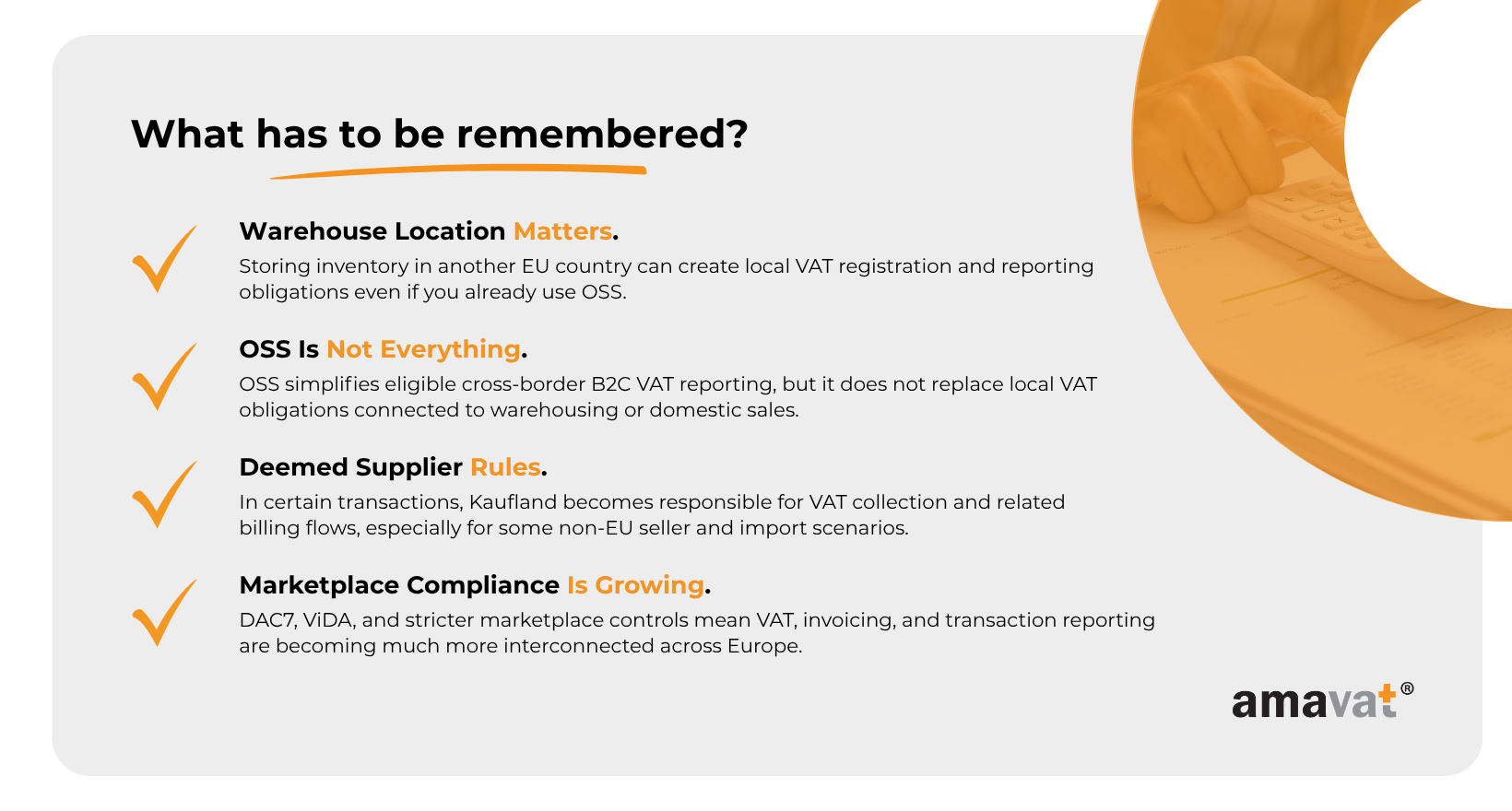
The complexity increases further once products begin moving between countries. Domestic sales made inside a country where the seller has a VAT registration generally remain the seller’s responsibility, even if the order itself came through Kaufland. Warehousing can also create additional obligations because storing stock in another EU country may trigger local VAT registration requirements regardless of whether OSS is used for cross-border reporting. For example, a Polish seller storing inventory in Germany may still need a German VAT registration because holding stock abroad creates a local taxable presence there. OSS can simplify reporting for eligible cross-border B2C sales within the EU, but it does not replace VAT obligations connected to local stock storage or domestic transactions taking place inside another Member State.
VAT Reporting for EU-Based Sellers
The Two Reporting Paths for EU Sellers
For businesses established inside the European Union, VAT reporting on Kaufland usually follows one of two routes. The first option is using the OSS system, which was introduced to simplify cross-border e-commerce reporting inside the EU. The second option is relying on traditional country-by-country VAT registrations in every market where reporting obligations arise. In practice, most growing e-commerce brands eventually interact with both systems in some form, because even sellers using OSS can still trigger local VAT obligations through warehousing or domestic sales in another country. This is one of the reasons VAT in marketplace e-commerce often feels more complicated than entrepreneurs initially expect. The system is not built around one universal reporting method but around several overlapping frameworks that apply differently depending on how a business operates.
For younger brands expanding internationally for the first time, OSS is usually the easiest place to start because it reduces the amount of administrative work connected to cross-border B2C sales. At the same time, many sellers incorrectly assume OSS completely replaces local VAT registrations everywhere in Europe, which is not true. The moment inventory is physically stored in another country or domestic sales are made locally from foreign stock, separate VAT obligations can still appear. This creates a situation where a seller may use OSS for some transactions while simultaneously maintaining local VAT registrations in one or several EU countries. Understanding the difference between those two reporting paths is essential before scaling sales across multiple Kaufland marketplaces.
Path 1 — OSS (One-Stop Shop) Registration
What Is OSS?
The One-Stop Shop system, usually shortened to OSS, was introduced as part of the broader EU VAT reform designed to simplify cross-border online selling. Before the current framework existed, e-commerce sellers often had to monitor separate distance selling thresholds for every EU country and register for VAT individually once those limits were exceeded. The OSS model replaced most of those national thresholds with a single EU-wide system intended to reduce administrative complexity for businesses selling internationally to consumers. Instead of registering separately in every country where B2C sales occur, sellers can submit one centralized VAT return covering eligible cross-border sales within the EU.
In practical terms, OSS allows an EU-based seller to report eligible cross-border B2C marketplace and webshop sales through the tax authority in their home country. The seller still charges the VAT rate applicable in the customer’s destination country, but the reporting process itself becomes centralized. This distinction is important because OSS does not create one single European VAT rate. A Polish company selling to German customers must still apply German VAT rates where required, while sales into France or Italy may require different local VAT calculations. OSS simply simplifies the reporting and payment structure by allowing the seller to declare those foreign VAT amounts through one quarterly filing instead of maintaining multiple registrations purely for distance sales purposes.
How OSS Works in Practice
From an operational perspective, the OSS system is relatively straightforward once the structure is understood. A seller registers for OSS in their home EU country, usually through the local tax authority portal. After registration, eligible cross-border B2C sales within the EU are included in a special quarterly OSS return instead of being reported separately in every destination country. The seller collects VAT from customers according to the VAT rate applicable in the buyer’s country, not the seller’s own domestic rate. This means a Polish company selling through Kaufland to Germany, Austria, and France may need to apply several different VAT rates depending on where the customers are located.
Although this sounds complicated at first, modern accounting systems and marketplace integrations make the technical side much easier than it used to be. The real advantage of OSS appears during reporting. Instead of filing separate VAT returns in every EU country where eligible B2C sales occurred, the seller files one quarterly OSS declaration through their home tax authority. That authority then distributes the VAT payments to the appropriate Member States internally. For small and medium-sized e-commerce businesses, this removes a large amount of administrative friction connected to marketplace expansion. Without OSS, scaling across several Kaufland marketplaces could quickly create a heavy reporting burden even before sales volumes become substantial.
EU-Wide €10,000 Threshold Explained
One of the most important parts of the OSS framework is the EU-wide €10,000 threshold for cross-border B2C sales. Before the 2021 reform, every EU country applied its own national distance selling threshold, which meant businesses had to track separate limits for Germany, France, Italy, and other markets individually. The reform abolished most of those country-specific thresholds and replaced them with one common threshold covering total eligible cross-border B2C sales within the EU. Once a seller exceeds €10,000 in combined cross-border sales to consumers in other Member States, destination-country VAT rules generally begin applying.
In practice, this means that a small seller operating only domestically may continue charging local VAT rates initially, but once cross-border activity grows beyond the threshold, VAT usually needs to be charged according to the customer’s country instead. For many modern e-commerce brands, especially those active on marketplaces, reaching €10,000 across several EU countries can happen surprisingly quickly. A few months of international sales on Kaufland may already push a business beyond the threshold, particularly if products are competitively priced and marketed across multiple marketplaces simultaneously. Because of this, many entrepreneurs choose to register for OSS relatively early instead of waiting until reporting obligations become more difficult to manage retroactively.
Why OSS Is Usually the Best Option
For most EU-based marketplace sellers, OSS is generally the most practical and scalable solution for handling cross-border B2C VAT reporting. The biggest advantage is the reduction in administrative complexity. Instead of maintaining separate VAT filings purely because customers are located in different countries, sellers can centralize reporting through one quarterly return. This becomes especially valuable once a business begins expanding into several Kaufland marketplaces at the same time. Managing Germany, France, Italy, Austria, and Poland separately without OSS would create significantly more accounting work, even for relatively modest sales volumes.
OSS also supports faster marketplace expansion because it removes part of the hesitation many younger businesses feel about international growth. Instead of treating every new country as a separate tax project, sellers can focus more on logistics, product localization, and pricing strategy while using OSS to simplify eligible reporting obligations. That does not mean VAT becomes fully automatic or effortless, but the system makes multi-country scaling much more realistic for smaller teams. At the same time, OSS is still legally optional in many situations. Some sellers instead rely on separate local VAT registrations, especially when their operations are concentrated in only a few countries. However, marketplaces may still apply their own onboarding or operational requirements regarding OSS numbers depending on how cross-border selling is configured.
Important Kaufland Exception for France & Italy
According to marketplace implementation guidance connected to Kaufland.fr and Kaufland.it, sellers activating those marketplaces are expected to provide a valid OSS number operationally, even if they have not yet exceeded the general €10,000 EU threshold for cross-border sales. This catches many smaller businesses by surprise because they assume the threshold automatically delays all OSS-related obligations. In reality, marketplace onboarding requirements and tax law thresholds are not always identical. A seller may technically still remain below the EU threshold while simultaneously facing marketplace-level requirements connected to cross-border activation settings.
For sellers planning early expansion into France or Italy through Kaufland, this means VAT preparation often needs to happen earlier than expected. A business that might legally still fall below the EU threshold could still encounter practical marketplace limitations if OSS registration is not completed before activating those channels. This reflects a broader trend across European marketplaces, where platforms increasingly tighten compliance expectations in response to evolving VAT regulations and upcoming reforms such as ViDA. For growing e-commerce businesses, it is becoming less realistic to treat VAT registration as something that can simply be postponed once international marketplace expansion begins.
Path 2 — Country-Specific VAT Registration
When Local VAT Registration Is Required
Even when OSS is used correctly, there are still many situations where local VAT registration inside another EU country becomes necessary. The most obvious case is when a seller chooses not to use OSS at all and instead registers individually in every country where reporting obligations arise. However, local VAT registration can also become mandatory even for businesses already using OSS if they create a taxable presence inside another Member State. This usually happens through warehousing, domestic sales from local stock, or certain fulfillment structures connected to marketplace logistics programs.
A common misunderstanding among marketplace sellers is the idea that OSS completely replaces foreign VAT registrations everywhere in Europe. In reality, OSS mainly simplifies eligible cross-border B2C sales between EU countries. It does not replace obligations connected to inventory storage or local domestic transactions. For example, if a Polish business stores inventory inside Germany and fulfills German customer orders directly from that warehouse, Germany may still require a local VAT registration because the stock itself is physically located there. The same logic can apply in France, Italy, or any other EU country where products are stored locally before sale.
Fulfillment by Kaufland and VAT
Warehousing creates one of the biggest VAT triggers in European e-commerce because tax authorities generally view local stock storage as creating a taxable connection to that country. This principle already became familiar to many businesses through Amazon FBA and similar fulfillment systems, where inventory can move automatically between warehouses in different Member States. Fulfillment by Kaufland can create comparable VAT implications because products stored locally may trigger registration and reporting obligations regardless of where the seller’s company is officially established. The physical location of the inventory matters almost as much as the seller’s legal headquarters.
For smaller e-commerce brands, this often becomes the point where VAT administration starts feeling significantly more serious. Selling cross-border through OSS is one thing, but storing products across several European warehouses introduces another level of reporting complexity. A business using warehouses in Germany, Poland, and France may need multiple VAT registrations while simultaneously using OSS for eligible cross-border B2C sales into other EU markets. This overlap between local VAT obligations and OSS reporting is completely normal in marketplace e-commerce, but many first-time international sellers underestimate how quickly it can develop once fulfillment networks expand beyond a single country.
Examples of Common Scenarios
A practical example helps show how these rules work in real business situations. Imagine a Polish seller using a warehouse in Germany to distribute products across Central Europe through Kaufland. Because the inventory is physically stored in Germany, the seller may need a German VAT registration even if OSS is used for certain cross-border B2C sales into other EU countries. German domestic sales fulfilled from that warehouse would generally remain part of local German VAT reporting rather than OSS. This setup is extremely common among growing e-commerce brands because Germany often becomes the logistical center for wider EU distribution.
Now compare that to a German seller operating only inside Germany without storing products abroad or selling cross-border to other EU countries at scale. In that case, the VAT situation may remain relatively straightforward because domestic German VAT rules continue applying without the same level of international reporting complexity. A third scenario involves sellers using warehouses in several countries simultaneously. Once inventory begins moving between multiple EU storage locations, the business may face several local VAT registrations together with OSS reporting obligations for eligible cross-border sales. This is why VAT planning becomes increasingly important as marketplace businesses scale internationally. The operational side of expansion may feel simple through one centralized Kaufland account, but the underlying VAT structure can become much more layered behind the scenes.
VAT Reporting for Non-EU Sellers
Why Non-EU Sellers Face Different Rules
For sellers established outside the European Union, VAT compliance on Kaufland is usually much stricter from the very beginning. EU-based businesses often have access to simplified systems such as OSS for eligible cross-border B2C sales, but non-EU sellers operate under a different framework because European tax authorities treat foreign businesses differently from companies established inside the EU VAT system. As a result, marketplaces and tax administrations often impose stricter registration, verification, and reporting requirements on non-EU sellers operating in the EU market. This becomes especially important for businesses based in China, the United States, the United Kingdom, or other non-EU jurisdictions that want to reach European customers through marketplaces rather than through their own local EU company structure.
For many non-EU sellers, the complexity appears surprisingly early in the onboarding process. Instead of activating several marketplaces under one simplified VAT structure, businesses often need separate VAT registrations depending on where products are shipped from, where inventory is stored, and which Kaufland marketplaces are being used. In addition, customs procedures, import VAT rules, and fiscal representative requirements can become part of the setup long before the business reaches significant sales volume. This is why many non-EU companies entering the European market eventually work with local VAT advisors or intermediaries. The combination of marketplace rules, customs obligations, and country-specific reporting requirements can become difficult to manage without a structured compliance process behind the scenes.
Mandatory VAT Registration per Country
One of the biggest differences for non-EU sellers is that the EU-wide €10,000 OSS threshold is mainly designed for EU-established businesses making intra-EU cross-border B2C sales and generally does not provide the same simplification for non-EU sellers. In practice, non-EU businesses usually face VAT obligations much earlier, especially once products are imported into the EU or stored inside a Member State. This means a non-EU seller often needs to think about VAT compliance before the first marketplace sale is even completed rather than waiting until sales volume grows beyond a certain threshold.
Operationally, Kaufland also expects non-EU sellers to provide VAT registration details connected to the marketplaces where they intend to sell. In many cases, this means obtaining country-specific VAT IDs linked to the relevant sales channels or warehouse locations. The exact setup depends on how the seller structures logistics and distribution inside Europe, but the overall compliance burden is usually heavier than for EU-established businesses. For smaller non-EU brands entering Europe for the first time, this can feel frustrating because the marketplace itself may look easy to access from the outside while the underlying tax framework requires much more preparation. However, from the EU’s perspective, these stricter requirements are designed to ensure imported marketplace sales remain properly connected to European VAT reporting systems.
Imports Under €150
One of the most important thresholds for non-EU marketplace sellers is the €150 import limit connected to the EU’s post-2021 VAT framework. When goods are shipped directly from outside the EU to European consumers in consignments not exceeding €150, marketplaces such as Kaufland may become responsible for collecting and remitting VAT under the Deemed Supplier mechanism. In these situations, VAT is usually collected during checkout instead of being charged later during delivery. This creates a smoother purchasing experience for customers because they are less likely to face unexpected import charges once the package arrives in their country.
These transactions are often connected to the Import One-Stop Shop framework, commonly called IOSS, which allows eligible import VAT to be declared centrally for consignments not exceeding €150. At the same time, the Deemed Supplier rules determine who is treated as the supplier for VAT purposes during the transaction itself. For sellers, this structure can simplify part of the VAT collection process because the marketplace handles the VAT side of eligible transactions directly. However, many businesses misunderstand what this simplification actually covers. Marketplace VAT collection does not automatically remove every compliance obligation connected to imports, customs documentation, accounting records, or operational reporting. Sellers may still need EORI numbers, import documentation, inventory tracking, and local VAT registrations depending on how their European logistics structure is organized.
Imports Over €150
Once imported consignments exceed €150 in value, the simplified import framework connected to low-value marketplace sales generally no longer applies. At that point, standard import VAT and customs procedures become much more important. The shipment may become subject to customs duties in addition to VAT, and the logistics setup used by the seller starts playing a much larger role in determining who handles the import process. Unlike lower-value consignments where VAT may be collected directly by the marketplace during checkout, higher-value imports usually involve more traditional customs clearance structures connected to the importer of record and the delivery terms used for the shipment.
This is where DDP, or “Delivery Duty Paid,” often becomes relevant for non-EU marketplace sellers. Under a DDP structure, the seller takes responsibility for handling import formalities, customs charges, and VAT before the goods reach the customer. From the buyer’s perspective, this creates a cleaner shopping experience because the order arrives without additional customs payments being requested at delivery. However, for sellers, DDP also increases operational and compliance responsibilities because import VAT, customs declarations, and logistics coordination all need to be managed correctly. For businesses scaling aggressively into Europe, higher-value imports often become the point where professional customs and VAT support becomes practically necessary rather than optional.
Warehousing Inside the EU
Many non-EU sellers eventually decide to store inventory inside Europe because local warehousing significantly improves delivery times and customer experience. Shipping every order individually from outside the EU can create long delivery windows, customs delays, and higher logistics costs, particularly for marketplaces where fast fulfillment expectations continue rising. However, the moment inventory is physically stored inside an EU country, local VAT obligations usually become much more significant. Holding stock in Germany, Poland, France, or another Member State often creates a requirement for local VAT registration regardless of whether the seller is established inside or outside the EU.
The Deemed Supplier framework can still apply in certain situations even when stock is already located inside Europe. For example, a non-EU seller storing products in an EU warehouse and selling those goods to EU consumers through Kaufland may still fall under marketplace-facilitated VAT collection rules for eligible B2C transactions. At the same time, the seller can still face local reporting obligations connected to inventory ownership, stock movements, or domestic transactions linked to the warehouse country itself. This overlap between marketplace VAT collection and local registration duties is one of the reasons non-EU marketplace operations in Europe can become administratively demanding quite quickly. The warehouse may solve logistics problems while simultaneously creating a much more advanced tax reporting environment behind the scenes.
Fiscal Representatives in Europe
Another major challenge for non-EU sellers is the fiscal representative requirement that still exists in several European countries. A fiscal representative is usually a locally established intermediary who acts as a compliance contact for VAT purposes and, in some cases, shares responsibility for the seller’s VAT obligations toward the tax authority. Several EU countries may require non-EU businesses to appoint a fiscal representative before VAT registration, depending on the seller’s country of establishment and applicable mutual assistance agreements. This can increase both onboarding time and compliance costs because the seller may need contractual agreements, guarantees, or additional administrative verification before registration is approved.
The rules are not identical across Europe, which adds another layer of complexity for international marketplace sellers. Some countries are generally considered more accessible because non-EU businesses can often register for VAT directly without appointing a local fiscal representative. Germany is commonly viewed as one of the more flexible examples in this regard. In other countries, the requirements may depend heavily on where the seller is established, whether mutual assistance agreements exist, and which VAT procedures are being used. This creates a fragmented compliance environment where the administrative complexity of entering France, Italy, Poland, or another EU market may look very different depending on the seller’s structure. For businesses expanding across several Kaufland marketplaces simultaneously, understanding these country-by-country differences becomes an important part of long-term VAT planning.
Country-by-Country VAT Snapshot for Kaufland Sellers
Before You Activate a New Kaufland Marketplace
VAT rates, fiscal representative requirements, EPR rules, and marketplace onboarding policies can change over time, so this country snapshot should be treated as a planning guide rather than a final compliance decision. Before entering a new Kaufland market, sellers should always verify the current VAT rate, product-specific reduced rates, local registration rules, and platform requirements. This matters especially for fast-moving areas such as Slovakia’s VAT changes, packaging obligations, and marketplace-level OSS onboarding rules.
Germany
Germany is usually the first Kaufland marketplace sellers look at, and for good reason. Kaufland.de is the strongest and most established part of the marketplace network, with a large customer base and high buyer trust. The standard German VAT rate is 19%, but sellers should be careful with reduced-rate goods because Germany also applies lower VAT rates to certain product categories, such as books, some food products, and selected services. This matters because entering the wrong VAT rate at offer level can either reduce your margin or create a reporting issue later.
Germany is also relatively accessible for many non-EU sellers from a registration perspective. Direct VAT registration is often possible without appointing a fiscal representative, depending on the seller’s structure and country of establishment. That does not mean Germany is “easy” from a compliance perspective, especially if you store stock locally, but it can be more straightforward than markets where fiscal representation is commonly required for non-EU businesses.
Czech Republic
Kaufland.cz is especially relevant for sellers already active in Central Europe, particularly businesses from Poland, Slovakia, Germany, or Austria that want to test nearby demand before moving into larger Western European markets. The standard VAT rate in the Czech Republic is 21%, and sellers should treat Czech sales as a separate VAT environment even if everything is managed through the same Kaufland account.
For EU sellers, OSS may simplify eligible cross-border B2C sales into the Czech Republic, but it will not remove local obligations if stock is stored there. For non-EU sellers, local VAT registration requirements can depend on the logistics setup, marketplace configuration, and whether goods are imported, stored locally, or sold from another EU country. The practical point is simple: Kaufland.cz may feel close and familiar for Central European sellers, but it still needs its own VAT review before activation.
Slovakia
Slovakia needs extra attention because its standard VAT rate increased to 23% from January 2025. Sellers should make sure marketplace tax settings, ERP systems, accounting tools, and listing integrations reflect the updated rate correctly. This is especially important if product data was copied from older templates or from another marketplace where the VAT rate is different.
Even though Kaufland.sk may look smaller than Germany, France, or Italy, VAT mistakes still matter. Automated order flows can process many transactions before anyone notices a wrong tax setting, and correcting historical VAT data is much more annoying than setting it up correctly at the start. Sellers should also check whether reduced rates apply to any specific product categories instead of assuming the standard rate applies to every item.
Poland
Kaufland.pl is important for Central European expansion, especially for sellers already using Poland as a logistics, sourcing, or operating base. The standard Polish VAT rate is 23%, and local registration may become necessary if a seller stores inventory in Poland or makes domestic Polish sales from local stock. OSS can help with eligible cross-border B2C sales into Poland, but it does not replace Polish VAT obligations created by local warehousing or domestic transactions.
Certain sellers may also face additional compliance obligations connected to BDO and packaging or environmental reporting. This should not be read as something that automatically applies to every Kaufland seller, but it is important for businesses selling physical products into Poland to check early. Packaging, waste, electronics, batteries, and similar product categories can create extra duties beyond VAT, and those obligations are easier to manage before sales scale up.
Austria
Kaufland.at gives sellers access to a smaller but often attractive German-speaking market. The standard Austrian VAT rate is 20%, and from a seller’s perspective Austria can feel operationally close to Germany because of language and customer overlap. Still, Austria should not be treated as an extension of Kaufland.de. It is a separate VAT environment with its own registration, reporting, and compliance expectations.
If goods are stored in Austria or domestic Austrian sales are made from local stock, local VAT obligations may arise. Austria may also involve packaging compliance requirements, including GLN-related setup in certain cases, so sellers should check both VAT and EPR obligations before activating the channel. This is especially important for small teams because packaging compliance often sits outside standard accounting workflows and can easily be missed during marketplace expansion.
France
Kaufland.fr is a major step in Kaufland’s move into Western Europe, and it is attractive because France is one of the largest consumer markets in the EU. The standard French VAT rate is 20%, but sellers should approach the marketplace with proper preparation rather than treating it as a simple extra sales channel. France can be administratively stricter than some Central European markets, especially for non-EU sellers or businesses with more complex fulfillment routes.
According to marketplace implementation guidance, sellers activating Kaufland.fr may be expected to provide a valid OSS number even if they have not exceeded the general €10,000 EU cross-border threshold. This should be understood as an operational marketplace requirement rather than a general tax-law rule that applies everywhere. For non-EU sellers, fiscal representative requirements may also apply depending on the seller’s country of establishment and applicable mutual assistance agreements.
Italy
Kaufland.it is another important Western European marketplace, with a standard VAT rate of 22%. Like France, Italy can offer strong growth potential, but it also comes with a more demanding compliance environment. Sellers should review VAT setup, invoicing flows, imports, and warehouse arrangements before activating the channel, especially if they plan to use local stock or multiple fulfillment routes.
According to marketplace implementation guidance, Kaufland.it may require a valid OSS number operationally even below the €10,000 threshold, so EU sellers should prepare their VAT setup before activation rather than after the first sales arrive. Non-EU sellers should also be careful with fiscal representative rules, import arrangements, and local registration requirements, because Italy can become administratively complex when goods are imported, stored locally, or sold through several fulfillment models.
VAT Rates at Offer Level — Why This Matters
Kaufland’s New VAT Rate Requirement
One of the more important operational changes for sellers on Kaufland is that VAT rates are no longer treated as a background accounting detail that can simply be ignored during product setup. The marketplace increasingly requires sellers to define the applicable VAT treatment at offer level, either by entering a VAT rate in the Seller Portal or by transmitting the correct storefront-specific VAT indicator through integrations. For smaller e-commerce businesses used to simpler domestic selling environments, this can feel surprisingly technical at first, especially when the same product category may be taxed differently across several European countries.
The reason this matters is simple: marketplaces are under increasing pressure to improve VAT transparency and reduce reporting errors connected to cross-border e-commerce. Platforms are no longer acting only as sales channels. They are becoming part of the wider tax compliance system inside the EU, particularly after the 2021 VAT reform and the upcoming ViDA changes. As a result, VAT settings inside seller panels now play a much larger role in determining how transactions are reported, invoiced, and reconciled. A product listing is no longer just a commercial entry with a price and description attached to it. It is also part of a tax reporting workflow that can affect both the seller and the marketplace itself.
ViDA and Marketplace Compliance
The tightening of VAT controls on marketplaces is closely connected to the EU’s broader ViDA initiative, short for “VAT in the Digital Age.” The reform package was formally adopted in 2025 and will be introduced gradually over the coming years, focusing on areas such as digital reporting, e-invoicing, platform economy rules, and broader VAT modernization across the EU. From the perspective of European regulators, marketplaces process enormous transaction volumes and therefore play a central role in improving VAT compliance standards. This is why platforms such as Kaufland increasingly ask sellers for more detailed tax information during onboarding, listing creation, and transaction reporting.
For sellers, the practical effect is that marketplaces are becoming less flexible about incomplete VAT settings, missing registration details, or unclear product categorization. In the past, some platforms allowed sellers to rely more heavily on default settings or broad tax templates. That approach is becoming riskier as marketplaces strengthen internal controls in response to changing VAT rules. ViDA reinforces the wider shift toward more structured VAT data, digital reporting, and stronger marketplace compliance controls. For small e-commerce brands, this means VAT configuration is becoming part of day-to-day operational setup rather than something handled only by accountants after the sale has already happened.
What Happens If You Leave VAT Blank?
If a seller does not actively assign the correct VAT treatment to an offer, the marketplace may automatically apply the standard VAT rate for the relevant country by default. At first glance, this might not sound like a major problem because the order still goes through and VAT is still charged. However, default rates can create both financial and compliance issues when the product actually qualifies for a reduced VAT rate instead. In those cases, sellers may end up charging more VAT than necessary, which directly affects pricing competitiveness and profit margins.
A simple example is the German market, where some books qualify for a reduced VAT rate of 7% instead of the standard 19%. If a seller leaves the VAT field blank and the marketplace automatically applies the standard rate, the product may become unnecessarily expensive compared with competitors using the correct reduced rate. Over time, this can damage conversion rates and reduce profitability without the seller immediately realizing the reason. The opposite scenario can also happen if a seller applies a reduced rate incorrectly to products that do not qualify. In that case, the business risks underreporting VAT and potentially creating problems during audits or tax reviews. Even small VAT configuration mistakes can become expensive once they are repeated across hundreds or thousands of marketplace orders.
Common Seller Mistakes
One of the most common mistakes sellers make is assuming that all products within the same broad category share the same VAT treatment across Europe. In reality, reduced rates often apply only to specific product types and may vary between countries. Books are a classic example because some EU countries apply reduced VAT rates to printed materials while others treat certain digital or mixed-format products differently. Sellers copying listings from one marketplace to another without reviewing local VAT treatment can accidentally create incorrect tax settings very quickly, especially when using automated listing tools or bulk uploads.
Another common issue involves incorrect product categorization inside marketplace systems. A seller may choose the wrong category during listing creation, which can indirectly affect VAT handling, invoicing, or tax assumptions connected to the product. Cross-border mismatches can create additional confusion because the same product may be treated differently depending on where the customer is located and how the sale is structured. A VAT setup that works correctly for domestic sales in Poland may not automatically remain correct when the same item is sold into Germany, France, or Italy through OSS reporting. For growing marketplace businesses, these problems usually appear gradually rather than all at once, which is why many sellers underestimate them until reporting becomes more complex later on.

Invoicing Rules on Kaufland Marketplace
When Sellers Must Issue Invoices
For most standard marketplace transactions where the seller remains the supplier for VAT purposes, the seller is generally responsible for ensuring the correct invoicing and VAT treatment of the transaction. Exactly what this looks like in practice depends on several factors, including the customer’s country, the type of sale, whether OSS is being used, and the invoicing rules that apply locally. In some EU countries, formal B2C invoices are not always mandatory for every marketplace order, while in others additional invoicing or reporting obligations may apply. This is one of the reasons cross-border marketplace accounting becomes more complicated as businesses expand into several European countries at once.
A seller operating from Poland, for example, may need to apply German VAT treatment for one customer, French VAT treatment for another, and domestic Polish VAT for local sales, all while using the same Kaufland account. The marketplace handles the storefront and order flow, but the seller still remains responsible for ensuring the VAT side of the transaction is handled correctly where the seller remains the taxable supplier. Invoice formatting requirements, mandatory invoice fields, numbering structures, local e-invoicing rules, and issuance deadlines can also differ depending on the country involved. For smaller e-commerce brands, these differences often remain invisible at the beginning because sales volumes are still manageable, but once international orders increase, invoicing quickly becomes part of the broader compliance infrastructure behind the business.
When Kaufland Issues Invoices
The invoicing flow changes in situations where Kaufland acts as the Deemed Supplier under EU VAT rules. In these transactions, the marketplace becomes responsible for the VAT side of the sale, which also affects how billing documentation is handled. Instead of the seller managing the standard VAT invoicing process directly, the marketplace generally handles the VAT billing flow and provides the relevant transaction documentation connected to the deemed-supplier transaction. This usually applies in specific situations involving non-EU sellers or imported consignments covered by the Deemed Supplier framework.
From the seller’s perspective, this creates a very different accounting structure compared with normal marketplace orders. Seller payouts for these transactions generally exclude the VAT amount because the marketplace already collected and handled it separately. Kaufland also provides marketplace-generated transaction records, credit notes, or billing documentation that sellers use for reconciliation and bookkeeping purposes. The important thing to understand is that the commercial transaction itself still remains connected to the seller even if the marketplace handles the VAT billing side of the order. Product liability, warranty obligations, returns management, and customer support responsibilities do not disappear simply because Kaufland became responsible for VAT collection and related transaction documentation in those specific cases.
Why Invoicing Confuses Sellers
Invoicing is one of the areas where marketplace VAT rules become genuinely difficult for growing e-commerce businesses, mainly because many sellers operate hybrid structures without fully realizing it. The same Kaufland account can contain standard seller-managed transactions, marketplace-managed deemed-supplier flows, domestic sales, OSS-reported cross-border sales, and warehouse-based local transactions across several countries at once. From the outside, all orders may look similar inside the dashboard, but the VAT and invoicing treatment behind them can be completely different depending on how the transaction is structured legally and operationally.
This confusion becomes even more noticeable once businesses scale internationally. A seller may process domestic German orders from local stock, cross-border OSS sales into Austria and France, and deemed-supplier transactions linked to imported goods from outside the EU at the same time. Each of those flows may involve different invoicing responsibilities, different VAT reporting structures, and different accounting treatment. For smaller teams without dedicated tax specialists, it becomes very easy to mix transaction types, apply incorrect VAT assumptions, or duplicate reporting unintentionally. That is why many experienced marketplace sellers eventually focus heavily on automation, accounting integrations, and clearly separated transaction flows. Upcoming EU digital reporting and e-invoicing reforms under ViDA are also expected to increase the importance of structured marketplace transaction data even further, which means invoicing will likely become even more integrated with VAT compliance systems over the next few years.
DAC7 / PStTG Reporting Requirements
What Is DAC7?
Over the last few years, European tax authorities have moved increasingly toward automatic data sharing and platform-based reporting. DAC7 is part of that broader shift. The name comes from the seventh version of the EU Directive on Administrative Cooperation, and its main purpose is to improve tax transparency for digital platform activity across the European Union. Under these rules, online marketplaces and digital platforms are required to collect and report information about sellers using their systems. This includes platforms involved in e-commerce, short-term rentals, transportation services, and other digital business models where income is generated through intermediary platforms. Importantly, DAC7 does not create a new tax. Instead, it is designed to improve transparency and reporting between marketplaces and tax authorities.
For marketplace sellers, the practical effect is that platforms such as Kaufland now play a direct role in sharing commercial information with tax authorities. In the past, many smaller sellers treated marketplace income reporting as something largely controlled internally through their own accounting systems. DAC7 changes that dynamic because tax authorities increasingly receive transaction-related information directly from the marketplace itself. This does not automatically mean sellers are doing something wrong or facing audits, but it significantly reduces the gap between what marketplaces know about seller activity and what tax authorities can verify independently. As a result, tax reporting consistency and proper registration become much more important once a business starts scaling across several European marketplaces.
What Is Germany’s PStTG?
Germany implemented DAC7 through national legislation called the Platform Tax Transparency Act, commonly referred to as PStTG. Since Kaufland operates through a German marketplace structure, this legislation is especially relevant for sellers using the platform. PStTG entered into force on 1 January 2023 and requires marketplace operators to collect, verify, and report certain seller information to the tax authorities under the DAC7 framework. For many marketplace businesses, this was the point where onboarding procedures became noticeably more detailed compared with earlier years.
From a seller’s perspective, the important thing to understand is that PStTG is not a separate VAT system. Instead, it is a reporting and transparency framework designed to help tax authorities compare marketplace activity against tax declarations, registration data, and reported income. In other words, the system is less about creating new taxes and more about making existing marketplace activity easier for authorities to monitor. For growing e-commerce businesses, this means the administrative side of selling on marketplaces is becoming more interconnected. VAT registrations, invoicing data, seller identification numbers, and reported marketplace turnover increasingly exist within the same broader compliance environment rather than as isolated accounting processes.
What Seller Information Must Be Submitted?
Under DAC7 and Germany’s PStTG framework, marketplaces are required to collect specific information about sellers operating on the platform. One of the most important identifiers is the TIN, or Tax Identification Number. Many sellers confuse this with the VAT ID, but they are not the same thing. A VAT number is primarily used for VAT reporting and VAT-related transactions, while a TIN is the broader taxpayer identification number used by national tax authorities. Depending on the country, the exact format and terminology may differ, but the distinction remains important because marketplaces may request both numbers separately during onboarding or account verification.
In addition to identification data, marketplaces may also report sales-related information connected to seller activity on the platform. This can include turnover figures, transaction volumes, payout information, and other marketplace-generated financial data required under the reporting framework. From a practical perspective, this means inconsistencies between marketplace activity and tax reporting become much easier for authorities to identify over time. Sellers who ignore VAT registration requirements, use incorrect tax details, or report inconsistent revenue figures may eventually attract attention simply because marketplaces already hold structured transaction records connected to their accounts.
There are limited exemptions for very small sellers in certain situations. For example, goods sellers with fewer than 30 sales and less than €2,000 in total annual consideration may fall outside some DAC7 reporting requirements. However, most active marketplace businesses scaling across several EU countries will exceed those thresholds relatively quickly, especially once cross-border sales begin increasing.
Who Is Affected?
The DAC7 reporting framework affects a wide range of marketplace sellers operating within the EU ecosystem, particularly businesses established inside the European Union or using EU-based marketplaces to sell goods to European customers. Under Germany’s PStTG implementation, reporting obligations became especially relevant for sellers registered on platforms after 1 January 2023, because marketplaces were required to begin collecting and verifying additional seller information under the new transparency rules.
Although EU-based sellers are one of the main groups affected by DAC7 reporting, the broader compliance environment also impacts many non-EU businesses selling into Europe through marketplaces. Once a seller operates within EU marketplace infrastructure, transaction visibility increases significantly compared with earlier marketplace models where cross-border activity was harder for authorities to track centrally. This does not mean every seller faces immediate reporting scrutiny, but it does mean that tax registrations, marketplace turnover, and seller identification data increasingly exist inside interconnected systems that authorities can compare much more efficiently than before.
Why This Matters for Marketplace Sellers
For marketplace sellers, the biggest impact of DAC7 and PStTG is not necessarily the reporting process itself but the increased level of data matching now possible between marketplaces and tax authorities. Platforms already hold detailed information about orders, payouts, transaction values, warehouse activity, and seller identity data. Once this information becomes part of structured reporting systems, tax authorities gain a much clearer picture of how marketplace businesses actually operate across borders. This makes it more difficult for inconsistencies to remain unnoticed for long periods of time, especially when VAT registrations, OSS reporting, and marketplace turnover do not align properly.
The practical risk for sellers is not only deliberate tax avoidance but also ordinary administrative mistakes. Many small e-commerce businesses grow faster than their accounting processes, particularly when expanding internationally through marketplaces. A seller might forget to register for VAT in a country where inventory is stored, misunderstand OSS reporting obligations, or accidentally mix deemed-supplier and seller-reported transactions. Under older systems, those issues could remain hidden for quite some time. Under DAC7-style reporting environments, mismatches between marketplace records and tax filings become easier for authorities to identify automatically. This is why compliance on marketplaces like Kaufland is increasingly about maintaining consistent data across the entire business structure rather than simply filing VAT returns at the end of the quarter.
Upcoming VAT Changes: ViDA (VAT in the Digital Age)
What Is ViDA?
ViDA, short for “VAT in the Digital Age,” is one of the biggest VAT modernization projects the European Union has introduced in years. The reform package is designed to update how VAT works in an increasingly digital and cross-border economy where marketplaces, online platforms, automated invoicing systems, and international e-commerce transactions play a much larger role than they did when many VAT rules were originally created. The EU formally adopted the ViDA package in March 2025, but the changes will be introduced gradually over several years, with implementation phases continuing well into the next decade. This means marketplace sellers are entering a long transition period where VAT reporting, invoicing, and platform compliance rules will continue evolving across Europe.
ViDA is built around three major areas: digital reporting and e-invoicing, single VAT registration simplification, and updated VAT rules for platform economies. From a practical perspective, the reform is less about creating entirely new taxes and more about restructuring how VAT data is collected, reported, and monitored. For marketplaces such as Kaufland, ViDA reinforces the broader shift toward structured transaction data and stronger compliance controls. For sellers, it means VAT administration will likely become even more integrated into daily operational workflows rather than remaining something handled only during quarterly accounting reviews.
Changes Coming in 2027
Beginning from 2027 onward, parts of the ViDA framework are expected to expand digital reporting and platform-related VAT obligations, reinforcing the role marketplaces play in transaction transparency and compliance. The broader direction of the reform is clear: European tax authorities want faster access to structured transaction data, more consistent digital invoicing systems, and stronger integration between marketplace activity and VAT reporting processes. This applies not only to e-commerce marketplaces but also to wider platform economy sectors such as accommodation and passenger transport services.
For marketplace sellers, the practical effect will likely be a continued increase in compliance expectations around transaction reporting, invoicing consistency, and VAT configuration accuracy. Platforms may request more structured data from sellers, strengthen onboarding verification procedures, and expand automated compliance checks connected to VAT treatment and transaction flows. Businesses relying on outdated invoicing workflows, incomplete VAT mapping, or manually managed cross-border reporting may find future compliance requirements increasingly difficult to handle as digital reporting obligations become more standardized across the EU.
Impact on Hybrid Sellers
Hybrid sellers are likely to feel some of the biggest effects from the ongoing ViDA rollout. These are businesses that combine several sales channels at the same time, such as their own Shopify or WooCommerce store alongside marketplaces like Kaufland, Amazon, or Allegro. In many cases, hybrid structures already create more complicated VAT reporting environments because different transaction types may fall under different reporting rules depending on where the sale happened, who processed the payment, and how the transaction is classified for VAT purposes.
As platform reporting obligations expand, some marketplace-facilitated transactions may be treated differently from direct webshop sales for VAT reporting purposes, which could affect how businesses track cross-border activity internally. This does not necessarily mean marketplaces and independent webshops will operate under completely separate VAT systems, but it does mean sellers may need clearer transaction separation and better reporting visibility across channels. For smaller e-commerce businesses, the biggest challenge will probably not be the legal theory behind ViDA but the operational reality of managing several sales systems that no longer behave identically from a VAT and reporting perspective.

What Sellers Should Do Now
For most marketplace businesses, the best approach right now is preparation rather than panic. ViDA will not completely replace the current VAT system overnight, but it clearly signals the direction European marketplace compliance is moving toward. Sellers should start by reviewing how VAT information currently flows through their business. That includes checking marketplace settings, accounting integrations, ERP systems, invoicing structures, and cross-border reporting workflows. Many smaller brands discover only during expansion that their operational setup was designed mainly for domestic selling and struggles once several EU countries become involved simultaneously.
It is also becoming increasingly important to separate different transaction types clearly inside accounting systems. Domestic sales, OSS-reported transactions, deemed-supplier orders, imported consignments, and local warehouse sales may all require different VAT treatment, even if they originate from the same marketplace account. Businesses that organize these flows properly early on will likely adapt much more easily as ViDA-related reporting requirements continue developing. Sellers should also pay attention to marketplace announcements because platforms such as Kaufland will probably continue updating onboarding rules, VAT configuration requirements, invoicing expectations, and transaction reporting processes as new EU compliance frameworks are introduced over the coming years.
Practical VAT Checklist Before Selling on Kaufland
Determine Your Seller Status Before Anything Else
Before activating any Kaufland marketplace, the first thing sellers should clarify is whether the business is considered EU-established or non-EU for VAT purposes. This single distinction affects almost everything that comes afterward, including OSS eligibility, Deemed Supplier treatment, import obligations, fiscal representative requirements, and local VAT registrations. Many newer e-commerce businesses focus first on logistics, pricing, or advertising strategy, but VAT structure should really be part of the expansion decision from the beginning because correcting mistakes later is usually much harder than setting things up correctly at launch.
It is also important to think about where goods are physically shipped from, not only where the company itself is registered. A seller established in Poland but shipping inventory from Germany may face very different VAT obligations compared with a seller shipping only domestically from Poland. The same applies to non-EU businesses storing inventory inside Europe through local warehouses or fulfillment programs. Before expanding internationally through Kaufland, sellers should have a clear overview of both their legal business structure and their physical inventory flow across the EU.
Register for OSS or Local VAT IDs Early
One of the most common marketplace mistakes is waiting too long to deal with VAT registration. Many businesses assume they can “test” a market first and organize VAT later, but cross-border sales often scale faster than expected once multiple Kaufland marketplaces are activated. EU-based sellers should review whether OSS is the right solution for their cross-border B2C sales, while also understanding that OSS does not replace local VAT obligations connected to warehousing or domestic transactions in another country.
Non-EU sellers usually need a more localized registration strategy from the beginning because the EU-wide OSS simplifications are not available in the same way as they are for EU-established businesses. In practice, this often means obtaining country-specific VAT registrations linked to inventory locations or marketplace operations. It is also worth remembering that some marketplace onboarding requirements may expect VAT or OSS-related information before certain sales channels can even be activated operationally. Waiting until the first compliance problem appears usually creates more stress, more accounting corrections, and higher administrative costs later.
Check Whether a Fiscal Representative Is Required
Fiscal representative rules are one of the most overlooked parts of European VAT expansion, especially for non-EU sellers entering several countries at the same time. Depending on the seller’s country of establishment and applicable mutual assistance agreements, some EU countries may require a local fiscal representative before VAT registration can be completed. This requirement can affect onboarding timelines significantly because additional contracts, guarantees, or verification procedures may need to be completed before registration approval.
The rules are not identical across Europe, which is why sellers should avoid assuming that one country’s VAT setup automatically applies everywhere else. Germany is often viewed as more flexible for direct VAT registration, while other markets may apply stricter conditions depending on the seller’s structure. For growing marketplace businesses, checking fiscal representative requirements early can prevent delays later when inventory is already moving or marketplaces are ready to go live.
Map Warehouse Locations Carefully
Warehousing decisions have a massive impact on VAT obligations inside Europe. Many sellers initially focus on customer reach and shipping speed without fully realizing that every warehouse location can potentially create additional tax registration and reporting duties. Holding inventory in Germany, Poland, France, or another EU country may trigger local VAT obligations regardless of whether the seller uses OSS for eligible cross-border B2C sales.
This becomes especially important once fulfillment networks start expanding automatically through marketplace or logistics partners. Inventory transfers between warehouses can create additional reporting obligations connected to stock movements, local VAT declarations, and intra-EU transfer reporting. Sellers should have a clear understanding of where stock is physically located, which transactions are domestic versus cross-border, and how warehouse movements interact with VAT reporting systems. For many scaling e-commerce brands, warehousing complexity becomes the moment where VAT administration shifts from manageable to genuinely operationally demanding.
Configure VAT Rates Correctly From the Start
Incorrect VAT settings are one of the easiest ways to create silent profitability problems on marketplaces. Sellers should make sure the correct VAT treatment is configured at offer level before products go live, especially when reduced VAT rates may apply to specific categories. A wrong VAT setting can either reduce margins unnecessarily or create underreported VAT exposure that becomes difficult to correct later once transaction volumes increase.
Cross-border selling makes this even more important because VAT treatment may differ depending on the customer’s country and the structure of the transaction itself. A product category taxed one way in Germany may not automatically receive the same treatment in another EU market. Sellers using integrations, ERP systems, or bulk uploads should also double-check that marketplace VAT indicators and tax mappings remain consistent across all active Kaufland channels. Small configuration mistakes repeated across thousands of orders can quickly become expensive.
Upload the Correct TIN and Seller Information
Marketplace onboarding now involves much more tax-related verification than it did several years ago. Under DAC7 and related reporting frameworks, marketplaces increasingly collect structured seller identification data connected to tax transparency obligations. Sellers should make sure their TIN, VAT numbers, company details, and registration information are consistent across all marketplace systems and accounting records.
This matters because tax authorities increasingly compare marketplace data against reported tax information automatically. Even ordinary inconsistencies can create administrative friction later if marketplace turnover, VAT registrations, or seller identification details do not align properly. For smaller businesses scaling internationally for the first time, this often becomes the moment where accounting systems need to become more professional and structured than they were during the early startup phase.
Understand Which Orders Fall Under Deemed Supplier Rules
Not every Kaufland transaction follows the same VAT logic. Some sales remain fully seller-managed from a VAT perspective, while others may fall under Deemed Supplier treatment where the marketplace handles VAT collection and related billing flows. Sellers need to understand which transaction types belong to which category because mixing them incorrectly can create reporting inconsistencies later.
This becomes especially relevant for non-EU sellers, imported consignments, and businesses operating through several fulfillment structures simultaneously. A marketplace account may contain domestic orders, OSS-reported transactions, imported consignments, and marketplace-managed VAT flows all at the same time. Without clear accounting separation, it becomes easy to duplicate VAT reporting, misunderstand payouts, or apply incorrect invoice assumptions. The larger the business grows, the more important transaction mapping becomes.
Do Not Ignore EPR and Packaging Compliance
VAT is not the only compliance layer marketplace sellers face when expanding across Europe. Many countries also apply EPR, packaging, electronics, battery, or environmental reporting obligations that operate separately from VAT systems. These requirements are often managed through different authorities, registration systems, or compliance organizations, which is why they can easily be overlooked during marketplace onboarding.
The exact obligations depend heavily on what products are being sold and where they are shipped. Some countries require packaging registration numbers, while others apply additional reporting obligations connected to recycling systems or environmental contributions. Sellers expanding into several Kaufland marketplaces simultaneously should review EPR obligations country by country instead of assuming one registration automatically covers the entire EU.
Keep Records for the Long Term
European VAT and OSS frameworks require businesses to maintain transaction records for long retention periods, especially for cross-border sales. OSS-related records generally must be retained for 10 years under EU VAT rules. This includes invoices, marketplace transaction records, VAT calculations, shipping evidence, and supporting documentation connected to cross-border sales activity.
For smaller businesses, recordkeeping often feels less important during the early stages of growth because sales volumes are still manageable. However, once multiple marketplaces, warehouse locations, and VAT registrations are involved, historical transaction records become extremely important during audits, reconciliations, or compliance reviews. Future digital reporting systems, including national e-invoicing frameworks and ViDA-related reforms, are also likely to increase the importance of structured long-term transaction storage even further. Sellers should treat organized recordkeeping as part of the operational foundation of international expansion rather than as a secondary accounting task handled only at year-end.

Frequently Asked Questions (FAQ)
Does Kaufland Collect VAT Automatically?
Not in every situation. Kaufland only handles VAT collection automatically in specific cases where the marketplace becomes the Deemed Supplier under EU VAT rules. This usually applies to certain transactions involving non-EU sellers or imported consignments valued at no more than €150. In those scenarios, the marketplace handles the VAT side of the transaction and provides the related billing documentation connected to the order.
For most standard marketplace sales where the seller remains the supplier for VAT purposes, the seller is still responsible for the correct VAT treatment, reporting, and invoicing obligations connected to the transaction. This is why sellers should not assume that marketplace sales are automatically “VAT handled” by default. Different orders inside the same Kaufland account may follow completely different VAT flows depending on how the transaction is structured.
Do I Need OSS for Kaufland?
OSS is not always legally mandatory, but for many EU-based sellers it is the most practical way to manage eligible cross-border B2C sales inside the EU. The system allows sellers to report qualifying cross-border sales through one centralized quarterly return instead of registering separately in every customer country purely for distance selling purposes.
At the same time, marketplace onboarding requirements and tax-law requirements are not always identical. According to marketplace implementation guidance, sellers activating certain Kaufland marketplaces such as France or Italy may be expected to provide an OSS number operationally even below the general €10,000 EU threshold. Sellers should therefore treat OSS not only as a tax simplification tool but also as part of practical marketplace expansion planning.
Does OSS Replace Foreign VAT Registration Completely?
No. OSS simplifies eligible cross-border B2C sales reporting inside the EU, but it does not replace local VAT obligations connected to warehousing, domestic sales, or certain import structures. If a seller stores inventory in another EU country or fulfills local domestic sales from foreign stock, separate VAT registration requirements may still apply even when OSS is already being used for cross-border reporting.
This is one of the most misunderstood parts of marketplace VAT compliance because sellers often assume OSS creates a single “EU VAT registration” covering every situation. In reality, OSS works alongside local VAT systems rather than replacing them entirely. Many growing e-commerce businesses therefore end up using both OSS and country-specific VAT registrations at the same time.
Do Non-EU Sellers Need VAT Registration in Every Country?
Non-EU sellers usually face more localized VAT obligations than EU-established businesses, especially when goods are imported into Europe or stored inside EU warehouses. In practice, this often means country-specific VAT registrations become necessary depending on where inventory is located and how fulfillment is organized.
However, the answer is not always identical for every business model. The exact VAT setup depends on factors such as shipping origin, warehouse locations, importer arrangements, and whether the marketplace acts as the Deemed Supplier for certain transactions. Non-EU sellers should avoid assuming that one VAT registration automatically covers all EU operations because marketplace selling structures can create obligations in several countries simultaneously.
What Happens If I Store Goods in Germany?
Storing inventory in Germany can create local German VAT obligations even if the seller is established in another country and already uses OSS for eligible cross-border sales. This is because warehousing creates a local taxable presence connected to the physical stock location. Domestic German sales fulfilled from German inventory may therefore need to be reported through local German VAT filings rather than through OSS.
For many e-commerce businesses, Germany becomes the first foreign warehouse location because of its central logistics position inside Europe. However, sellers should remember that warehousing affects much more than shipping speed. Inventory movements, domestic transactions, and local stock ownership can all create additional VAT reporting and compliance obligations that continue alongside OSS reporting for eligible cross-border sales.
Who Issues Invoices on Kaufland?
The answer depends on the type of transaction. For most standard marketplace orders where the seller remains the supplier for VAT purposes, the seller is generally responsible for ensuring the correct invoicing and VAT treatment of the transaction. Exactly what invoicing obligations apply can vary depending on the country involved, the customer type, and the reporting structure being used.
In Deemed Supplier situations, the marketplace generally handles the VAT billing flow and provides the relevant transaction documentation connected to the order. Sellers should therefore understand which transactions are seller-managed and which fall under marketplace VAT handling because different orders inside the same account may follow different invoicing logic.
Is Kaufland Responsible for DAC7 Reporting?
Yes, marketplaces such as Kaufland are subject to DAC7-related reporting obligations under EU tax transparency rules and Germany’s PStTG framework. This means the marketplace may collect and report seller-related information such as identification data, transaction activity, and payout information to tax authorities where required under the reporting system.
For sellers, this mainly means marketplace activity is becoming much more transparent from a tax reporting perspective. Marketplace turnover, seller identity data, and broader tax and VAT reporting increasingly exist inside connected reporting environments that authorities can compare automatically. Even smaller sellers should therefore make sure their tax information and marketplace records remain accurate and consistent.
What VAT Rate Should I Enter for Reduced-Rate Products?
Sellers should always use the VAT treatment that correctly applies to the product category and destination country involved in the sale. Reduced VAT rates can apply to certain categories such as books, food products, or other goods depending on local national VAT rules. The important point is that reduced rates are not universal across Europe and may differ from one country to another.
If VAT treatment is left blank or configured incorrectly, the marketplace may apply the standard VAT rate automatically. This can create margin problems if the product actually qualifies for a lower rate, or compliance risks if a reduced rate is applied incorrectly. Sellers using integrations or ERP systems should also verify that VAT indicators and product mappings remain consistent across all active Kaufland marketplaces.
Do I Need a Fiscal Representative in France or Italy?
Possibly, especially if your business is established outside the European Union. Fiscal representative requirements depend on several factors, including the seller’s country of establishment and whether mutual assistance agreements exist between that country and the EU Member State involved. France and Italy are generally considered stricter markets from a VAT administration perspective, particularly for non-EU sellers.
Because the rules vary depending on the seller’s structure, businesses should avoid assuming the same setup works everywhere in Europe. Some non-EU sellers may need a fiscal representative before local VAT registration can be completed, while others may qualify for more direct registration procedures depending on their establishment country and reporting structure. Checking this before marketplace activation is usually much easier than trying to solve it later once inventory and orders are already moving through the system.
Conclusion
Selling through Kaufland Global Marketplace gives e-commerce businesses access to one of the fastest-growing marketplace ecosystems in Europe, but it also places sellers inside a VAT environment that becomes more complex with every additional country, warehouse, and fulfillment route added to the business. The most important thing to understand is that VAT obligations are never determined by just one factor. In practice, everything depends on the combination of seller establishment, warehouse location, shipping origin, and the specific Kaufland marketplace involved in the transaction. A seller based in Poland shipping domestically will face a very different VAT setup compared with a non-EU seller importing goods into Germany or storing inventory across several EU warehouses.
For EU-based sellers, OSS has become one of the most useful tools for simplifying eligible cross-border B2C VAT reporting. It reduces the need for multiple registrations purely for distance selling purposes and makes international expansion much more manageable operationally. At the same time, OSS is not a complete replacement for local VAT obligations. Warehousing, domestic sales, and local stock movements can still create separate registration and reporting requirements inside individual EU countries. This distinction is one of the most important concepts marketplace sellers need to understand before scaling internationally.
Non-EU sellers usually face an even more demanding compliance environment. Country-specific VAT registrations, import VAT, customs procedures, fiscal representative requirements, and Deemed Supplier rules can all become relevant at the same time depending on how the business is structured. The marketplace may handle VAT collection in certain scenarios, particularly for eligible imported consignments or specific non-EU seller transactions, but that does not remove the seller’s broader compliance responsibilities. Understanding exactly which orders fall under Deemed Supplier treatment and which remain seller-managed is essential for correct reporting and reconciliation.
The next few years will also bring additional changes through ViDA and wider EU digital reporting reforms. Marketplaces are becoming more deeply integrated into the European tax reporting ecosystem, and sellers should expect stronger compliance checks, more structured VAT data requirements, and increasing automation connected to invoicing and transaction reporting. For growing e-commerce businesses, this means VAT can no longer be treated as a purely administrative issue handled only at quarter-end. It is becoming part of the operational foundation of cross-border marketplace selling itself.
The good news is that most VAT problems are preventable when sellers plan early. Businesses that map their warehouse structure properly, configure VAT treatment correctly from the start, separate transaction flows clearly, and understand where local registrations are required usually avoid the most expensive mistakes later. Marketplace expansion across Europe will probably never become completely simple from a VAT perspective, but the businesses that treat compliance as part of their scaling strategy rather than as an afterthought are usually the ones that grow more smoothly in the long run.