Pan-European FBA and VAT – All Requirements
Spis treści
This is where Pan-European FBA starts becoming more than an operations decision. Once your inventory is stored in several countries, tax authorities may view your business very differently than before. You may have started as a seller operating from one EU country, but under Pan-European FBA you can quickly become a multi-country seller from a VAT perspective. That often means local VAT registrations in countries where Amazon stores your stock, ongoing filing obligations, reporting of domestic sales and stock transfers, and potentially the use of OSS or IOSS on top of those requirements. For many young entrepreneurs, especially those scaling quickly through Amazon, this part often comes as a surprise because the marketplace makes expansion feel almost frictionless, while tax compliance rarely is.
A big reason sellers underestimate the tax side is that Pan-European FBA can be activated through a few clicks in Seller Central, while the consequences sit mostly outside Amazon’s ecosystem. Inventory may be moved between Germany, France, Italy, Spain, Poland or Czechia without much seller involvement, but those movements can create reporting obligations that exist whether or not the seller actively requested each transfer. That disconnect causes confusion. Many assume Amazon somehow “covers” VAT because it handles fulfilment, or that OSS solves everything once registered. In reality, the rules are more layered. Pan-European FBA generally does trigger multiple VAT registrations, and storage of goods itself can create obligations even when you do not have a company established in that country. That is one of the biggest misunderstandings new Pan-EU sellers run into.
Another common misconception is around simplification schemes. Sellers often hear about OSS or IOSS and assume these systems replace local VAT compliance entirely. They can simplify certain parts of cross-border reporting, especially for B2C sales, but they do not remove the need for VAT registrations where inventory is physically stored. That distinction matters a lot. Using Pan-European FBA often means dealing with both local VAT obligations and wider EU reporting frameworks at the same time. That is why understanding the structure early matters much more than trying to fix compliance later after your sales and inventory have already expanded.
This guide is designed to make that whole picture easier to understand. We will look at how Pan-European FBA works in practice, why VAT becomes more complex once inventory is spread across Europe, when multiple VAT registrations are usually required, how OSS and IOSS fit into the bigger compliance setup, and what country-specific rules sellers should pay attention to. We will also cover filings, stock transfer reporting, practical compliance steps, and the requirements many sellers only discover after they have already joined the programme. The aim is to answer not just whether Pan-European FBA creates VAT obligations, but what those obligations actually look like in the real world for growing e-commerce businesses.

What Is Pan-European FBA?
How Pan-European FBA Works
At its core, Pan-European FBA is Amazon’s way of turning one inventory pool into a distributed fulfilment network across multiple EU countries. Instead of a seller deciding exactly which warehouse in each country should hold stock, Amazon uses a dynamic model where inventory is positioned closer to customers based on demand patterns, delivery efficiency and marketplace activity. You send products into the programme through Amazon fulfilment centres, and Amazon may then move eligible stock within its network so orders can be shipped from locations nearer to buyers. For growing e-commerce brands, this can be a huge operational advantage because it allows you to scale internationally without building your own warehousing structure country by country. It can make selling across Europe feel far more local, even when your business is still relatively lean.
Germany, France, Italy, Spain and Poland are generally treated as key Pan-European FBA storage countries, while Amazon’s broader EU sales network also includes stores such as the Netherlands, Sweden, Belgium and Ireland. That distinction matters because not every Amazon EU marketplace should automatically be understood as a core Pan-EU storage location. Amazon’s fulfilment structure and programme setup can evolve, so sellers should always verify where inventory may actually be stored as part of their own configuration. What stays consistent, though, is the model itself: inventory may be redistributed by Amazon, sometimes beyond the country where you first sent it. That redistribution is what drives both the commercial value of Pan-European FBA and much of the complexity that comes with it, especially once VAT enters the conversation.
How Pan-EU Differs From Standard European FBA
Many sellers assume Pan-European FBA is simply a bigger version of standard European FBA, but the two operate quite differently. In a more traditional setup, inventory may be stored in one country while Amazon fulfils cross-border orders into other marketplaces. That structure can still support international sales, but inventory remains relatively centralized. Pan-European FBA changes the model by allowing Amazon to distribute stock across multiple countries, often positioning goods in local fulfilment centres before customers even place orders. That means orders can often be delivered domestically rather than cross-border, which can reduce fulfilment costs and improve delivery speed in ways many smaller sellers would struggle to achieve on their own.
That is a big reason the programme attracts ambitious brands. Faster Prime delivery, broader marketplace reach and potentially lower fees can make Pan-European FBA a strong growth channel. But those advantages come with a different compliance profile. A centralized FBA setup may sometimes involve fewer moving parts from a VAT perspective, while distributed storage under Pan-EU can create obligations in multiple countries because stock itself is located there. That is the major tradeoff sellers need to understand. Pan-European FBA can offer stronger logistics performance, but it often asks for a more sophisticated tax setup in return. It is not simply “European FBA plus more countries”; it can be a fundamentally different operating structure.
Why Pan-EU Creates VAT Complexity
The reason Pan-European FBA creates so much VAT complexity is that it combines inventory storage, cross-border trade and multiple national tax systems in one model. Amazon may move inventory between countries as part of its optimisation process, and those transfers can have consequences even though ownership of the stock does not change. In VAT terms, movements of your own goods between EU warehouses can often be treated as reportable intra-community stock transfers, sometimes handled as deemed dispatches and acquisitions for reporting purposes. That is one layer many sellers do not anticipate, because they tend to focus on customer sales and overlook inventory movements themselves as a tax event.
This is also why sellers can start looking like multi-country businesses almost overnight. Each country where inventory is stored may create a local VAT registration obligation, even if you have no company established there. Suddenly, what looked like a fulfilment programme can lead to several registration and reporting requirements across Europe. That is where many young sellers realise Pan-European FBA is not only a logistics tool but part of their tax structure too. It is also important to understand that OSS may simplify VAT reporting for certain cross-border B2C sales, but it does not remove the need for local VAT registration where inventory is stored. That distinction is crucial. Pan-European FBA can support growth in a powerful way, but the moment inventory starts moving across borders, VAT becomes part of the operating model whether sellers planned for it or not.

Why Pan-European FBA Triggers VAT Obligations
Storage Creates a VAT Registration Requirement
The main VAT rule behind Pan-European FBA is surprisingly simple: when your stock is stored in another EU country, that country will usually treat your business as having a local VAT reporting presence there. This is different from simply selling cross-border from your home country. With standard distance selling, the tax question often focuses on where the customer is and how the sale should be reported. With Pan-European FBA, the question starts earlier: where are your goods physically located before the sale happens? If Amazon stores your inventory in Germany, France, Italy, Spain, Poland or another eligible storage country, this typically creates a VAT registration obligation because your business is holding stock there. You do not need to have an office, staff, a local company or a showroom in that country for the obligation to arise. The inventory itself can be enough.
This point matters for both EU and non-EU sellers. A young brand based in Poland, Germany or Spain can trigger VAT duties abroad when Amazon stores its goods in another member state, just as a seller based outside the EU can trigger obligations by holding stock inside the EU. In practice, tax authorities are not only looking at where your business is incorporated; they also care about where the goods are stored, where sales take place and where VAT should be collected. This is why Pan-European FBA changes the compliance picture so quickly. The programme is designed to move inventory closer to customers, but from a VAT angle, every storage country can become part of your reporting footprint. Registration may also trigger not only VAT returns, but potentially EC Sales Lists and, in some cases, Intrastat obligations.
Domestic Sales vs Cross-Border Sales Under Pan-EU
Once your stock is spread across Amazon’s European fulfilment network, not every sale is treated in the same way. If goods are stored in Germany and sold to a customer in Germany, that is usually treated as a domestic German sale for VAT purposes. The same logic applies in France, Italy, Spain, Poland and other storage countries. In that situation, local VAT rules normally apply, and the sale is reported through the VAT return of the country where the domestic transaction takes place. This is one of the reasons local VAT numbers become so important under Pan-European FBA. You are not only making cross-border sales from one home base anymore; you may be making local sales in several countries because your inventory is already sitting there before the customer orders.
Cross-border B2C sales add another layer. If your goods are stored in one EU country and sold to a private customer in another, the transaction may often be reportable through the Union OSS, depending on the transaction structure. However, OSS does not erase the local VAT obligations linked to stored inventory. On top of customer sales, Pan-European FBA sellers also need to pay attention to movements of their own stock between Amazon warehouses. These transfers do not involve a normal sale to a customer, but they can still be reportable for VAT purposes as own-stock transfers, often treated as deemed intra-Community transfers, or deemed WDT/WNT equivalents in local terminology. This is where many sellers get caught out: VAT compliance under Pan-EU is not only about sales revenue, but also about where stock moves before the sale happens.
Why Pan-EU Usually Means Multiple VAT Numbers
Pan-European FBA usually leads to multiple VAT numbers because the programme is built around distributed inventory. If Amazon stores your goods in several countries, you may need to register in each of those countries and file the required local returns there. In a classic Pan-EU setup, sellers often need to think about key storage countries such as Germany, France, Italy, Spain and Poland, while Amazon’s broader European sales network may also include marketplaces such as the Netherlands, Sweden, Belgium and Ireland. The exact obligation depends on where your inventory is actually stored, not simply where your listings are visible. That is an important distinction for small sellers who may sell across many marketplaces but only hold stock in selected fulfilment countries.
Sellers may need multiple VAT registrations, sometimes five or more, depending on where inventory is stored and how their supply chain is structured. This can feel intense, especially for entrepreneurs who started with one VAT number in their home country and expected Amazon to simplify everything else. But from the tax authority’s perspective, each country where your stock is held has its own right to monitor local supplies, domestic sales and inventory movements. That means separate VAT numbers, separate filing calendars, separate local rules and often separate bookkeeping requirements. Pan-European FBA can absolutely help a small e-commerce business grow across Europe, but it usually turns VAT from a single-country task into a multi-country compliance system.
Mandatory VAT Registrations for Pan-European FBA Sellers
Countries Where Sellers Typically Must Register
One of the biggest shifts sellers face after joining Pan-European FBA is realising that VAT registration is often no longer limited to a single country. In many cases, your home country remains part of the picture, especially if your business is EU-established and domestic sales continue to be reported there. But once Amazon begins storing inventory in other countries, additional VAT registrations are typically required in countries where stock is held. In practice, sellers commonly look first at Germany, France, Italy, Spain and Poland, because these are key countries in Pan-European FBA storage structures. Depending on fulfilment configuration and supply chain setup, additional jurisdictions can become relevant too. Some sellers may also encounter Czechia through broader Central European logistics structures, though it should be viewed in context rather than treated automatically as a core Pan-EU marketplace in every case.
This is where many growing brands move from a simple VAT setup into something much more multi-jurisdictional. The important principle is that registrations are driven by actual storage and taxable activity, not by how many Amazon marketplaces you list products in. A seller can be visible in several EU stores without needing registration in every marketplace country, while at the same time being required to register in countries where stock is physically held even if those markets are not yet a major source of revenue. That distinction matters. It is why many advisers recommend sellers map their real storage footprint before thinking about VAT strategy. A country-by-country VAT registration matrix can be useful here, showing where inventory is stored, where domestic supplies arise, where OSS may cover distance sales, and where separate registrations are still needed. For Pan-European FBA sellers, that kind of mapping is often where compliance planning starts.

What Each VAT Registration Requires
Getting a VAT number in multiple countries is often where sellers first focus, but registration is only the starting point. Once registered, each country generally brings its own compliance obligations. That usually includes charging and reporting the correct local VAT rates on domestic sales, filing VAT returns according to local schedules, and maintaining records that meet country-specific requirements. Depending on the jurisdiction, returns may be monthly, quarterly or subject to other filing frequencies, and the administrative expectations can differ much more than new sellers often expect. What looks like one EU VAT system from the outside is really a framework made up of separate national systems, each with their own practical rules.
This is why Pan-European FBA can create workload beyond the registrations themselves. Compliance often means coordinating invoice requirements, sales records, VAT reporting data and transaction evidence across multiple countries at once. Some countries may have stricter documentation standards, others may require additional disclosures, and in some cases registrations can bring linked reporting obligations such as EC Sales Lists or Intrastat, depending on activities and thresholds. For smaller e-commerce businesses, this is often where software, VAT advisers or specialist compliance providers start becoming relevant. The challenge is rarely just obtaining VAT numbers. It is managing the ongoing obligations each number creates. For non-EU sellers, there can also be an extra layer to assess, as some jurisdictions may require a fiscal representative or guarantees as part of the registration process. That is an important mindset shift, because under Pan-European FBA VAT registration is not a one-time task but part of the operating structure of the business.
Reporting Intra-EU Stock Transfers
One of the least understood parts of Pan-European FBA compliance is that VAT reporting does not only cover customer sales. It can also apply when your own inventory moves between countries inside Amazon’s network. If stock is transferred from one fulfilment centre to another in a different member state, those movements are generally treated as own-stock transfers for VAT purposes, often reported as deemed intra-Community transfers under local equivalents of WDT and WNT treatment. No customer has bought anything at that stage and ownership has not changed, but the movement itself may still need to be reported. For many sellers, this is the point where Pan-EU starts feeling much more like international tax compliance than marketplace administration.
These transfer obligations are one reason VAT reporting under Pan-European FBA often requires more than sales data from Amazon alone. Sellers may need visibility into inventory movement reports, intra-EU acquisitions linked to stock arrivals, and how those flows interact with local VAT returns. In some cases, transfer reporting can connect with EC Sales Lists and, where applicable, Intrastat obligations as well. This is why many compliance specialists treat stock movement tracking as just as important as output VAT reporting on sales. If inventory can move automatically across borders, the reporting process needs to be able to follow it. For sellers scaling through Pan-European FBA, understanding this early can prevent one of the most common compliance gaps: assuming VAT only applies when a customer places an order.
OSS, IOSS and EU VAT Threshold Rules Explained
The €10,000 EU-Wide Distance Selling Threshold
One of the biggest VAT changes affecting e-commerce sellers in recent years was the move, in 2021, from individual country-by-country distance selling thresholds to a single EU-wide threshold of €10,000. Before that reform, sellers had to monitor separate thresholds in different member states, which made cross-border VAT treatment much harder to manage. The newer system was designed to simplify compliance, at least conceptually. For many EU-based businesses, once total EU-wide qualifying cross-border B2C sales covered by the rule exceed €10,000, VAT generally needs to be accounted for in the customer’s member state rather than only in the seller’s home country. That is where the Union OSS scheme became central, because it offers a way to report much of that VAT through a single portal instead of registering in every destination country purely for distance selling. The threshold is primarily relevant to EU-established businesses using that simplification, which is another detail often missed in oversimplified discussions.
This threshold, however, is often misunderstood in the context of Pan-European FBA. Some sellers assume crossing or staying below €10,000 determines whether they need multiple VAT registrations, but that is not how Pan-EU generally works. The threshold mainly relates to qualifying cross-border B2C sales, not to the VAT consequences created by storing inventory in multiple countries. That is why many Pan-European FBA sellers still need local VAT registrations despite OSS existing. If stock is physically held abroad, those storage obligations sit alongside distance selling rules rather than disappearing because of them. This is one of the most important distinctions for growing sellers to understand, especially because the threshold often gets discussed online as if it replaces broader compliance planning. For Pan-EU sellers, it usually does not.
How OSS Works With Pan-European FBA
The Union OSS was designed to simplify VAT reporting for certain cross-border B2C sales within the EU, and for many e-commerce businesses it can be genuinely useful. Instead of registering separately in every customer destination country solely because of distance sales, a seller may be able to report qualifying cross-border VAT through one OSS registration in a single member state. That can significantly reduce friction when selling to customers across Europe. For Pan-European FBA sellers, OSS can often sit alongside local VAT registrations as part of the broader compliance structure. It may help consolidate reporting for eligible cross-border B2C sales, while local registrations continue to cover domestic and inventory-related obligations. OSS generally applies to qualifying B2C transactions and does not replace treatment for B2B intra-EU supplies, which continue to follow their own VAT rules.
What OSS does not do is replace local VAT obligations linked to inventory storage. That is where confusion often starts. If you hold stock in Germany or Spain through Pan-European FBA, the need for local VAT registration there generally does not disappear because you file OSS returns elsewhere. Local VAT returns may still be needed for domestic sales, own-stock transfers, acquisitions and other country-specific reporting, while OSS covers a different layer of transactions. It is better to think of local VAT returns and OSS returns as complementary rather than competing systems. One often deals with domestic and inventory-linked obligations, while the other may simplify part of your cross-border B2C reporting. For many Pan-European FBA sellers, both exist at the same time, which is why OSS should be seen as part of the solution, not a substitute for the whole VAT framework.
When IOSS Applies for Imports Under €150
IOSS, or the Import One Stop Shop, deals with a different problem altogether. While OSS is mainly about certain cross-border supplies within the EU, IOSS is designed for low-value imports, generally consignments with an intrinsic value not exceeding €150 sent to EU consumers. For sellers sourcing products outside the EU and shipping directly to customers, this can matter a lot. The scheme allows import VAT on eligible sales to be declared and paid through one system rather than managed separately at import for each transaction. For smaller e-commerce brands working with overseas fulfilment or dropshipping models, that can bring useful simplification, though whether IOSS makes sense depends heavily on supply chain structure.
For Pan-European FBA sellers, IOSS may or may not be relevant, depending on whether imported low-value consignments are part of the business model. It becomes especially important to understand in the context of marketplace deemed supplier rules, because in certain deemed supplier scenarios, Amazon or another marketplace may be treated as supplier for VAT purposes and may collect and remit VAT on qualifying transactions. That can happen in some import scenarios involving low-value goods, particularly where marketplace rules shift part of the VAT collection responsibility. But that does not mean sellers can ignore their broader obligations. Even where Amazon may collect VAT in specific cases, sellers still need to understand when IOSS applies, when marketplace liability applies and when their own registrations remain relevant. These are connected rules, but they are not interchangeable.
Important update as of 1 July 2026: The EU abolished the €150 customs duty exemption for low-value imports. From this date, a temporary flat-rate customs duty of €3 per item applies to all e-commerce consignments valued at €150 or less imported from outside the EU, including those reported through IOSS. This duty applies in addition to import VAT and will remain in place until 1 July 2028. For Pan-European FBA sellers importing low-value goods directly to EU consumers, IOSS still simplifies VAT collection, but the €3 customs duty must also be factored into pricing and customer communication.
Note: As of January 2026, Amazon updated Pan-European FBA requirements to mandate participation in a minimum of five EU countries. Sellers joining or continuing in the programme should plan for VAT registrations in at least five Member States alongside their OSS reporting obligations. This change increases the minimum compliance footprint for new Pan-EU participants.
OSS vs IOSS vs Local VAT Registration
A lot of confusion comes from treating OSS, IOSS and local VAT registration as if they are alternative choices, when in reality they serve different purposes. Local VAT registrations are generally linked to activities such as holding inventory, making domestic supplies and reporting certain stock movements in specific countries. OSS is aimed at simplifying reporting for qualifying cross-border B2C sales within the EU. IOSS focuses on low-value imported consignments sold to EU consumers. They sit in different parts of the VAT framework, even though sellers often encounter them at the same time. Understanding that separation helps avoid one of the most common mistakes in Pan-European FBA planning, which is assuming signing up for one scheme solves obligations covered by another.
In practice, some sellers may use only one of these mechanisms, while others may need all three. A business storing inventory through Pan-European FBA, selling cross-border to consumers in multiple member states and importing low-value goods from outside the EU could potentially interact with local VAT registrations, OSS and IOSS at once. That does not make the system elegant, but it reflects how layered EU VAT can be. For growing Amazon sellers, the goal is not to treat these tools as overlapping bureaucracy, but to understand what each one is meant to do. Once that is clear, the structure makes much more sense. Pan-European FBA often pushes businesses into a more advanced VAT setup, and understanding how these systems work together is a big part of managing that growth properly.
Country-Specific VAT Requirements Under Pan-EU (Example: Germany)
Why Germany Is Critical for Pan-EU Sellers
Germany often sits at the centre of conversations about Pan-European FBA and VAT, and for good reason. It has long been one of Amazon’s most important logistics and marketplace hubs in Europe, which means many sellers using Pan-European FBA may find inventory stored there, whether Germany is their main target market or not. For many small e-commerce businesses expanding across Europe, Germany is often one of the first countries where Pan-EU VAT obligations become practically visible to sellers. It is not simply a large consumer market; it is frequently part of the infrastructure supporting Amazon’s broader European fulfilment network. That makes Germany especially relevant when talking about how storage can trigger registration obligations.
Another reason Germany matters so much is that it is often viewed as a jurisdiction with robust VAT compliance enforcement. Compared with the casual assumptions some sellers may make about cross-border marketplace selling, German compliance expectations tend to be taken seriously by both tax authorities and marketplaces. Sellers often discover that Germany is not a country where VAT can be treated as an afterthought while figuring things out later. For businesses using Pan-European FBA, Germany often becomes the example that makes the wider VAT logic click: if inventory stored in one country creates obligations there, those principles can often apply elsewhere too. German registration obligations linked to stored inventory are separate from Union OSS reporting, which is an important distinction. That is why Germany is often used as the reference point when discussing Pan-EU compliance, and why many broader VAT guides start with Germany before expanding into France, Italy and Spain as supporting country-specific topics.
German VAT Obligations Triggered by Inventory Storage
When inventory is stored in Germany through Pan-European FBA, that generally creates a German VAT registration obligation even without having an office, personnel or business establishment in Germany. That is one of the clearest examples of how stock location drives compliance. Once registered, sellers typically need to deal not only with obtaining German tax/VAT registration, including relevant tax identifiers, but also with ongoing reporting obligations tied to domestic supplies and inventory movements. This is where many businesses realise that VAT registration is not a passive administrative formality. It creates an ongoing reporting relationship with the German tax system, often requiring structured bookkeeping and reliable transaction data from the outset. Filing frequency in Germany may be monthly, quarterly or annual depending on circumstances and taxpayer profile, which is another reason sellers need to treat compliance as ongoing rather than one-off.
Those obligations can include German VAT returns covering taxable domestic sales, reporting of intra-EU acquisitions linked to stock arriving in Germany, and reporting of own-stock transfers where inventory moves between member states. Because Pan-European FBA often involves inventory relocating inside Amazon’s network, these transfer movements can be just as important as customer sales for compliance purposes. Depending on transaction flows, related obligations such as EC Sales Lists or, where applicable, Intrastat reporting may also need attention. What makes Germany particularly useful as an example is that it shows how Pan-EU VAT works in practice rather than just in theory. The principles often discussed at EU level become very concrete once translated into local registration, returns and stock movement reporting.
Risks of Non-Compliance
One reason sellers should take German VAT obligations seriously is that the risks of non-compliance can go well beyond filing issues. At the tax authority level, failures around registration, inaccurate reporting or missed obligations can potentially lead to penalties, interest exposure and compliance disputes that are expensive to unwind later. For young e-commerce businesses focused on growth, these risks are often underestimated because VAT problems do not always show up immediately. Sometimes the issue surfaces only when an audit begins, when historical reporting gaps are discovered, or when expansion into new countries triggers deeper scrutiny of past transactions.
There is also a marketplace risk many sellers pay attention to only after hearing stories from others. Amazon has, in different regulatory contexts, required evidence of VAT compliance, and marketplace selling privileges can in some circumstances be affected by VAT compliance requirements. For a business relying heavily on Amazon revenue, that makes VAT risk operational as well as tax-related. Documentation becomes critical here, because compliance is not only about paying the right VAT but being able to support registrations, returns, invoice records and inventory movements with proper evidence. That is why many experienced Pan-European FBA sellers treat documentation systems as part of risk management, not just accounting hygiene. And while Germany is often used as the clearest illustration, the same logic is why expanding future content into France, Italy and Spain as separate supporting guides can be valuable, because country-specific differences often matter once sellers move beyond the basics.




Pan-European FBA VAT Compliance Checklist (Step-by-Step)
Step 1 — Map Your Inventory Storage Countries
Before anything else, sellers using Pan-European FBA need clarity on where Amazon may actually store their inventory. Many businesses focus on where they sell and not where their stock sits, and for VAT those are not the same thing. Your compliance obligations are often driven by storage locations, so the first practical step is mapping every country in which Amazon may hold your products under your fulfilment setup. For many sellers that starts with Germany, France, Italy, Spain and Poland, but the right answer depends on your actual programme configuration, not assumptions. Pan-European FBA can move inventory dynamically, which means relying on a one-time setup understanding is rarely enough. This should be treated as an ongoing monitoring exercise, not a box you tick once.
For a growing e-commerce business, this inventory map often becomes the foundation of the whole VAT strategy. It helps determine where registrations may be required, where domestic reporting may arise, and how stock transfers may need to be tracked. Sellers should periodically reconcile Amazon inventory movement reports against their VAT registration footprint, because that is often where compliance gaps first become visible. Inventory placement often matters before sales thresholds do, which is why experienced sellers treat storage mapping almost like compliance infrastructure. If you do not know where your stock is, it becomes very hard to know where your VAT exposure begins.
Step 2 — Register for VAT Where Required
Once storage countries are mapped, the next step is making sure VAT registrations are in place where inventory storage and taxable activities trigger registration obligations. For Pan-European FBA sellers, this is where theory turns into administration. It may mean maintaining registration in your home country while adding registrations in countries where Amazon stores inventory. For newer sellers, the temptation is often to delay registrations until sales volumes justify the effort, but with stock-based obligations that logic can be risky. In many cases, registration needs arise because inventory is held there, not because turnover has crossed a dramatic threshold in that country.
This is also where sellers begin to understand that VAT registration is not simply collecting numbers for compliance files. Each registration creates reporting responsibilities, local filing deadlines and operational consequences that need to fit into how the business runs. Some sellers handle this through software, others through advisers, and many use a mix of both. What matters is treating registration as part of business setup, not a reactive fix. Pan-European FBA can scale revenue fast, but if the registration structure lags behind inventory reality, problems often grow quietly before they become visible. Getting registrations aligned early usually makes everything downstream easier.
Step 3 — Register for OSS / IOSS (If Applicable)
Alongside assessing local registrations, sellers should evaluate whether OSS or IOSS should form part of their VAT structure. For many EU-established businesses making qualifying cross-border B2C sales, Union OSS can simplify reporting significantly. It does not replace local VAT registrations linked to stored inventory, but it can simplify one part of the wider compliance picture. That distinction matters. The role of OSS is often misunderstood because sellers hear “single return” and assume broad simplification across all VAT obligations. In reality, it often works best as one component inside a larger structure, particularly for Pan-European FBA sellers.
IOSS may be relevant in a different set of scenarios, especially where low-value imports from outside the EU form part of the supply chain. Not every Pan-EU seller needs it, but where it applies, it can affect both tax treatment and operational setup. The important thing is not to treat OSS and IOSS as optional add-ons explored much later, but as systems worth evaluating early in your growth planning. A good compliance checklist should not ask only where VAT registrations are needed, but whether wider reporting schemes could simplify or support the model you are building. That is often where scaling businesses start moving from reactive compliance into structured tax planning.
Step 4 — Configure VAT Settings in Amazon Seller Central
A step many sellers underestimate is configuring tax settings correctly inside Amazon itself. Even where registrations are complete on paper, problems can still arise if Seller Central does not reflect the right tax setup. Pan-European FBA and VAT compliance do not sit entirely outside Amazon’s ecosystem. There is a practical layer inside Seller Central where your VAT registrations and tax settings should be kept aligned with your compliance structure. If those systems drift apart, reporting errors can follow surprisingly quickly.
This is why many experienced sellers treat Seller Central configuration as part of compliance, not just marketplace administration. Tax settings should be reviewed regularly and revisited whenever inventory structures expand or registrations change. As a business scales, these configurations often evolve, particularly when additional countries or reporting schemes come into play. It is easy to focus heavily on registration paperwork while assuming Amazon setup is secondary, but in practice they need to work together. Pan-European FBA creates enough moving parts already; inconsistent platform tax settings should not become another one.
Step 5 — Set Up Accounting and Filing Processes
At a certain point, Pan-European FBA stops being mainly about registrations and starts being about systems. That is where accounting and filing processes become critical. Multi-country VAT compliance rarely works well when handled manually for long, especially once domestic sales, cross-border transactions and inventory transfers all feed into reporting. Sellers need processes that can separate transaction types correctly, support local returns, and provide reliable data for OSS or other filings where relevant. Good compliance usually depends less on last-minute filing efforts and more on whether the data flow is structured from the start.
For many young e-commerce businesses, this is where the real maturity step happens. Bookkeeping needs to support not only sales reporting but stock movements, acquisitions, documentation retention and audit trails. Depending on activities, EC Sales Lists and, where applicable, Intrastat may also sit in that wider process. This is why VAT compliance under Pan-European FBA often becomes as much an operations topic as a tax one. The businesses that handle it well usually build repeatable systems early, rather than relying on fragmented manual spreadsheets as complexity grows.
Step 6 — Monitor EU VAT Changes (Including ViDA)
One thing sellers learn quickly is that VAT compliance is not static. Rules evolve, reporting expectations change, and systems that worked a few years ago may need adapting. That is why monitoring regulatory developments needs to be part of any serious Pan-European FBA compliance checklist. A major example is ViDA, the EU’s VAT in the Digital Age reforms, which are set to introduce phased changes around digital reporting, e-invoicing and wider VAT administration. Even where implementation is gradual, sellers building long-term EU operations should already be paying attention.
This matters especially for smaller businesses because regulatory change tends to affect systems before it affects strategy. Businesses that monitor developments early usually adapt more smoothly than those reacting once rules are already in force. Sellers should monitor not only legislative changes such as ViDA, but also evolving marketplace compliance requirements that can affect how VAT obligations are administered in practice. And this is really the broader lesson of Pan-European FBA and VAT as a whole. Compliance is rarely about one dramatic rule; it is about keeping your setup aligned as the business and the rules evolve together.
Step 7 — Keep Documentation and Audit Trails Ready
A compliance setup is only as strong as the evidence behind it. That is why documentation deserves to be treated as its own step, not something hidden inside accounting processes. For Pan-European FBA sellers, documentation often means maintaining support for stock transfers, reconciliation files, invoice records, VAT registration evidence and filings across multiple countries. In a multi-jurisdiction environment, being compliant and being able to demonstrate compliance are not always the same thing. Both matter.
Strong audit trails also make day-to-day compliance easier, not just audits. When stock movements are documented properly and reporting figures can be traced back to source data, filings become more reliable and issues easier to resolve. This matters even more as businesses scale into multiple marketplaces and multiple VAT registrations. Many sellers think about VAT mainly in terms of returns, but experienced operators often think just as much about evidence. Under Pan-European FBA, documentation is not admin overhead. It is part of the compliance system itself.
Common VAT Mistakes Pan-EU Sellers Make
Assuming OSS Replaces Local Registrations
One of the most common misunderstandings around Pan-European FBA and VAT is the belief that registering for OSS solves everything. It is easy to see why sellers think that. The One Stop Shop is often presented as a simplification mechanism, and in some areas it absolutely is. For qualifying cross-border B2C sales, it can reduce the need for separate destination-country registrations driven solely by qualifying distance sales. But that is only one piece of the compliance picture. What OSS does not do is replace local VAT registrations triggered by inventory storage. That distinction catches many sellers out, especially those moving into Pan-European FBA for the first time and assuming one EU-wide reporting system covers all obligations.
The problem with that assumption is that it often leads businesses to under-register. A seller may set up OSS, feel compliant, and only later realise that stock stored in Germany, Spain or Poland has created local obligations outside the scope of OSS from the start. This is one of those mistakes that often happens because sellers misunderstand simplification as substitution. They are not the same thing. OSS can support part of a VAT strategy, but it is not a replacement for registrations linked to stored inventory, domestic supplies or stock transfer reporting. For Pan-European FBA sellers, understanding that distinction early can prevent one of the more costly compliance mistakes to correct later.
Assuming the €10,000 Threshold Removes Registration Obligations
Another very common mistake is assuming the EU-wide €10,000 threshold somehow protects Pan-European FBA sellers from needing multiple VAT registrations. This confusion is widespread because the threshold is often discussed as if it governs all cross-border VAT obligations, when in reality it addresses a much narrower area. It relates to qualifying cross-border B2C sales under specific rules. It does not override VAT obligations created by storing inventory in multiple countries. Yet many sellers still treat the threshold almost like a general exemption from broader registration requirements, which can lead to serious misunderstandings.
The problem is that threshold rules and storage-based VAT obligations sit in different parts of the framework. A seller may be below the threshold and still have registration obligations because Amazon stores goods abroad. That is why using the threshold as a shortcut for deciding whether Pan-European FBA creates VAT exposure can be risky. In practice, many sellers discover too late that these are separate issues. Understanding that difference early often prevents under-registration, late corrections and a lot of avoidable cleanup work.
Ignoring Stock Transfer Reporting
Another major mistake is focusing only on customer sales while ignoring inventory movements between Amazon warehouses. For many sellers, VAT is instinctively associated with invoices and customer transactions, so stock transfers can feel like logistics noise rather than tax events. Under Pan-European FBA, that can be dangerous. Inventory moved by Amazon from one EU country to another can trigger reporting obligations even where no sale has taken place, because these own-stock movements are generally treated as reportable intra-Community transfers. The fact that ownership does not change does not make the VAT consequences disappear.
This is one area where fast-growing sellers often discover gaps only much later, sometimes during reconciliations or audits. Sales may have been reported correctly while transfer movements were not captured properly at all. That can create mismatches across VAT returns, intra-Community acquisition reporting and inventory records. The issue is rarely bad faith; it is often simply that sellers did not realise stock movements belonged inside VAT compliance in the first place. But under Pan-European FBA, they do. Treating stock transfers as operational data rather than tax data is one of the most common and avoidable mistakes sellers make.
Not Tracking Where Amazon Stores Inventory
A surprisingly basic but very costly mistake is not actively tracking where Amazon stores inventory. Many sellers assume Amazon’s fulfilment logic happens in the background and only affects delivery performance. From a VAT perspective, that assumption can cause real problems. Pan-European FBA is built around dynamic inventory placement, which means stock can move across jurisdictions in ways sellers do not manually control. If you do not regularly monitor where inventory is being stored, you may not notice when your VAT registration footprint has effectively expanded before your compliance setup has caught up.
This is why experienced sellers often treat storage monitoring as part of routine compliance, not optional housekeeping. Amazon inventory reports, fulfilment movement data and reconciliation checks are not just operational tools; they can be early warning systems for tax exposure. A lot of VAT problems do not begin with wrong returns, but with missing visibility. Sellers often think compliance starts when something has to be filed, but in reality it often starts with knowing where your goods are. Under Pan-European FBA, failing to track inventory locations can lead directly to missed registrations, missed reporting and avoidable risk.
Missing Country-Specific Filing Deadlines
A mistake that tends to appear once sellers have multiple registrations is assuming all VAT filing obligations work on one shared rhythm. In practice, every country has its own filing frequencies, deadlines and administrative expectations. Some returns may be monthly, quarterly or, in some cases, annual, depending on jurisdiction and taxpayer profile. Sellers moving into multi-country compliance sometimes focus heavily on getting registrations done, only to underestimate what ongoing filing management involves. That is where deadlines start being missed, sometimes simply because the compliance calendar was never structured properly.
This matters because late filing issues can escalate even when VAT itself has been accounted for correctly. Penalties, interest and compliance scrutiny can arise from process failures, not only tax underpayments. And once several countries are involved, small deadline misses can become hard to manage if systems are weak. This is why Pan-European FBA sellers usually need to think beyond whether they have the right VAT numbers and ask whether they have a filing system that works across countries. Many compliance issues come not from misunderstanding VAT law, but from underestimating administration.

Relying Solely on Amazon for Tax Compliance
Another mistake, especially among newer sellers, is assuming Amazon handles more of the tax side than it actually does. Because Pan-European FBA automates so much on the logistics side, some businesses naturally assume compliance is embedded into the service in the same way. Amazon provides tools, data and in some cases tax-related functionality, but that does not make the marketplace responsible for managing a seller’s full VAT obligations. This misunderstanding can lead sellers to rely too heavily on marketplace systems while neglecting independent VAT oversight.
The risk here is not usually that Amazon provides bad data, but that sellers mistake platform support for full compliance management. Those are very different things. Marketplace systems may support parts of the process, but registrations, filings, stock transfer reporting and documentation remain primarily the seller’s responsibility. Even where marketplace rules affect VAT collection in specific scenarios, that does not remove broader obligations tied to Pan-European FBA. Sellers who treat Amazon as one data source inside a wider compliance system tend to manage VAT far more successfully than those who assume the platform itself is the compliance system. That difference often becomes very visible as businesses scale.
Pan-European FBA VAT Requirements at a Glance
Exact obligations depend on storage locations, transaction flows and seller profile, but for most sellers using Pan-European FBA, the core VAT framework tends to revolve around the same practical themes.
VAT Registration Scope
At the heart of Pan-European FBA VAT compliance is the fact that registration obligations are usually driven by where inventory is stored, not simply where sales happen or where a business is incorporated. That is one of the biggest mindset shifts for sellers moving into the programme. Many assume VAT registration follows marketplace activity or turnover alone, but under Pan-European FBA the physical movement and storage of goods often matter just as much. If Amazon stores your inventory in multiple countries, those countries can typically trigger local registration obligations, even without an office, personnel or incorporated presence there.
This is also why sellers should avoid treating VAT registration as something tied only to expansion milestones. In practice, storage can create obligations much earlier than some businesses expect. The right question is often not where you sell, but where Amazon holds your stock. That is a very different compliance lens, and it sits at the core of how Pan-European FBA and VAT interact.
Typical Storage Countries
In many Pan-European FBA setups, sellers often begin assessing compliance around countries such as Germany, France, Italy, Spain and Poland, because these are commonly associated with Pan-EU inventory storage. Amazon’s wider European sales network can involve additional countries too, but the key point is not memorising a standard country list. It is understanding your own storage footprint. Two sellers using Pan-European FBA may not have identical inventory patterns, and their VAT obligations may differ accordingly.
That is why experienced sellers tend to focus less on generic programme descriptions and more on reconciling actual Amazon inventory movement data. Storage countries are not just a logistics detail. They define where compliance may arise. For VAT purposes, your inventory map is often more important than your marketplace map.
Filing Obligations
Once registrations exist, compliance moves beyond simply holding VAT numbers. Each registration can bring ongoing filing duties, and this is where complexity often increases. Depending on activities, sellers may face domestic VAT returns, reporting of own-stock transfers, intra-Community acquisition reporting and, where applicable, obligations such as EC Sales Lists or Intrastat. For businesses new to multi-country VAT, this is often where Pan-European FBA starts feeling much bigger than a fulfilment programme.
The challenge is not just the number of filings, but the fact that each country may have its own cadence and rules. Filing obligations may be monthly, quarterly or in some cases annual, depending on jurisdiction and taxpayer profile. That is why many sellers discover that registration is only the beginning. The real compliance burden often sits in managing what comes after registration.
OSS and IOSS Use Cases
OSS and IOSS often get mentioned together, but they solve very different problems. Union OSS can help simplify reporting for qualifying cross-border B2C sales within the EU, while IOSS may apply in certain low-value import scenarios. Both can be useful tools, particularly for growing e-commerce businesses trying to manage VAT more efficiently, but neither should be confused with a replacement for inventory-driven VAT registrations under Pan-European FBA.
That distinction matters because sellers often approach these schemes as if choosing between alternatives, when in practice they may sit alongside local registrations. A Pan-European FBA seller may use local VAT registrations, OSS and in some cases IOSS as part of one combined structure. Understanding where each fits is often what separates a clean VAT setup from a confused one.
Threshold Rules
The €10,000 EU-wide threshold is one of the most misunderstood areas in e-commerce VAT, largely because many sellers assume it governs much more than it actually does. In reality, it relates mainly to qualifying cross-border B2C sales for EU-established sellers using that simplification. It does not generally remove obligations linked to storing inventory in multiple countries through Pan-European FBA.
That is why sellers should be careful not to treat threshold rules as a shortcut for deciding whether VAT registrations are required. Being below the threshold does not usually neutralise stock-based obligations. For Pan-EU sellers, that distinction is critical, because many compliance mistakes begin when those two rule sets are incorrectly conflated.
Marketplace Liability
Another area that creates confusion is marketplace VAT liability. In certain deemed supplier scenarios, Amazon may be treated as supplier for VAT purposes and may collect and remit VAT on qualifying transactions. That can be relevant in specific fact patterns, particularly around certain imports or marketplace-facilitated supplies, but it should not be mistaken for Amazon taking over a seller’s wider VAT compliance responsibilities.
This is where nuance matters. Marketplace rules can affect who accounts for VAT on particular transactions, but they do not automatically remove obligations tied to registrations, filings or documentation. For Pan-European FBA sellers, platform support and marketplace liability rules may shape parts of compliance, but they do not replace the need for independent VAT oversight.
Germany as a Practical Example
Germany often serves as the clearest example of how Pan-European FBA VAT obligations work in practice. Inventory stored there generally creates German registration obligations, and those obligations can include not only reporting domestic sales but also addressing intra-EU acquisitions and own-stock transfers. Local filing obligations then follow German rules and filing frequencies, which adds another country-specific compliance layer many sellers first encounter there.
It also shows why country-specific compliance still matters even within an EU-wide strategy. Pan-European FBA may operate as one fulfilment concept, but VAT obligations still play out country by country. Germany simply makes that especially visible, which is why it is often used as the benchmark example when sellers first start understanding how serious inventory-based VAT obligations can be.
Do You Need an OSS Registration, Local VAT Registrations, or Both?
One of the biggest questions sellers ask when looking at Pan-European FBA and VAT is whether they need OSS, local VAT registrations, or both. For many Pan-European FBA sellers, the answer is often both, but the right setup depends on how your business operates. This is where a decision-tree mindset helps. Rather than starting with tax schemes and asking which one sounds simpler, it is usually better to start with your supply chain and work outward. Where is your inventory stored? Are you EU-established or non-EU? Are you importing goods directly into the EU? Those questions usually determine the structure much more than whether a seller simply “chooses” OSS or local registrations.
A common mistake is treating this like a single fork in the road, as if there is one route for OSS and another route for local VAT registrations. In reality, these systems often overlap. Pan-European FBA can create inventory-driven registration obligations, while OSS may simplify part of your cross-border B2C reporting at the same time. For some businesses, IOSS may sit alongside both. That is why the more useful question is often not which one you need, but which combination applies to your setup.
If You Are an EU-Based Seller Using Pan-European FBA
If you are established in the EU and using Pan-European FBA with inventory stored in multiple countries, the answer is often both local VAT registrations and OSS. Local registrations are typically driven by where Amazon stores your inventory and where domestic supplies arise. Those obligations generally exist regardless of whether you also use OSS. At the same time, OSS may help simplify reporting for qualifying cross-border B2C sales that fall within its scope. In that kind of structure, OSS often sits on top of, rather than instead of, your local registrations.
This is where many sellers initially overcomplicate things because they assume using OSS should reduce the need for country-level registrations created by Pan-EU storage. Usually, it does not. A more practical way to view the setup is that local registrations often cover inventory-linked and domestic obligations, while OSS may simplify part of your cross-border consumer sales reporting. For many sellers using Pan-European FBA, that combination is often a common model rather than an exception.
If You Are a Non-EU Seller Using Pan-European FBA
For non-EU sellers using Pan-European FBA, the structure often leans even more heavily toward local VAT registrations, because inventory storage obligations still generally apply where stock is held. In practice, the analysis often starts not with OSS, but with where inventory sits and what registration obligations arise from that footprint. Depending on jurisdictions involved, there may also be additional considerations such as fiscal representatives or registration guarantees, which can make the compliance setup more layered than for some EU-established sellers.
That does not make OSS automatically irrelevant, but its role often needs careful analysis in the context of the broader supply chain rather than being treated as a default simplification tool. This is why many non-EU businesses using Pan-European FBA end up with a stronger focus on local registrations and country-level compliance management from the start. The decision-tree here is often less about choosing between systems and more about understanding which reporting layers sit on top of the registration structure already created by inventory storage.
If You Import Goods Under €150
If your business imports low-value consignments with an intrinsic value not exceeding €150, then IOSS may become part of the analysis as well. In that case, the question may no longer be local registrations or OSS, but whether all three frameworks interact in your model. IOSS can simplify import VAT handling in qualifying situations, but whether it applies depends heavily on how goods enter the EU and how fulfilment is structured. For some sellers it may be highly relevant. For others, not at all.
This is also where marketplace deemed supplier rules may affect the analysis in specific cases, particularly where marketplaces may be deemed suppliers for VAT purposes on qualifying transactions. But even then, IOSS should be understood as solving a particular import-side issue, not replacing the broader VAT framework around Pan-European FBA. If your model combines imported low-value goods, EU storage and cross-border consumer sales, it is entirely possible that local registrations, OSS and IOSS all sit in the same compliance structure.
Which Setup Applies to You?
A practical way to think about it is to start with inventory first. If Amazon stores your goods in multiple EU countries through Pan-European FBA, local VAT registrations are often part of the picture. Then ask whether you make qualifying cross-border B2C sales that make OSS useful. Then ask whether low-value imports bring IOSS into play. That sequence often produces a much clearer answer than starting with tax schemes in isolation.
A simple rule of thumb is this. If inventory is stored in multiple EU countries, assess local VAT registrations. If you make qualifying cross-border B2C sales, assess OSS. If you import consignments valued at €150 or below, assess IOSS. For many sellers, the final structure may include more than one of these.
For growing Amazon businesses, the answer is often not one or the other, but layered compliance. Local VAT registrations may deal with storage and domestic reporting. OSS may simplify part of cross-border B2C reporting. IOSS may address specific import scenarios. Once viewed through that framework, the question becomes much less confusing. Instead of choosing between systems, the real task is understanding how they fit together within the way your business actually operates.

Frequently Asked Questions
Do I Need VAT Registration in Every Country Amazon Stores My Inventory?
In most standard Pan-European FBA setups, inventory storage in another EU country will typically trigger local VAT registration obligations there. That is one of the central principles running through almost every part of Pan-European FBA compliance. The reason is simple: tax authorities generally focus not only on where you are established or where your customers are, but also where your goods are physically held. If Amazon stores your products in multiple countries, those countries often become relevant from a VAT registration perspective.
That said, sellers should avoid treating this as a generic requirement to register in every EU country where you sell. The analysis depends on where inventory is actually stored, not every marketplace where products are listed. That distinction matters. The practical answer for most Pan-European FBA sellers is that registrations are generally assessed based on storage footprint, which is why monitoring inventory locations is such a recurring compliance theme.
Does OSS Eliminate the Need for Multiple VAT Numbers?
Short answer: usually no. This is probably the biggest misconception in Pan-European FBA VAT compliance. OSS can simplify reporting for qualifying cross-border B2C sales, but it does not generally replace local VAT registrations required because inventory is stored in multiple countries. Those are different layers of the VAT system. One deals largely with certain cross-border sales reporting. The other often arises because your goods physically sit in different jurisdictions.
That is why many Pan-European FBA sellers end up using both local VAT registrations and OSS rather than choosing one over the other. OSS can simplify part of the compliance picture, but it is rarely a substitute for the inventory-driven registration obligations created by the Pan-EU model. For many sellers, understanding this distinction early prevents major compliance misunderstandings later.
Can I Use OSS If I Am Below the €10,000 Threshold?
This is a very common point of confusion. For eligible EU-established sellers, being below the €10,000 threshold may allow certain qualifying cross-border B2C sales to remain subject to home-country VAT treatment rather than requiring destination-country treatment under the threshold rules. That is where many sellers stop their analysis, but there is more nuance to it.
Being below the threshold does not mean OSS is irrelevant, and it definitely does not override inventory-based registration obligations under Pan-European FBA. In some cases, sellers may still assess whether using OSS makes sense strategically, but the bigger point is that the threshold and Pan-EU storage obligations are separate issues. Sellers often blend them together, and that is where mistakes begin.
Can Amazon Handle VAT Compliance for Me?
Amazon can support parts of the process, but it does not replace seller responsibility for VAT compliance. This is a very important distinction. Pan-European FBA automates fulfilment, and Amazon provides tools, reporting data and in some cases tax-related support, but that does not mean Amazon manages a seller’s full VAT registration and reporting obligations. Many sellers assume the platform covers more than it actually does simply because so much else is automated.
A better way to think about Amazon is as part of the compliance ecosystem, not the compliance system itself. Amazon data can support registrations, reporting and stock tracking, but filings, registrations, documentation and compliance oversight remain primarily the seller’s responsibility. Even where marketplace deemed supplier rules affect certain transactions, sellers still need independent visibility over their broader VAT obligations.
How Many VAT Registrations Do Pan-EU Sellers Usually Need?
There is no single number that applies to everyone, because it depends on where inventory is stored and how the supply chain is structured. Many sellers using Pan-European FBA may need registrations in several countries, often including storage jurisdictions such as Germany, France, Italy, Spain and Poland, while some fact patterns may involve additional countries. What matters is that the number is driven by actual storage and taxable activity, not by a standard package of registrations copied from another seller.
That is why asking how many VAT numbers you need is often less useful than asking where Amazon stores your goods and what transactions your model creates. For some sellers, the answer may be relatively contained. For others, especially more mature operations, the footprint can be broader. The right number is the one your inventory and transaction profile require, not a generic benchmark.
What Happens If I Don’t Register Where Inventory Is Stored?
The risk is that a compliance gap may exist from the point inventory creates a registration obligation that has not been addressed. Depending on jurisdiction and circumstances, that can lead to issues such as backdated registration problems, penalties, interest exposure and difficult corrective filings. Often the biggest problem is not one dramatic event, but that compliance gaps can remain undetected for some time before becoming visible during audits, reconciliations or expansion reviews.
There can also be operational consequences. In some contexts, marketplace selling privileges can be affected by VAT compliance requirements, and documentation requests can become part of the picture. For a seller relying heavily on Amazon, that can turn a tax issue into a business risk. This is why delayed registration is often much harder to fix retroactively than addressing obligations early. With Pan-European FBA, inventory location is not something to treat casually from a compliance perspective.
Do I Need a Fiscal Representative as a Non-EU Seller?
Possibly, depending on where you register and your seller profile. Some jurisdictions may require certain non-EU businesses to appoint a fiscal representative or provide guarantees as part of the VAT registration process, while others may not. This is highly country-specific, which is why it should be assessed jurisdiction by jurisdiction rather than assumed one way or the other.
For non-EU sellers using Pan-European FBA, this is one of those compliance issues worth checking early rather than discovering midway through registration. It does not apply in every case, but where it does apply it can affect both timing and cost of compliance. It is another example of why Pan-European FBA VAT planning often needs to look beyond registrations alone.
Does Pan-European FBA Make Sense for Small Sellers?
It can, but not automatically. For small sellers, Pan-European FBA can offer major advantages, especially around delivery speeds, marketplace reach and growth potential. For the right business, those benefits can absolutely outweigh the additional VAT complexity. But the tax side has to be part of that calculation. Pan-European FBA is not just a logistics decision. It changes your compliance footprint too, and smaller businesses need to assess whether they have the systems, margins and support to manage that responsibly.
For some newer sellers, starting with a simpler fulfilment model before moving into full Pan-European FBA may make sense. For others, especially brands already seeing demand across multiple EU markets, Pan-EU may still be worth it from the beginning. The question is usually not whether Pan-European FBA is for big sellers only, but whether the operational benefits justify the added VAT complexity for your stage of growth. For many small businesses, that is a strategic decision, not just a tax one.
Conclusion
Pan-European FBA can be a powerful growth tool for e-commerce businesses that want to expand across Europe without building their own fulfilment network country by country. Faster delivery, wider marketplace reach and operational efficiency are real advantages, and for many sellers they can be transformative. But as this guide has shown, those benefits come with a compliance framework that should not be treated as secondary. Once inventory starts moving and being stored across borders, VAT stops being a simple home-country obligation and becomes part of how the business operates across multiple jurisdictions.
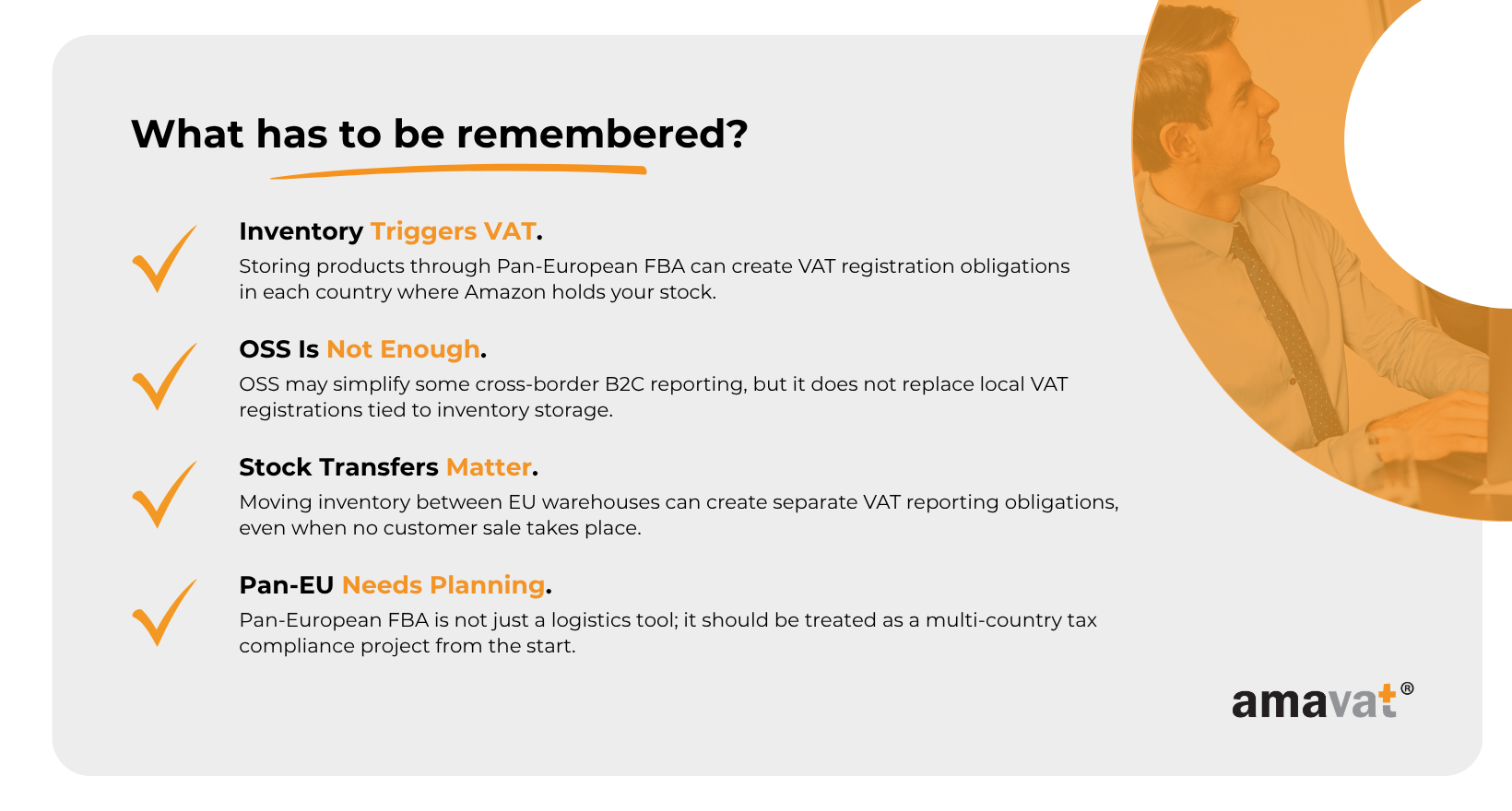
That is the core takeaway. Pan-European FBA can increase reach, but it often creates multi-country VAT obligations at the same time. Inventory storage is what usually drives those obligations, which is why understanding where stock is held matters so much. That single point sits behind registrations, domestic reporting, stock transfer reporting and much of the complexity sellers encounter later. It is also why so many compliance mistakes start not with incorrect tax calculations, but with misunderstanding how much inventory location affects VAT exposure.
OSS can help, and for many sellers it should absolutely be part of the conversation. It may simplify reporting for qualifying cross-border B2C sales and can be a valuable tool inside a broader compliance setup. But it does not replace local VAT obligations where inventory is stored, and treating it as if it does is one of the most common Pan-European FBA mistakes sellers make. The same logic applies more broadly to IOSS, marketplace VAT rules and other simplification mechanisms. They can support compliance, but they do not remove the need to understand the underlying obligations.
If there is one practical mindset shift worth taking away, it is this: treat Pan-European FBA enrollment as a tax compliance project as much as a logistics decision. Too many sellers evaluate the programme based only on fulfilment costs and growth potential, then deal with VAT questions later when complexity has already arrived. Usually the smarter approach is the opposite. Understand the compliance structure first, then scale into Pan-EU with that framework already in place.
For young e-commerce brands, that should not be seen as a reason to avoid Pan-European FBA. It is simply part of using it well. Sellers who approach Pan-EU with a clear view of registrations, reporting obligations and system setup often gain the upside without being surprised by the downside. And in practice, that is what good Pan-European FBA strategy usually looks like — not just selling across Europe faster, but building the VAT structure to support that growth from the beginning.