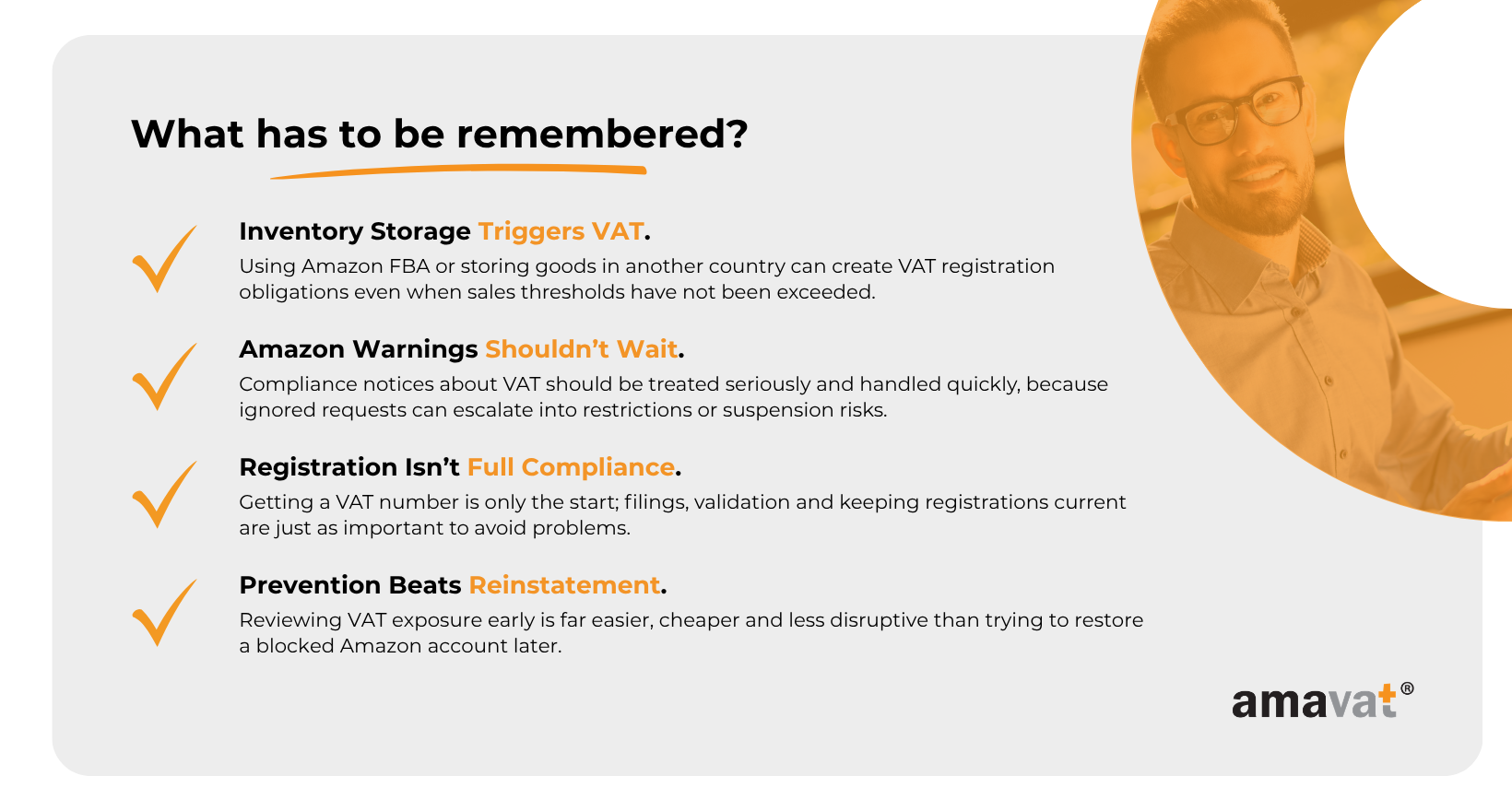
Amazon requires a VAT number – when is it mandatory, and what can you do to prevent your account from being blocked?
Spis treści
The reason these requests have become much more common is that Amazon has been tightening compliance controls, largely in response to increasing pressure from tax authorities across Europe and the UK. Marketplaces are expected to verify that sellers using their platforms meet certain tax obligations, particularly when inventory is stored locally or when sellers use cross-border fulfillment programs. Because of this, Amazon is carrying out more checks, requesting more VAT documentation, and in some cases proactively identifying accounts where it believes registration may be required. What some sellers interpret as Amazon becoming stricter is often a reflection of broader regulatory enforcement, and understanding that difference is important because it changes how these requests should be viewed. In many cases, Amazon is not creating a new rule but enforcing an obligation that may already exist under VAT law.
This has become a growing concern for smaller brands and young entrepreneurs building businesses through Amazon because VAT compliance now sits much closer to account health than many sellers realize. It is no longer just an issue handled quietly in the background by an accountant. It can affect whether you can continue selling without interruptions. More sellers are reporting sudden requests for VAT numbers in countries where they store inventory, notices related to validation issues with existing VAT IDs, and in some cases warnings connected to possible account restrictions. That has made VAT much more than an accounting topic. For many Amazon businesses, it has become a practical risk that can directly affect operations if ignored.
At the center of all of this is a very straightforward question: when does Amazon actually require a VAT number, and when is it mandatory rather than optional? The short answer is that a VAT number typically becomes mandatory when your business activities create a legal obligation to register in a country, whether because you store goods there, use certain Amazon fulfillment programs, or trigger local VAT registration rules. Once that obligation exists, Amazon may expect you to provide that VAT number as part of its compliance controls. This is where many sellers get caught out, because they assume VAT registration is mainly about turnover thresholds, while in reality inventory storage through FBA can create obligations even when sales volumes are still relatively modest.
Ignoring these requests can create serious problems, and that is where the risk of account restrictions enters the picture. If Amazon believes you should have a valid VAT registration and you fail to provide one, consequences can escalate from compliance notifications to FBA limitations, listing restrictions, or even account suspension in certain cases. That does not mean every request leads to an account block, but it does mean sellers should treat these notices seriously rather than assuming they can be dealt with later. In many situations, what starts as a simple document request becomes a much bigger issue only because it was ignored or misunderstood at the beginning.
This guide is designed to remove some of that confusion and explain clearly how these situations arise, when VAT numbers become mandatory on Amazon, what can trigger compliance requests, and what practical steps sellers can take to reduce the risk of restrictions or suspension. We will look at the most common scenarios that lead Amazon to request VAT registrations, explain what happens if you do not provide one, and cover how to stay ahead of these issues before they become account-level problems. For sellers growing across Europe, understanding this is no longer just about avoiding tax mistakes, it is about protecting the stability of the business you are building.

Why Is Amazon Asking for a VAT Number?
For many sellers, the biggest source of confusion is not the VAT requirement itself but why Amazon is the one raising the issue. It is common to assume that if Amazon asks for a VAT number, Amazon has introduced a new rule or suddenly changed something internally. In reality, that is usually not what is happening. In most cases, Amazon is not creating the underlying VAT obligation itself, but responding to compliance requirements that already exist under national or EU tax rules, while also applying its own platform-level verification requirements. That distinction matters, because it changes how sellers should interpret these requests. They are often not simply administrative requests generated by Amazon, but part of a wider compliance framework shaped both by tax law and by Amazon’s own responsibility to verify seller information.
As Amazon has expanded cross-border fulfillment and become deeply embedded in European e-commerce logistics, regulators have put far more attention on how marketplaces handle tax compliance. Platforms are increasingly expected to ensure sellers meet registration requirements where applicable and to maintain proper tax-related records. That pressure has led Amazon to request more VAT information, validate registrations more actively and, in some situations, restrict sellers who do not meet compliance requirements. What many sellers experience as Amazon becoming stricter is often Amazon responding to broader regulatory expectations.
Amazon Is Enforcing Tax Compliance, Not Creating New Tax Rules
A common misunderstanding among sellers is that Amazon decides when you need a VAT number. That is only partly true, and it is important to separate legal obligations from marketplace requirements. Amazon does not create the underlying legal VAT registration obligation, but it may impose platform-level requirements to verify VAT compliance or as a condition for using certain services or marketplaces. The legal obligation itself generally comes from tax law and depends on how and where your business operates, particularly where you store inventory, where goods are sold, and whether specific VAT registration triggers apply.
This becomes especially relevant for sellers using FBA or selling across multiple EU countries. Many assume VAT registration is mainly about turnover thresholds, but in cross-border e-commerce the picture is often much broader. Storing inventory in another country, participating in certain fulfillment programs or moving stock between EU countries can create VAT obligations even where turnover alone might not suggest immediate registration. Amazon may identify these situations through fulfillment data and request VAT numbers for countries where obligations may arise. When that happens, Amazon is usually not inventing a new requirement but asking sellers to demonstrate compliance with one that may already exist.
This is also where many sellers misunderstand how the One Stop Shop system works. Some assume that registering for OSS means they no longer need local VAT registrations when selling through Amazon in Europe. That can be a costly assumption. OSS can simplify reporting for qualifying cross-border B2C distance sales, but it does not replace local VAT registration in every scenario. When goods are stored in another EU country, when local domestic sales occur there, or when inventory is moved between countries through fulfillment networks, separate local VAT obligations may still apply. For Amazon sellers using FBA, this distinction matters a great deal, because logistics choices can create tax consequences that OSS alone does not solve.
Part of the reason Amazon takes this seriously is that marketplaces themselves face growing compliance responsibilities. EU e-commerce reforms, marketplace-facilitator rules in certain contexts and country-level enforcement have all increased pressure on platforms to monitor seller tax compliance more closely. From Amazon’s perspective, verifying VAT registrations is not simply about helping sellers stay compliant; it is also about reducing regulatory risk for the marketplace. That is why requests for VAT numbers are often framed as mandatory compliance actions rather than optional account updates.
This also explains why Amazon may be strict even with relatively small sellers. Many young entrepreneurs assume VAT scrutiny only matters once they reach substantial turnover, but in cross-border selling that is often not true. A business can be relatively small in revenue terms and still create registration obligations through where stock is stored or how fulfillment is structured. In those situations, compliance checks may be triggered long before a seller considers themselves “big enough” to worry about tax complexity.
Why Sellers Get “Unexpected” VAT Requests
One of the biggest frustrations sellers express is that Amazon may ask for a VAT number after they have already been selling for months or even years without problems. That leads to a natural question: if this mattered all along, why is Amazon only asking now?
There are several reasons this happens, and many relate to compliance triggers inside Seller Central that sellers may not realize exist. Certain activities can move an account into a higher-risk compliance category. Inventory being stored in another country through FBA can be one trigger. Enrollment in Pan-European fulfillment or similar programs can be another. In other cases, changes in regulatory enforcement, periodic document reviews or inconsistencies in tax-related account data may lead Amazon to request additional information.
Sometimes the request appears sudden only because Amazon has only recently identified an issue that may have existed for some time. A seller may have had a VAT registration obligation long before receiving a compliance notice, but the account may not have been flagged until later through an automated review or a change in enforcement focus. From the seller’s perspective it looks unexpected. From a compliance perspective it may simply be delayed detection.
Automation plays a major role here. Amazon increasingly relies on automated controls to identify situations where VAT registration may be required or where an existing VAT number may need validation. Those checks can compare inventory locations, seller information, marketplace activity and tax registration data in ways that generate requests without any obvious change on the seller’s side. That is one reason sellers sometimes receive compliance notices even though they believe they have done nothing differently.
Tax authority enforcement can also trigger broader waves of requests. In some cases, Amazon tightens controls in response to increased scrutiny in particular countries, which can lead to groups of sellers suddenly receiving similar notifications. That often creates the impression Amazon has launched a new policy overnight, when in reality the marketplace may simply be reacting to regulatory pressure that has intensified.
Another reason these requests often feel surprising is that many sellers view fulfillment decisions purely as operational choices, while compliance systems may interpret them very differently. Moving stock into another country through Amazon’s logistics network may feel like a warehousing decision, but from a VAT perspective it may trigger registration obligations. That gap between operational thinking and tax reality is where many “unexpected” VAT requests begin.
This is also why the fact that no one asked for a VAT number before does not necessarily mean no issue existed. A seller may have operated for years without receiving a request, but that does not guarantee there was never an obligation. It may simply mean it had not yet been reviewed, flagged or enforced.
Once you understand that, these requests tend to make much more sense. In many cases they are not random and they are rarely just Amazon creating bureaucracy for sellers. They are usually the result of compliance triggers, automated controls, changing enforcement priorities or business activities that have tax consequences sellers may not have fully considered. And once viewed through that lens, they become much easier to manage proactively rather than react to in panic.
When Is a VAT Number Mandatory on Amazon?
This is usually the point where sellers want a clear answer. Does Amazon require a VAT number in every case? No. But there are situations where a VAT number becomes effectively mandatory, and once you fall into one of those situations, treating it as optional can become risky very quickly.
It helps to start with an important distinction. Amazon does not simply require VAT numbers from every seller by default. Many businesses begin selling without immediate VAT obligations in multiple countries. The problem is that sellers often grow into business models, fulfillment setups or tax triggers without realizing they have crossed into a different compliance category. In those situations, what looks like Amazon “suddenly” asking for a VAT number is often Amazon identifying an obligation linked to how the business is already operating.
In practice, a VAT number tends to become mandatory on Amazon when tax law requires registration in a country where you operate, or when Amazon requires you to demonstrate compliance with those obligations to continue using certain services or marketplaces. And for many e-commerce businesses, the trigger is not turnover alone. Very often it is inventory, fulfillment structure and the way cross-border selling is set up.
If You Store Inventory in Another Country (FBA)
One of the clearest situations where VAT registration can become mandatory is when your inventory is stored in another country. This catches many Amazon sellers by surprise because they often associate VAT registration mainly with turnover thresholds, while in EU e-commerce, storing goods abroad can itself create registration and reporting obligations.
This is particularly relevant for sellers using Fulfillment by Amazon. Once stock is physically held in a warehouse in another EU country, that can trigger local VAT obligations, often regardless of whether your sales volume there is high or still relatively modest. For many FBA sellers, this is where VAT complexity starts. The compliance trigger is not necessarily the volume of sales but the fact that inventory is present in another jurisdiction.
Many sellers do not even realize how easily this can happen. They may think they are simply using Amazon fulfillment in one market, while inventory is in practice being positioned in another country as part of Amazon’s logistics network. Operationally that may look like normal fulfillment optimization, but from a VAT perspective it can have consequences that need to be addressed.
This is where the turnover myth causes problems. In domestic VAT discussions, people often focus on revenue thresholds, but in EU warehouse scenarios storing goods can create a registration trigger independently of those thresholds. For sellers using FBA, that distinction is crucial. Waiting until turnover increases before thinking about VAT can mean reacting too late.
It is also worth clarifying something many sellers misunderstand about OSS. The One Stop Shop can simplify VAT reporting for qualifying cross-border B2C distance sales within the EU, but it does not replace local VAT registration where stock is stored in another country or where inventory movements themselves create reporting obligations. For FBA sellers, that means OSS may help with some reporting, but it does not remove the need to consider local VAT registrations where goods are actually held.
Because Amazon can see where your inventory is stored, this is also one of the clearest areas where compliance requests can arise. If stock is held in a country where VAT registration may be required, Amazon may expect the corresponding VAT number to be provided.
If You Use PAN-EU, NAP, or Multi-Country Fulfillment Programs
Things become even more important when sellers move beyond basic FBA into broader Amazon logistics programs. Pan-European FBA and other multi-country inventory storage solutions can create VAT obligations in several jurisdictions, often much faster than sellers expect. That is because these programs may involve inventory being stored in multiple countries, which can trigger separate registration requirements country by country.
This is where many growing brands first encounter real VAT complexity. A seller may begin in one marketplace and assume one VAT setup is enough because they operate through one Amazon account. But once inventory is distributed across multiple countries, that assumption can quickly break down.
The key point is that one Amazon marketplace does not necessarily mean one VAT jurisdiction. You may manage one seller account while stock is physically stored in several countries, and each of those countries may potentially require local VAT registration. That is why a single Amazon expansion strategy can lead to multiple VAT numbers.
The European Fulfillment Network needs a little more nuance here, because it is often misunderstood. EFN can create cross-border VAT considerations, particularly around how sales are reported. Crucially, under EFN inventory typically remains stored in one country while Amazon ships cross-border from there — which generally does not trigger registration in the destination country from inventory alone. That makes it different from Pan-European inventory storage models, even though sellers sometimes group them together. However, the VAT treatment of EFN sales and local reporting should still be reviewed, as it differs from domestic sales.
This distinction matters because not every cross-border Amazon program creates the same VAT exposure. Some create direct inventory-based registration obligations, while others may raise different reporting considerations. But once sellers move into multi-country inventory storage programs, reviewing VAT obligations country by country becomes essential.
This is also where Amazon compliance scrutiny often increases. The more countries involved in inventory storage, the more likely VAT registrations become part of routine compliance expectations rather than something that can be treated as a future issue.
If You Exceed Domestic VAT Registration Thresholds
Inventory storage is a major trigger, but turnover still matters too. In many cases, VAT registration becomes mandatory because a business exceeds the domestic threshold in its home country or another country where threshold-based rules apply.
For newer entrepreneurs, this is often the most familiar trigger. Once taxable turnover passes a country’s registration threshold, registration is generally no longer optional. At that point, if you are selling through Amazon, that VAT number should normally be reflected correctly in your seller account as part of your tax information.
This matters not only for legal compliance, but because Amazon may expect your registration status, invoicing settings and account data to align. If you are legally required to be VAT registered and your Seller Central information does not reflect that, compliance questions can arise later.
It is also important not to confuse domestic threshold obligations with cross-border obligations. Many sellers assume staying below a turnover threshold means VAT registration is not relevant yet, but as discussed above, inventory storage in another EU country can trigger obligations independently of turnover. These are separate issues, and both need to be considered.
For growing e-commerce businesses this often becomes relevant faster than expected. Many brands move from early-stage revenue into threshold territory quickly, and VAT registration can become necessary before founders realize how close they are to triggering it.
When Marketplace Facilitator Rules Do Not Remove Your VAT Obligations
This is one of the biggest misconceptions among Amazon sellers. Because Amazon sometimes collects and remits VAT under marketplace-facilitator or deemed supplier rules, some sellers assume they no longer need to worry about VAT registration at all.
That assumption can cause problems.
There are cases where Amazon may be responsible for collecting VAT on specific transactions. But that does not automatically remove a seller’s own registration or reporting obligations. Those are separate questions, and they should not be confused.
A common misunderstanding is that if Amazon handles VAT collection, a VAT number is no longer needed. In reality, there are situations where Amazon may remit VAT on certain sales while the seller still needs local VAT registration because inventory is stored in a country, local taxable transactions occur there, or other registration triggers apply.
This is where marketplace-facilitator rules are often oversimplified. They may affect who accounts for VAT on certain transactions, but they do not universally eliminate seller obligations. For FBA sellers in particular, assuming “Amazon handles the VAT” can create a false sense of security.
That is also why Amazon may still request VAT numbers even where sellers believe marketplace rules should have removed the need. From a compliance perspective, those are often separate issues.

Country-Specific Enforcement (Germany, Austria, Italy, UK and Others)
Not all Amazon marketplaces carry the same compliance risk. Some countries have stricter VAT enforcement controls and stronger marketplace compliance expectations than others, which helps explain why sellers often hear about VAT-related problems appearing first in certain markets.
Germany is often the example sellers mention first, and for good reason. VAT compliance has historically been enforced quite aggressively there, which has influenced how marketplaces approach seller verification. Similar concerns exist in Austria, Italy and other jurisdictions where authorities have pushed harder on marketplace oversight.
For sellers, this matters because stronger enforcement often means VAT issues escalate faster. It is not necessarily that the legal principles are entirely different, but in some markets the consequences of non-compliance tend to appear sooner.
That is one reason VAT-related account blocks are often associated first with specific countries. Where compliance controls are stricter, marketplaces may move more quickly to request documentation or restrict accounts until issues are resolved.
The UK also brings its own complexities, especially because marketplace liability rules and post-Brexit VAT treatment have added layers many sellers still misunderstand. For businesses selling into both the EU and the UK, assuming one compliance approach covers everything can create mistakes.
The practical takeaway is that VAT risk is not evenly distributed across all Amazon marketplaces. Some countries tend to trigger scrutiny earlier, and sellers operating there should be especially cautious about delaying registration questions.
For most Amazon businesses, the answer to when a VAT number becomes mandatory is ultimately much simpler than it first appears. If your business model creates a legal registration obligation, if your fulfillment setup triggers country-specific requirements, or if Amazon’s compliance systems identify those obligations, then in practice a VAT number is often not optional. And understanding that early is much easier than dealing with it once a compliance request turns into an account problem.
How Amazon Requests and Verifies Your VAT Number
For many sellers, the real confusion does not begin when they learn a VAT number may be required, but when Amazon actually asks for one. That is often the moment the issue starts to feel urgent. A compliance notification appears, an email lands in your inbox referring to tax information, or an Account Health alert starts warning that action may be required. For sellers who have never dealt with this before, those requests can feel vague and intimidating, partly because Amazon’s compliance language is often formal and partly because it is not always obvious whether you are looking at a routine request or the beginning of something more serious.
The good news is that these requests usually follow fairly predictable patterns. Amazon generally does not ask for VAT information in a random or informal way. There are specific places where VAT numbers are maintained, specific ways compliance notices are issued, and specific processes through which the information you provide may be verified. Understanding how that works makes these requests much easier to deal with and often helps sellers avoid problems simply by responding correctly and early.
Where to Add Your VAT Number in Seller Central
When Amazon requests a VAT number, the starting point is usually the tax settings within Seller Central, particularly the section where VAT and GST registration details are maintained. For many sellers, this is a part of the account they may have configured once and rarely revisited, which is exactly why issues can sometimes develop unnoticed.
This section matters more than many sellers realize because Amazon uses the information there not simply as a passive record, but as part of how tax settings and compliance data are managed across the account. If you are VAT-registered in countries where registration is required, those registrations generally need to be reflected accurately there and kept current.
That point is important. Many sellers treat VAT numbers as something uploaded once and forgotten, but Amazon expects the information to stay aligned with the reality of how the business operates. If a new country registration becomes necessary, if an existing registration changes, or if a VAT number encounters issues, Seller Central information may need updating. A surprising number of compliance problems do not begin because a seller failed to register, but because account information no longer matches actual tax registrations.
This becomes especially relevant for businesses expanding into multiple countries through FBA or broader European selling programs. As operations grow, VAT registrations often evolve as well, and tax settings need to evolve with them. One reason Amazon places emphasis on this section is because registration information can feed into wider compliance controls rather than functioning as simple background account data.
For that reason, keeping VAT details updated should be treated less as admin maintenance and more as part of routine account health management.
Compliance Notifications You Should Never Ignore
For many sellers, the first sign of a VAT issue does not come through tax settings at all but through a compliance notification. This is often where problems are either solved early or allowed to escalate.
Amazon typically communicates VAT-related concerns through several channels. Sellers may receive email notices, Performance Notifications, Account Health alerts, marketplace-specific compliance messages or requests inside Seller Central dashboards. Sometimes the message appears as a request for additional information. Sometimes it includes a deadline. In some cases it may explicitly warn that account restrictions could follow if no action is taken.
Whatever form it takes, these are not notices to leave sitting unread.
One of the most common mistakes sellers make is assuming these requests are routine administrative emails that can wait until later. That can be risky because Amazon often gives sellers time to respond before restrictions are considered, and missing that response window is often where manageable issues turn into much bigger ones.
Another complication is that these notices are not always especially obvious. Some arrive in the language of a local marketplace. Some appear in account areas sellers rarely check. Some sound procedural until you realize they contain compliance deadlines. That is why experienced Amazon operators often treat monitoring compliance notifications as part of ordinary account management rather than something to review only when there is already a problem.
This matters because VAT-related restrictions often do not emerge completely out of nowhere. In many cases, warnings or requests came first. Sellers sometimes describe accounts being suddenly blocked, but often there were earlier notifications that were missed, misunderstood or deprioritized.
That is why speed matters. Even if you are unsure whether a request fully applies to you, it is usually far easier to investigate and respond early than to deal with account limitations later.
Amazon VAT Validation Checks (Including VIES)
Providing a VAT number is only part of the process. Amazon may also verify that number, and this is where some sellers run into problems even after believing they have already complied.
Many assume that once a VAT number has been entered, the issue is resolved. In practice, validation may still take place to confirm that the number is active and consistent with the business information associated with the seller account. For EU VAT numbers, validation may include checks against VIES or other verification systems used to confirm that a VAT number is active and consistent with seller information. Amazon may also rely on additional documentation checks, internal validation processes or country-specific controls, depending on the jurisdiction involved.
That matters because compliance issues do not only arise when a seller has no VAT number. They can also arise when the number provided does not validate correctly.
Sometimes the issue is something straightforward, such as a mismatch in business details or a simple data entry error. In other cases, a VAT number may exist but not validate correctly because of administrative issues, registration delays or country-level tax authority problems. From a seller’s perspective the number may seem perfectly valid. From a compliance system’s perspective it may still trigger questions.
And when a number appears invalid or cannot be verified properly, that can lead to additional checks or fresh compliance notifications.
This is why many VAT specialists advise not only obtaining the right registrations but also checking periodically that VAT numbers remain active and verifiable where relevant. Sellers often focus heavily on registration itself and much less on ongoing validity, but Amazon’s verification approach makes both important.
There is another point many sellers overlook. A VAT number can become problematic even after previously being accepted, though processes differ by country. If a VAT registration becomes inactive, subject to tax authority issues, or no longer validates correctly, Amazon may flag it even if it caused no issues before. That can trigger a new compliance problem unless it is caught and fixed early.
For non-EU jurisdictions such as the UK, validation may also follow separate national systems rather than VIES, which is another reason sellers operating across multiple markets should not assume one verification logic applies everywhere.
This is why VAT verification should be viewed as an ongoing compliance layer rather than a one-time hurdle cleared once registration is obtained. Getting the VAT number is one step. Keeping it valid and verifiable is another.
Why VAT Enforcement Is Tightening on Amazon
A lot of sellers have noticed that VAT requests feel more common than they did a few years ago, and that impression is largely correct. Enforcement has become tighter, and there are several reasons for that.
Part of it comes from regulatory pressure. Tax authorities have pushed marketplaces to strengthen compliance oversight, and Amazon has responded with more verification, tighter document controls and increased scrutiny where obligations may exist.
Part of it is also operational. As Amazon’s fulfillment infrastructure has become more sophisticated, the marketplace has far greater visibility into where sellers store inventory, how stock moves across borders and where tax exposure may arise. More visibility naturally supports more compliance checks.
That is one reason sellers are seeing more document requests, more validation controls and, in some cases, stricter consequences tied to missing or incorrect VAT information. It is not necessarily that the underlying rules have changed overnight, but enforcement has become much more active.
Recent developments around digital invoicing, evolving VAT reporting systems and broader marketplace compliance expectations have added to this. Sellers who once treated VAT settings as something largely passive often find that approach no longer works as comfortably.
Another factor is automation. Amazon’s compliance systems appear to be becoming more proactive, with checks increasingly happening earlier rather than waiting for obvious problems to emerge. For sellers, this can make requests feel more frequent, but it also means issues may be identified before they become much larger tax problems.
That is why VAT checks or document requests should not be seen as isolated annoyances. They are part of a broader shift in how marketplaces and regulators approach compliance.
Realistically, that trend is unlikely to reverse.
For Amazon sellers building long-term businesses across Europe, the practical takeaway is simple. VAT verification is no longer something to think about only when Amazon raises an issue. It has become part of the operating environment. Sellers who manage it proactively usually experience it as routine compliance. Sellers who ignore it often only engage with it once it has become urgent.
What Happens If You Don’t Provide a VAT Number?
This is usually the part sellers care about most, because once Amazon asks for a VAT number, the next question is often not whether the request is legitimate, but what actually happens if you ignore it. Can Amazon really restrict your account over this, or are these compliance warnings that look more serious than they are?
In practice, the consequences can range from relatively manageable compliance friction to serious account-level problems, depending on why the VAT number was requested, which country is involved, and whether the issue is simply unresolved or clearly non-compliant. That range matters, because not every missing VAT number leads directly to suspension. In some cases, Amazon may first request additional tax documentation or clarification before any restrictions are considered. At the same time, sellers should not underestimate the risk of ignoring these requests. Many serious VAT-related account issues do not begin with sudden suspension, but with missed notices, delayed responses or compliance problems that gradually escalate.
FBA Restrictions and Selling Limitations
One of the first possible consequences sellers may encounter is not a full suspension but restrictions affecting their ability to operate normally in the marketplace. This is often how compliance concerns surface before stronger action is considered.
Depending on the nature of the issue and the marketplace involved, that may include marketplace-level selling restrictions, listing limitations or other operational disruptions linked to unresolved compliance concerns. Exactly how those issues appear can vary, which is why sellers should avoid assuming VAT requests are purely administrative and disconnected from day-to-day account performance.
This matters because even partial restrictions can be disruptive, particularly for businesses relying heavily on Amazon as a primary sales channel. What may initially look like a paperwork issue can begin affecting commercial activity if compliance concerns remain unresolved.
For smaller e-commerce brands, even limited disruption can be significant. If a business depends on a relatively focused product range or concentrated marketplace revenue, restrictions affecting visibility or selling activity can have an outsized impact. That is one reason VAT compliance requests should be taken seriously even when they do not initially look dramatic.
The bigger point is not that every VAT issue automatically leads to operational limitations, but that unresolved compliance problems can affect more than tax administration. In some cases they can start affecting the practical functioning of the business on Amazon.
Can Amazon Block or Suspend Your Account?
This is the question many sellers worry about most, and the honest answer is that VAT-related compliance issues can in some cases contribute to account suspension or blocked selling privileges. But it helps to understand that problems often escalate through stages rather than moving immediately from first notice to full suspension.
Typically, a compliance issue begins with requests for information or warnings. If concerns remain unresolved, restrictions may follow, and in more serious cases stronger action may be taken. That progression matters because it means many VAT-related issues can often be addressed before reaching the worst-case scenario, provided sellers act early.
It is also important to recognize that enforcement may be stricter in some marketplaces, which can increase compliance pressure. That is one reason sellers should be cautious about assuming a warning in one marketplace carries the same practical risk as in another.
Where some sellers get caught out is assuming that partial responses will always be enough. A common example is believing that proof a VAT registration application has been submitted will necessarily satisfy Amazon while waiting for the number to be issued. In practice, an application in progress may not always resolve the restriction, particularly where Amazon requires an active verifiable registration as part of compliance.
That distinction matters. Demonstrating that you are working toward compliance may help in some contexts, but it is not always the same as meeting a requirement that depends on a valid, active VAT number.
This is often why sellers who delay dealing with registration obligations until after warnings appear may find themselves under much more pressure than those who addressed them proactively. Once an issue has escalated into suspension territory, options can become narrower.
It is also worth noting that “account blocked” can mean different things in practice. Sometimes it refers to full suspension of selling privileges. Sometimes it may mean marketplace-specific restrictions until compliance concerns are resolved. But either can be commercially serious.
The practical lesson is not that every VAT issue leads to suspension, but that sellers should not assume suspension is impossible simply because the issue began as a tax request.
Retroactive Tax Risks and Audits
Amazon restrictions are only one side of the risk. The other side is what can happen from a tax perspective if VAT registration should have existed earlier but did not.
This is often the part sellers underestimate most, especially when they focus entirely on satisfying Amazon and overlook the underlying tax exposure.
If a business should have been registered in a country because inventory was stored there or other VAT triggers applied, resolving the issue may not simply mean registering going forward. In some cases there may be historical implications, meaning tax authorities may expect compliance to be corrected back to when the obligation first arose.
That can lead to backdated reporting obligations, corrective filings and, depending on the facts and jurisdiction involved, potential VAT liabilities relating to prior periods.
For sellers who have expanded quickly across borders without much tax planning, this is often where the bigger financial exposure sits. The Amazon compliance issue may be what brings attention to the problem, but the larger exposure may be historical.
Penalties and interest can also become part of the picture, particularly where registrations should have existed earlier or filing obligations were missed. Exactly how that plays out varies significantly by country and circumstances, but the broader point remains the same: ignoring VAT registration issues can create consequences beyond marketplace compliance.
That is why many sellers dealing with these issues eventually realize the question is not only how to satisfy Amazon, but whether underlying tax obligations need to be regularized as well.
For growing e-commerce businesses, this is often where early advice can matter enormously. Problems that are manageable when addressed early can become far more expensive when left until audits or corrective filings are already in play.
What If Your VAT Number Becomes Invalid?
There is another risk many sellers overlook because they assume once a VAT number has been provided, the issue is solved permanently.
Unfortunately, that is not always true.
A VAT problem can arise not only because no registration exists, but because an existing VAT number later stops validating properly or encounters problems. And that can trigger a fresh compliance issue even for sellers who believed everything had already been handled.
This can happen for different reasons. A VAT registration may become inactive, be affected by tax authority issues, or no longer validate correctly, though the mechanics differ by country. From the seller’s perspective, nothing may appear wrong until Amazon raises a concern.
That is one reason maintaining a VAT registration matters just as much as obtaining one in the first place.
If a number no longer validates or appears problematic during a compliance review, Amazon may issue fresh notifications or request corrective action. In some cases, that can lead to restrictions similar to those triggered by missing registrations if the VAT number on file is no longer acceptable.
This catches many sellers off guard because they think compliance is something completed once and then forgotten. In reality, VAT compliance can be ongoing, and invalid or problematic registrations can reopen issues sellers thought were resolved.
It is also one reason neglected tax compliance can create indirect Amazon risks. What begins as an issue with filings or registration status can eventually become a marketplace compliance problem if the VAT number no longer validates correctly.
For businesses operating across multiple countries, this risk can grow simply because multiple registrations mean multiple points where something may need attention.
That is why experienced operators often treat VAT compliance less as a one-time registration exercise and more as ongoing maintenance.
Because from Amazon’s perspective, a VAT number that no longer works can raise many of the same concerns as not having one at all.
And that is really the bigger point of this entire section. The risk is rarely just “Amazon asked for a VAT number and I ignored the email.” The real risk is that unresolved VAT issues can affect selling activity, contribute to account restrictions, expose historical tax liabilities and even reappear later if registrations are not kept valid. Once sellers understand that, compliance requests stop looking like routine bureaucracy and start looking much more like what they often are — something worth addressing early.
How to Prevent Your Amazon Account From Being Blocked Over VAT
The good news in all of this is that most VAT-related Amazon problems are far more preventable than many sellers assume. A lot of the anxiety around account blocks comes from the fact that compliance issues often appear technical and reactive, as though sellers only discover them when Amazon raises a problem. In reality, many of the risks that lead to VAT-related restrictions can be reduced significantly with relatively simple preventive habits, especially when those habits are built into normal business operations rather than treated as emergency fixes.
That matters because prevention in this area is usually much easier than recovery. Once an account is under restriction, everything becomes slower, more stressful and often more expensive. But when VAT compliance is managed proactively, many of the major risks become far more controllable.
For smaller e-commerce businesses, this is also encouraging because preventing VAT problems does not necessarily mean building a large compliance function or turning your business into a tax administration project. In many cases, it comes down to visibility, consistency and responding early rather than late.
Map Your VAT Obligations Country by Country
One of the biggest reasons sellers run into VAT trouble is not necessarily because they ignore compliance, but because they never map out where obligations may exist in the first place. They know where they sell, but they have not fully looked at where tax exposure may arise.
That distinction matters because where you make sales and where you create VAT obligations are not always identical.
A good starting point is to separate two questions that sellers often blur together. In which countries do you actively sell, and in which countries is your inventory stored or potentially moved? Those are not always the same list, particularly for businesses using Amazon fulfillment programs.
Many VAT surprises happen because sellers focus only on marketplaces where orders are generated and overlook inventory locations, even though inventory placement can be a major registration trigger. Mapping both sales activity and inventory presence country by country often reveals risks much earlier.
This is where even a simple VAT registration checklist can be extremely useful. It does not have to be complicated. The goal is to have a practical overview showing where the business operates, where stock may sit, what registrations exist, and whether there are gaps that need reviewing.
That exercise alone often surfaces issues sellers did not realize they had. Many businesses discover they assumed one VAT setup covered much more than it actually does.
For EU distance sellers, it is also worth periodically reviewing whether OSS is being used appropriately, and where local VAT registrations may still be required despite OSS. Many sellers assume OSS covers everything, and that assumption is one reason registration gaps sometimes go unnoticed.
And that is exactly why this is such an important preventive step. You cannot manage obligations you have never mapped.
Keep Your VAT Numbers Active and Verifiable
Registration itself is only the beginning. A surprising number of compliance issues arise not because sellers failed to obtain VAT numbers, but because registrations later become problematic, outdated or difficult to verify.
That is why prevention does not stop at “get the VAT number and move on.” It also means making sure those registrations stay active and verifiable.
For EU registrations, periodic checks through systems such as VIES can be a useful practical habit, even if Amazon may also use other validation methods or country-specific checks. The point is not that sellers need to obsessively monitor registrations every week, but that they should not assume a VAT number once accepted will never need attention again.
This matters because validation problems can emerge quietly. Administrative issues, registration data mismatches or tax authority-level problems can sometimes affect whether a VAT number validates properly long before a seller realizes there is an issue.
And once Amazon flags a validation problem, what could have been fixed quietly can suddenly become a compliance matter.
That is why it makes sense to deal with visibility or validation issues early rather than waiting for Amazon to surface them. If a registration is not validating properly, solving that before the next compliance review is obviously much easier than trying to do it under account pressure.
For businesses operating across several countries, this becomes even more important. More registrations generally mean more things that need occasional checking.
Stay Ahead of VAT Filings and Deadlines
Another common mistake is treating VAT compliance as something completed once registration is done. In reality, registration is usually the start of compliance, not the end of it.
This is where many sellers who believe they have “handled VAT” can still run into problems later.
A VAT registration only stays useful if the ongoing obligations attached to it are actually maintained. Returns need to be filed. Deadlines need to be met. Registrations need to remain valid and ongoing obligations need to be met. That is why compliance does not stop at registration.
For Amazon sellers with obligations in multiple countries, this can become difficult to manage casually. Different jurisdictions may have different filing frequencies, different deadlines and different practical requirements. Trying to track that ad hoc is where mistakes tend to happen.
That is why many experienced sellers build some form of compliance calendar, even if it is simple. The goal is not complexity but visibility. Knowing what needs filing, where and when reduces the chance that something important gets missed.
This is one of those boring systems that often prevents very expensive problems.
It also helps sellers move from reactive compliance to proactive compliance, which is usually where businesses become much safer operationally.
And importantly, staying current with filings does not just reduce tax risk. It can reduce the chances of registrations developing issues that later feed into Amazon compliance problems.
Respond to Amazon Compliance Notices Immediately
If there is one habit that prevents a surprising number of account problems, it is responding quickly when Amazon raises a compliance issue.
Speed matters here far more than many sellers realize.
A lot of VAT-related account problems become serious not because the underlying issue was impossible to solve, but because warnings were ignored, delayed or treated as low priority until deadlines had already passed.
That is why compliance notices should never be handled as something to revisit “when things calm down.” They should usually move close to the top of the list.
Part of this is simply having a system to ensure these notices are not missed. That sounds obvious, but many sellers discover problems late because compliance emails went unnoticed, marketplace-specific messages were overlooked or important notifications were buried in routine Amazon communication.
Some sellers deal with this by setting rules around who monitors compliance emails, who reviews Account Health notifications or how tax-related requests are escalated internally. However simple the process, the principle is the same: do not rely on chance.
Because the earlier a compliance request is handled, the more options sellers usually have.
And just as importantly, quick responses often help distinguish between issues that need urgent correction and situations where Amazon is simply asking for clarification or documentation.
In compliance matters, delay tends to reduce flexibility.
Keep Invoices, Amazon Reports, and VAT Filings Consistent
Another major preventive step is consistency.
This sounds less dramatic than VAT registrations or account blocks, but inconsistencies between invoices, Amazon transaction data and VAT filings are one of those issues that can quietly create problems.
Tax compliance issues do not always arise because something is missing. Sometimes they arise because information does not align.
If Amazon reporting shows one thing, invoices show another and VAT filings reflect something else, that kind of mismatch can raise questions during compliance reviews or audits.
That is why reconciliation matters.
For growing businesses, especially those managing multiple marketplaces, keeping reporting consistent can become surprisingly challenging. Amazon reports can be detailed and complex, and if they are not being reconciled against VAT reporting with some discipline, discrepancies can develop without anyone noticing.
This does not mean sellers need perfect accounting precision at every moment. It means they should avoid treating invoicing, Amazon reporting and VAT compliance as separate silos that never get compared.
Because once discrepancies are discovered externally, they are usually harder to explain than they would have been to prevent internally.
And in many cases, consistent records can help reduce audit risk and make compliance reviews easier to navigate.

Stay Ahead of VAT and Amazon Compliance Rule Changes
One final point that many sellers overlook is that compliance risk does not stay static. The rules, systems and expectations around VAT and Amazon compliance continue evolving.
That matters because some sellers approach VAT as if once they have understood the rules today, they can simply leave the topic alone indefinitely.
In practice, that is rarely wise.
Marketplace requirements evolve. Tax systems evolve. Amazon processes evolve. Programs change. Reporting expectations change. Even sellers who are fully compliant today can run into problems later if they assume nothing around them is moving.
That is one reason ongoing monitoring matters.
This does not mean following every minor compliance rumor circulating in seller forums. It means keeping enough awareness of changes affecting VAT, Amazon programs and marketplace compliance that your business does not get caught off guard.
For growing businesses, this is especially important because expansion often introduces new risks faster than founders realize. A process that was compliant when operating in one country can become incomplete once inventory, marketplaces or fulfillment structures expand.
And often it is not major legal reforms that cause problems, but quieter operational changes sellers fail to notice.
The businesses that tend to stay out of trouble are rarely the ones that know every tax rule in microscopic detail. More often they are the ones that treat compliance as something reviewed regularly rather than something solved once.
And that is really the bigger message in this entire section. Preventing an Amazon account block over VAT is usually not about one dramatic action. It is about doing several ordinary things consistently: knowing where your obligations exist, keeping registrations valid, staying current on filings, responding fast to Amazon notices, keeping records aligned and paying attention as requirements evolve.
None of those things is especially glamorous. But together they do a very good job of reducing the kind of VAT problems sellers usually only start thinking about once Amazon has already raised them.
Already Blocked? Here’s What to Do
If Amazon has already restricted or blocked your account over a VAT-related issue, the instinct is usually to react immediately and try to fix everything at once. For most sellers, especially businesses heavily dependent on Amazon revenue, a suspension can feel existential, so the first reaction is often to upload whatever documents seem relevant, open cases quickly and try to push for reinstatement as fast as possible. That reaction is understandable, but it can also make the situation harder to resolve if it leads to responding before understanding what actually triggered the restriction. VAT-related suspensions are usually compliance problems rather than ordinary support issues, and they often need to be approached as structured problems to diagnose and correct, not simply escalated through urgency.
In many cases, the sellers who resolve these situations fastest are not the ones who react most aggressively, but the ones who first understand exactly what caused the restriction and then address that issue in the right order. That usually means treating reinstatement as a process: first identify the root cause, then resolve the compliance gap, then satisfy Amazon’s verification requirements and finally strengthen processes so the same issue does not happen again. That may sound less dramatic than rushing into appeals or document uploads, but in practice it is often the more effective route.
Confirm Why Your Account Was Blocked
The first step is understanding exactly why the account was restricted, and this is where many sellers move too quickly. It is common for someone to receive a suspension notice mentioning VAT and immediately assume the issue is obvious, when in reality the underlying problem may be much more specific. Before taking action, it is important to review the compliance messages connected to the restriction carefully, especially Performance Notifications, Account Health alerts and any marketplace-specific notices tied to the affected store. Amazon often provides more detail than sellers initially realize, but under stress people tend to read these notices only at a surface level and jump straight into responding.
That can create unnecessary delays, because a missing VAT registration, an invalid VAT number, a request for additional documentation and a broader tax compliance concern may all require different corrective steps. If you misunderstand the cause of the restriction, you can end up responding to a different problem than the one Amazon is actually asking you to solve.
It is also important not to assume the suspension is solely about the first issue that seems obvious. Sometimes VAT concerns appear alongside other compliance matters, and reducing everything to “Amazon wants my VAT number” can oversimplify what needs attention. The goal at this stage is not to rush into an appeal or start sending documents immediately. It is to understand precisely what compliance issue Amazon is raising, because every later step depends on getting that diagnosis right.
Resolve the Underlying VAT Compliance Issue
Once you understand the cause of the restriction, the next step is resolving the underlying issue itself. In some cases, that may mean registering for VAT in a country where an obligation genuinely exists. In others, it may involve correcting account mismatches, providing clarification, validating an existing registration or addressing documentation concerns. The key point is that reinstatement often depends on solving the actual compliance problem, whatever form that problem takes.
This is where honesty matters. Some sellers go straight into arguing they should not need a VAT number at all, when the more important question is whether the obligation actually exists based on how the business operates. If inventory was stored in the country concerned, if fulfillment arrangements triggered local registration requirements or another clear VAT obligation applies, the practical route may be to address that obligation rather than trying to argue around it.
At the same time, sellers should not assume Amazon is automatically right without checking the facts. Determining whether registration is genuinely required should come first. If it is, deal with it properly. If the issue is something else, solve that issue directly.
Where this can become more complex is when the obligation may have existed earlier than the suspension itself. Depending on the circumstances, it may be necessary not only to obtain a registration going forward but also to consider whether historical compliance needs to be regularized. This is often where specialist VAT advice becomes valuable, because decisions made in a rushed suspension response can have implications beyond the Amazon account.
And importantly, in many cases reinstatement may depend less on persuading Amazon and more on correcting the compliance problem itself. That distinction matters because it shifts the focus from arguing with the marketplace to resolving what caused the restriction in the first place.
Upload the VAT Number and Complete Verification
Once the compliance issue has been addressed, the next step is usually providing Amazon what it has actually requested for verification and reinstatement. This is another point where sellers sometimes make things harder than necessary by assuming more documentation always helps. In reality, overloading submissions with irrelevant documentation can create noise. What usually matters is providing the information Amazon requested, through the correct channels, in a way that aligns with seller account details and supports verification.
Where a VAT registration is involved, sellers should remember that registration and verification are not always the same thing. It may not be enough simply to show a VAT application has been submitted, depending on the circumstances. In some cases, Amazon may require an active verifiable registration rather than evidence a number is pending.
That distinction can be frustrating when time matters, but it is often central to how VAT-related restrictions are resolved.
It is also worth being realistic about timing. Sellers sometimes expect that once a VAT number or supporting documentation is uploaded, reinstatement should happen immediately. Sometimes it does. Sometimes compliance review takes time. That delay does not necessarily mean something has gone wrong. What matters far more is whether the submission directly addresses the issue raised and supports the verification process rather than creating inconsistencies or confusion.
Where Amazon requests an appeal or Plan of Action, responses are often stronger when they focus on root cause, corrective action already taken and preventive controls going forward, rather than relying mainly on urgency or explanations of commercial impact. That tends to align much more closely with how compliance reviews are assessed.
In many cases, successful reinstatement is less about pushing harder and more about making sure the response precisely resolves the concern Amazon identified.
Put Prevention Systems in Place Going Forward
Once the account is reinstated, many sellers understandably want to move on and treat the episode as a crisis that has passed. But in practice, a VAT-related suspension is often a signal that compliance processes inside the business may need strengthening, and ignoring that lesson can create the risk of repeating the same problem later.
That is why reinstatement should ideally be followed by prevention. Not in a dramatic sense, but in the practical sense of putting systems in place so the business is less exposed going forward. That often means formalizing the basics many smaller sellers tend to handle informally: mapping VAT obligations more carefully, reviewing registrations periodically, tracking filings and deadlines more deliberately, monitoring Amazon compliance notifications consistently and making sure marketplace tax data stays aligned with actual VAT compliance.
The sellers who often come out of these situations strongest are not simply the ones who got reinstated, but the ones who used the experience to improve how the business handles compliance. That matters even more for businesses continuing to scale, because expansion into new marketplaces or fulfillment programs can create entirely new VAT exposures later if internal controls stay weak.
A suspension can be disruptive, but it can also reveal where processes were relying too much on assumptions or too little on structure. Used well, that insight can make the business more resilient than it was before the problem arose.
And that is really the bigger takeaway. If your account is already blocked, the goal is not only to get selling privileges restored. It is to resolve the immediate issue correctly, deal realistically with any underlying compliance exposure and come out of the experience with stronger systems than you had before.
Reinstatement addresses the immediate symptom.
Better compliance processes reduce the chances of facing the same problem again.
Common VAT Mistakes Amazon Sellers Make
One of the more frustrating things about VAT problems on Amazon is that they often do not begin with highly technical tax issues that only specialists could have predicted. Much more often, they begin with ordinary assumptions sellers make while trying to grow their business, assumptions that feel reasonable at the time but can quietly create compliance risk in the background. That is actually good news, because common mistakes are usually preventable mistakes. A lot of account problems linked to VAT do not happen because sellers deliberately ignore obligations or take reckless shortcuts. They happen because founders focus, understandably, on products, margins, ads, logistics and growth while treating tax compliance as something secondary that can be handled later. In practice, that “later” is often the moment Amazon sends a compliance notice, and by then a preventable issue may already have become a problem.
What makes these mistakes worth discussing is how repetitive they are. Across small and growing e-commerce businesses, the same patterns show up again and again. Sellers assume Amazon handles more of the VAT side than it really does. They focus on where they sell but ignore where inventory is actually being stored. They treat VAT registration as a one-time hurdle and overlook the ongoing filing obligations that follow. They wait for Amazon to raise a warning rather than reviewing risk proactively. They assume OSS covers every VAT issue once they have signed up for it. Or they assume a VAT number once entered into Seller Central takes care of itself forever. None of these mistakes sounds dramatic in isolation, which is exactly why they are so common. They look harmless until they combine into the kind of compliance issue sellers often only recognize when it starts affecting the account.
Assuming Amazon Handles All VAT for You
Probably the most common mistake newer Amazon sellers make is assuming the platform itself handles VAT compliance in a broader sense than it actually does. It is an easy assumption to make because Amazon simplifies so many operational aspects of selling that people naturally extend that logic to tax. Amazon calculates taxes on certain transactions, may collect and remit VAT in some marketplace-facilitator situations and offers tax-related tools inside Seller Central, so it can appear as though VAT compliance largely sits inside Amazon’s ecosystem. But there is a major difference between a marketplace supporting parts of the tax process and a marketplace taking responsibility for a seller’s VAT obligations. Confusing those two things is where many problems begin.
This misunderstanding often surfaces as sellers expand. A business may move into FBA or begin selling across several countries and assume that because Amazon is powering the fulfillment structure, the tax implications are somehow handled alongside it. But logistics support and VAT compliance are not the same thing, and treating them as if they move together can lead sellers to miss obligations they did not realize existed. Many costly mistakes begin with some version of “I thought Amazon handled that,” and while the assumption is understandable, it is one of the first ones sellers should challenge if they want to avoid compliance problems later. The safest mindset is to treat Amazon as a platform with compliance expectations, not as a substitute for understanding your own VAT responsibilities.
Ignoring Inventory Stored Abroad
Another extremely common mistake is paying close attention to where sales happen while paying too little attention to where stock is physically located. This is especially common among sellers who think of logistics as purely operational and VAT as something tied mainly to turnover. In reality, those things often overlap much more than people expect. A business may have a very clear picture of which Amazon marketplaces generate sales, but a much weaker picture of where inventory is actually being held or moved inside Amazon’s network, and that gap is where a lot of VAT exposure gets missed.
Part of the problem is that inventory storage decisions do not always feel like tax decisions. A seller enrolls in a fulfillment program or allows Amazon to optimize stock placement, and it feels like a logistics choice designed to improve delivery performance. But those same inventory movements may have VAT implications the seller never consciously considered. That is why this mistake is so common: it often does not feel like a mistake while it is happening. It feels like normal operational scaling. Only later do some sellers realize that what they saw as fulfillment optimization may have created registration obligations they had not accounted for. And because those obligations can develop quietly in the background, they are easy to overlook until much later than ideal.
Missing VAT Filing Deadlines
Another major mistake is assuming the difficult part of VAT compliance is getting registered and that once the VAT number exists, the hard work is largely done. In practice, that is often where the real compliance work begins. A surprising number of VAT problems arise not because a business never registered, but because ongoing obligations attached to those registrations were not maintained consistently over time. Returns get missed, deadlines slip, obligations in one country are managed while another jurisdiction gets neglected, and often none of this happens because someone decided compliance did not matter. It happens because growing businesses often outpace the informal systems managing them.
This is particularly common among younger e-commerce brands growing quickly, because compliance often starts as something handled manually or ad hoc and only later becomes structured. That can work for a while, until complexity increases. Then missed filings stop being occasional admin mistakes and start becoming compliance risks. What makes this mistake dangerous is that filing problems often remain invisible for some time. They do not always create immediate consequences, which can make them feel lower risk than they really are. But when registration validity, tax authority scrutiny or Amazon compliance verification intersects with those neglected obligations, something that once looked like routine admin can become a much bigger problem. That is why VAT compliance is never just about registration. It is about keeping the obligations behind that registration functioning properly over time.
Waiting Until Amazon Sends a Warning
Another common mistake is relying on Amazon to be the system that tells you when something needs attention. A lot of sellers operate, consciously or not, on the assumption that if a compliance issue matters, Amazon will raise it and they can deal with it at that point. That approach feels practical because it treats compliance reactively rather than devoting attention to risks that may never materialize. But the problem is assuming warnings will reliably appear before risks escalate. By the time Amazon sends a warning, you may already be operating inside a risk scenario you would have preferred to identify much earlier.
This is particularly dangerous because sellers often overestimate how easy it will be to solve whatever a warning raises. They assume a notice means plenty of time and a relatively simple fix, when in reality some compliance issues are much harder to solve under deadline pressure than people expect. And more fundamentally, relying on Amazon warnings as your compliance monitoring system means outsourcing risk detection to the moment enforcement begins. That is rarely the strongest strategy. The sellers who tend to avoid serious problems are usually not the ones who are best at reacting to warnings. They are the ones who reduce the chance of needing those warnings in the first place. There is a significant difference between responding to compliance and staying ahead of it, and many Amazon VAT problems begin in the gap between those two approaches.
Assuming OSS Solves Everything
This is another mistake that has become much more common as more sellers use the One Stop Shop and assume it removes most VAT complexity across Europe. OSS can be extremely useful, but many sellers overestimate what it solves. Some treat OSS registration almost as if it replaces the need to think about local VAT registrations entirely, and that can create a false sense of security.
The issue is that OSS generally helps simplify reporting for qualifying cross-border B2C distance sales, but it does not necessarily replace local registrations where inventory is stored or where local reporting obligations arise. That distinction is often missed, particularly by sellers who hear “OSS simplifies EU VAT” and understandably interpret that more broadly than they should.
This is one of those mistakes that often comes from partial understanding rather than complete misunderstanding. Sellers hear something true — that OSS can simplify VAT compliance — and then extend it too far. But partial truths can create just as many problems as incorrect assumptions when they shape business decisions.
For Amazon sellers using FBA or multi-country fulfillment models, treating OSS as a complete substitute for reviewing local VAT obligations can be a risky shortcut. And because the assumption feels sophisticated rather than careless, it often goes unchallenged longer than it should.
Using Invalid or Outdated VAT Numbers
Another surprisingly common mistake is assuming that once a VAT number has been entered into Seller Central, the issue is effectively solved forever. Many sellers treat VAT registrations almost like account credentials — something entered once and then forgotten. But VAT registrations are part of an ongoing compliance framework, not static pieces of account data, and problems can emerge even when a seller technically has the right registrations in place.
Details can become outdated. Validation issues can arise. Legal entity information can drift out of sync with registration records. A VAT number that once presented no issues may later trigger questions during verification checks or compliance reviews. What makes this mistake so common is that these problems often stay invisible until something surfaces them, which can create the impression the issue appeared suddenly when in reality it may have been developing quietly for some time.
That is why maintaining registrations matters almost as much as obtaining them. For businesses operating in multiple countries especially, assuming all VAT numbers on file remain valid without periodic checks can be a risky shortcut. And as with so many of the mistakes in this section, the problem rarely starts dramatically. It begins with ordinary assumptions left untested and becomes serious only when something that could have been maintained quietly ends up triggering compliance scrutiny.
That is really the broader pattern behind all of these mistakes. Most Amazon VAT problems do not begin with one catastrophic decision. They begin with a handful of reasonable-sounding assumptions that go unchallenged for too long: assuming Amazon handles more than it does, assuming logistics decisions have no tax consequences, assuming registration is the hard part, assuming warnings will reliably appear before risks escalate, assuming OSS solves more than it does, assuming VAT numbers take care of themselves. Individually those assumptions can seem minor. Together they account for many of the VAT problems Amazon sellers run into. And the upside of that is simple: if common mistakes create much of the risk, avoiding those mistakes removes a large part of that risk as well.
FAQ: Common Questions Amazon Sellers Ask About VAT
By the time sellers start researching Amazon VAT requirements, they are usually looking for direct answers, often because they have seen a compliance notice, heard contradictory advice in seller groups or started realizing that VAT on Amazon is much less straightforward than it first appears. And to be fair, a lot of confusion comes from the fact that many of the biggest questions do not have clean yes-or-no answers without context. Much depends on how your business operates, where inventory is stored, which Amazon programs you use and what exactly triggered the question in the first place.
Still, there are some questions that come up so often among Amazon sellers that they deserve clear answers. The goal here is not to replace tax advice for specific situations, but to answer the questions most sellers ask when they are trying to understand whether they have a risk, whether Amazon can take action and what they should be thinking about before a compliance issue arises.
Does Amazon require a VAT number to sell?
Not every Amazon seller needs a VAT number from day one simply to open a seller account, which is where a lot of confusion starts. Some sellers hear that Amazon “requires a VAT number” and assume no one can sell without one. That is generally not how it works. A more accurate answer is that a VAT number becomes necessary when your business activities create a registration obligation or when Amazon requires VAT information as part of compliance for the marketplaces or services you use.
That distinction matters. Selling on Amazon itself does not automatically mean every seller needs multiple VAT registrations immediately. But using FBA, storing inventory abroad, exceeding domestic registration thresholds or operating in ways that trigger country-specific obligations can change that very quickly. In practice, many sellers do not ask whether Amazon requires a VAT number until they have reached a point where the more relevant question is whether their business model already does.
So the short answer is no, not every seller needs one simply to begin selling. But many growing Amazon businesses reach a point where a VAT number becomes mandatory in practice, and that is usually the question sellers really need to assess.
Can Amazon suspend my account for not having a VAT number?
In some cases, yes, VAT-related compliance issues can contribute to account restrictions or suspension, but this is an area where nuance matters. It would be too simplistic to say “no VAT number equals suspension,” because that is not usually how these situations work. More often there is an escalation path involving compliance requests, unresolved issues, possible restrictions and, in some cases, stronger enforcement if the issue is not addressed.
That said, sellers should not assume VAT requests are harmless paperwork. If Amazon believes a valid VAT registration is required and the issue is ignored, account-level consequences can become possible. Exactly how far that goes depends heavily on the facts, the marketplace involved and the nature of the compliance issue.
The practical takeaway is not that every VAT request leads to suspension, but that unresolved compliance issues can escalate there, which is why these requests should be taken seriously early.
Do I need VAT registration if Amazon collects VAT for me?
This is one of the most misunderstood questions in Amazon VAT compliance, and the safest short answer is: sometimes yes.
The fact that Amazon may collect and remit VAT in certain marketplace-facilitator or deemed supplier scenarios does not automatically remove all of a seller’s own VAT obligations. That is where many misconceptions begin. Sellers often hear “Amazon handles the VAT” and assume registration questions disappear, but those are not necessarily the same issue.
There are situations where Amazon may account for VAT on certain transactions while the seller may still need local VAT registration because inventory is stored in a country, local reporting obligations exist or other registration triggers apply.
This is also where sellers often confuse transaction-level VAT collection with business-level VAT obligations. They overlap in some cases, but they are not interchangeable.
So if Amazon collects VAT on some sales, do not assume that automatically means you do not need your own VAT registration. It may or may not, depending on how your business operates.

Do I need a VAT number in every country where Amazon stores my inventory?
This is one of the areas where sellers often underestimate how important inventory location can be.
For many EU FBA scenarios, storing goods in a country can create local VAT registration obligations independently of sales thresholds, which is why this question matters so much. That does not mean every inventory scenario is identical or that the answer is automatically the same in every jurisdiction, but as a general rule, inventory storage abroad is one of the clearest reasons sellers may need local VAT registration.
This is also why sellers should not assume one VAT number necessarily covers every country where Amazon may hold stock. In multi-country inventory models, separate registrations may be required.
The practical answer is that if Amazon stores your inventory in multiple countries, that should be treated as a VAT review question at minimum, not something to assume is covered automatically.
And this is exactly where many sellers discover obligations they did not realize existed.
Can I sell on Amazon while waiting for a VAT number?
This depends very much on context, which is why broad answers here can be misleading.
If you are asking whether a business can operate while a VAT registration application is pending, the answer may depend on whether registration is newly required, whether Amazon has already raised a compliance issue and whether an active VAT number is required for a particular marketplace or compliance request.
If you are already under Amazon compliance pressure and the platform is requiring an active verifiable VAT registration, being “in the process of applying” may not always resolve that issue by itself.
If, on the other hand, you are proactively applying before any account restriction exists, the question may look very different.
That is why this is less a universal yes-or-no issue and more a timing and compliance-status issue.
The bigger point is that waiting until Amazon requests a VAT number before starting the registration process can reduce flexibility. Where registration may be needed, earlier is usually easier.
How do I check if my VAT number is valid on Amazon?
There are really two parts to this question. One is whether your VAT number is valid generally. The other is whether it is correctly reflected and accepted within Amazon’s compliance systems.
For EU VAT numbers, checking whether a registration appears active through VIES can be a useful practical step, although Amazon may also use other verification methods or country-specific checks. For non-EU jurisdictions such as the UK, separate national systems may apply.
Beyond that, sellers should also check that the VAT number entered in Seller Central matches legal entity details and tax registration data correctly, because sometimes validation issues arise from mismatches rather than the VAT number itself.
And perhaps most importantly, do not assume that because a number worked once it never needs checking again. Periodically checking registration validity is a sensible compliance habit, especially for sellers operating across several countries.
A lot of sellers think of VAT validity as something confirmed once. In practice, it is often something worth reviewing periodically.
Does OSS mean I don’t need local VAT registrations for Amazon FBA?
No, not necessarily, and this is one of the most common misconceptions among EU sellers.
OSS can simplify VAT reporting for qualifying cross-border B2C distance sales within the EU, which is why many sellers find it valuable. But many people extend that idea too far and assume OSS replaces local VAT registrations entirely.
In many FBA scenarios, that is not how it works.
OSS generally does not replace local VAT registrations where inventory is stored in another country or where local reporting obligations arise. That is why sellers using FBA or multi-country inventory programs should be cautious about treating OSS as a complete substitute for reviewing country-by-country VAT obligations.
OSS can simplify part of the compliance picture.
It does not necessarily remove the rest of it.
What if Amazon asks for a VAT number but I don’t think I need one?
The worst response is usually to assume Amazon must either be completely wrong or automatically right without checking the facts.
If Amazon requests a VAT number and you believe no registration should be required, the first step is to understand what triggered the request. Review whether inventory is stored in countries you may have overlooked, whether fulfillment settings have created exposure you did not consider or whether the issue may relate to validation or documentation rather than a missing registration.
Sometimes the request reflects a real obligation sellers missed.
Sometimes it may require clarification or correction rather than new registration.
The key is not to ignore the request simply because you think it may be mistaken, but also not to assume registration is automatically required without understanding why Amazon raised the issue.
In many cases, the right next step is simply a proper VAT review of the facts.
And that reflects a broader theme running through this guide. Most Amazon VAT problems are much easier to prevent than to fix after they surface. Asking these questions early is usually a good sign, because it often means you are thinking about compliance before Amazon forces the issue.
Conclusion
If there is one theme running through this entire topic, it is that Amazon asking for a VAT number is rarely “just Amazon being difficult.” In most cases, these requests appear when business activity has triggered a compliance obligation, whether through inventory stored abroad, cross-border fulfillment structures, domestic registration thresholds or country-specific enforcement pressures. That is why the central question is usually not whether Amazon has suddenly invented a new rule, but whether the way a business is operating has already created VAT obligations that now need to be addressed.
For many sellers, that realization changes how they think about VAT completely. It stops looking like a side issue handled only by accountants and starts looking much more like what it often is for Amazon businesses — part of operational risk management. Because at a certain stage, VAT compliance does not just affect filings in the background. It can affect marketplace access, fulfillment continuity and, in some cases, whether the business can keep selling without interruption.
And that is why understanding when a VAT number becomes mandatory matters so much. In many EU and Amazon FBA scenarios, the trigger is not simply turnover. It may arise because inventory is stored in another country, because multi-country fulfillment programs create local registration obligations or because Amazon’s compliance systems identify exposure sellers may not have realized existed. That is often where sellers get caught out — not because they intended to ignore obligations, but because they assumed they had more time, fewer obligations or more protection from Amazon than they actually did.
The risks of ignoring Amazon VAT requests flow directly from that misunderstanding. At the lighter end, unresolved issues may lead to repeated compliance notices or requests for documentation. In more serious cases, sellers may face restrictions, suspensions or discover that what looked like an Amazon account issue has exposed a deeper historical tax problem as well. And that is often the most important mindset shift in this entire discussion: VAT problems on Amazon are rarely just “Amazon problems.” Very often they are compliance problems that Amazon has surfaced.
The good news is that most of these risks are much easier to prevent than they are to fix after they escalate. That is really the biggest practical takeaway. Mapping obligations before expanding, understanding where inventory creates exposure, keeping registrations valid, staying on top of filings and treating compliance notices seriously usually does far more to protect an Amazon account than trying to solve problems once restrictions have already started.
And honestly, that is where smaller e-commerce businesses often have an advantage. Prevention here does not usually depend on having a huge tax team or enterprise-level compliance infrastructure. It often depends on building a few disciplined habits early, before complexity catches up. That is far more manageable than many sellers assume.
If there is one final takeaway worth keeping, it is this: prevention is almost always easier than reinstatement. Fixing VAT issues before Amazon flags them is usually faster, cheaper and far less disruptive than trying to recover once selling privileges are already affected. By the time Amazon raises a serious compliance concern, you are often solving under pressure. Before that point, you are usually managing risk.
And those are very different situations.
If you sell through Amazon in Europe, especially if you use FBA or operate across borders, one of the smartest things you can do after reading this is take an hour and audit your VAT setup now. Review where you sell, where your stock may be stored, what registrations you currently hold, whether OSS is being relied on correctly and whether your Seller Central tax information still matches reality. Even a simple review can surface gaps before they become account-level problems.
Because the best time to deal with Amazon VAT compliance is usually before Amazon asks you to.