VAT on international sales on Allegro – what you need to know as a seller
Spis treści
At the same time, expanding into other EU markets creates VAT obligations that many sellers underestimate in the beginning. VAT rules inside the European Union are not always intuitive, especially once products start moving regularly between countries. A business that operates smoothly within Poland can suddenly face different reporting obligations once cross-border sales volumes begin increasing or goods are stored abroad. In some cases, sellers discover these issues only after speaking with accountants, receiving marketplace notifications, or reviewing foreign VAT requirements for the first time. Selling internationally on Allegro is easier than ever, but VAT mistakes can quickly become expensive if the rules are ignored for too long.
Who This Guide Is For
This guide is designed mainly for small and medium-sized e-commerce sellers who already operate on Allegro or plan to expand through its foreign marketplaces. Some readers may run growing Shopify brands and use Allegro as an additional sales channel, while others may rely entirely on marketplace sales as their primary source of income. The common factor is that most sellers want practical explanations without overly technical legal language or accounting terminology that feels disconnected from everyday business operations. VAT compliance is often explained in a way that sounds far more complicated than it needs to be, especially for younger entrepreneurs trying to manage logistics, customer service, advertising, and inventory at the same time.
The article is relevant for several groups of sellers. First, it addresses Polish businesses shipping products to customers in other EU countries, especially through allegro.cz, allegro.sk, and allegro.hu. Second, it is useful for sellers established elsewhere in the European Union who use Allegro marketplaces as part of their regional expansion strategy. Finally, it also covers important VAT considerations for non-EU businesses selling goods into the European market through Allegro. Although the exact obligations depend on where a company is established and where goods are shipped from, the underlying challenge is usually the same: once cross-border EU sales begin growing, VAT can no longer be treated as a secondary issue.
Cross-Border Growth Creates VAT Responsibilities Automatically
One reason VAT has become such an important topic is the scale at which Allegro itself has expanded across the region. The platform is no longer focused exclusively on Poland and increasingly operates as a regional marketplace ecosystem connecting buyers and sellers throughout Central Europe. With nearly 20 million active buyers across its marketplaces, Allegro gives smaller businesses access to audiences that previously required separate local marketplaces, dedicated advertising budgets, or independent logistics infrastructure. For many younger sellers, this significantly lowers the barrier to entering foreign markets and makes international expansion possible much earlier in the life of a business.
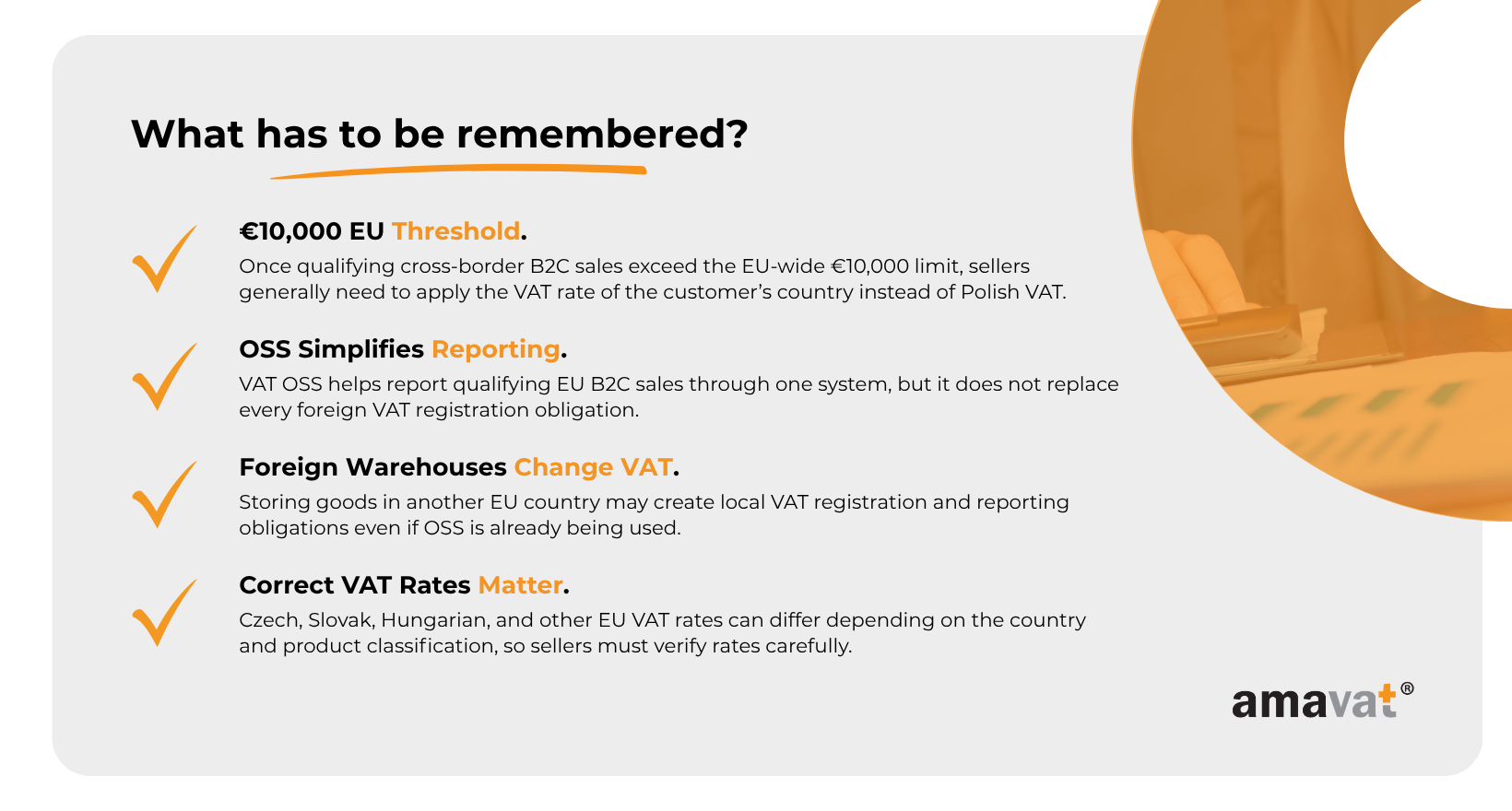
However, once products begin moving regularly between EU countries, VAT obligations often start changing automatically. Crossing the EU-wide €10,000 distance-selling threshold may require sellers to apply foreign VAT rates instead of Polish VAT. Many businesses use the VAT One Stop Shop system, commonly called OSS, to report foreign VAT without registering separately in every EU country, although OSS does not eliminate all registration requirements. Sellers who store inventory abroad, use foreign fulfillment warehouses, or perform local taxable activities may still need separate VAT registrations in those countries. In specific scenarios defined under EU marketplace VAT rules, some VAT responsibilities may also shift between the seller and the platform itself. These are no longer rare edge cases affecting only large corporations. They are becoming part of normal day-to-day operations for modern e-commerce businesses selling across multiple EU markets.

How VAT Works on Cross-Border Sales on Allegro
The Core VAT Principle: Where Are the Goods Shipped From, and Who Is the Buyer?
When sellers first start expanding internationally on Allegro, many assume VAT depends mainly on the country where the order was placed. In reality, the rules are based on several connected factors working together. Tax authorities look at where the seller is established, where the goods are physically shipped from, where the customer is located, and whether the transaction is B2B or B2C. These details determine which VAT system applies, which country has taxing rights over the sale, and whether the seller can use simplifications such as VAT OSS. This is why two sellers operating on the same Allegro marketplace can still have completely different VAT obligations depending on how their logistics and sales structure work in practice.
For EU-established businesses, the general obligation is relatively straightforward in theory: if the sale is taxable in the European Union, the seller is responsible for calculating, declaring, and paying VAT correctly. The complexity appears once sales start crossing borders regularly. A Polish seller shipping products from Poland to private customers in Czechia, Slovakia, or Hungary may initially continue applying Polish VAT rules, but only under specific conditions. Once the EU-wide €10,000 net threshold for cross-border B2C distance sales is exceeded, or once the seller voluntarily opts for destination-country taxation, the seller generally needs to apply the VAT rate of the customer’s country and report those sales either through OSS or, where OSS is not available, through local VAT registration. This threshold applies collectively across EU countries rather than separately for each market and is commonly referenced in Poland as approximately PLN 42,000.
Domestic Sales, Cross-Border Sales, and Why OSS Does Not Cover Everything
Domestic sales are usually the easiest situation from a VAT perspective. If a Polish business stores goods in Poland and sells them to customers in Poland, the transaction is generally settled entirely under Polish VAT rules. The same principle applies in other EU countries where the seller is established and dispatches products locally. Most smaller e-commerce businesses begin operating within this simpler model before expanding internationally through marketplaces like Allegro. Once orders start moving between EU countries, however, the VAT treatment changes significantly because the transaction may fall under EU distance-selling rules instead of ordinary domestic taxation.
Cross-border B2C sales within the EU are now largely governed by the distance-selling framework introduced through the EU e-commerce VAT package. For qualifying sales above the €10,000 threshold, sellers generally need to apply the VAT rates of the customer’s country rather than the VAT rate of their home country. In practice, this means a Polish seller shipping goods to consumers in Czechia or Slovakia may need to charge Czech or Slovak VAT rates instead of Polish VAT. Many businesses use the VAT OSS system to simplify reporting and avoid separate VAT registrations in every EU country where customers are located. However, OSS mainly applies to qualifying B2C distance sales and does not replace all foreign VAT obligations. If a seller stores stock in another EU country, performs local sales there, or transfers inventory between warehouses, separate local VAT registration may still be required. B2B transactions also follow different rules and are generally outside the OSS system, which is why sellers expanding internationally need to distinguish carefully between consumer sales, business sales, and local warehouse operations from the very beginning.
The €10,000 EU Distance Selling Threshold Explained
What Changed in July 2021?
One of the biggest VAT changes for European e-commerce sellers arrived on 1 July 2021, when the EU introduced a completely new system for cross-border B2C sales. Before that date, each EU country had its own separate distance-selling threshold. A Polish seller shipping products abroad needed to monitor different limits individually for Germany, Czechia, France, Hungary, and every other destination country. In practice, this created a confusing structure where sellers could remain below the threshold in one country while already exceeding it in another. For smaller online businesses trying to scale internationally, managing several national thresholds at once was difficult, time-consuming, and often unclear from a reporting perspective.
The 2021 reform replaced those separate national limits with one common EU-wide threshold of €10,000 for qualifying cross-border B2C sales and certain digital services. Under EU VAT rules, these transactions are generally classified as intra-EU distance sales of goods, commonly referred to as WSTO. The legal threshold is fixed at €10,000 across the European Union, although in Poland it is commonly referenced as approximately PLN 42,000. Most importantly, the threshold applies collectively to total qualifying cross-border B2C sales within the EU rather than separately for each country. This means sellers do not receive a separate €10,000 limit for Czechia, another for Slovakia, and another for Hungary. Once the total value of qualifying cross-border B2C sales exceeds the EU-wide €10,000 net threshold during the current or previous calendar year, destination-country VAT generally applies from the transaction that caused the threshold to be crossed.

What Happens Below and Above the €10,000 Threshold?
If a Polish seller remains below the €10,000 threshold and has not voluntarily opted into destination-country taxation, qualifying cross-border B2C sales may generally continue to be settled under Polish VAT rules. For many smaller businesses beginning international expansion, this simplifies accounting considerably because foreign VAT rates do not yet need to be applied. A seller dispatching products from Poland to consumers in Czechia through allegro.cz, for example, may continue charging Polish VAT while total qualifying EU cross-border B2C turnover remains below the threshold. The same principle applies to sales into Slovakia, Hungary, and other EU countries as long as the combined EU-wide limit is not exceeded.
The situation changes once the threshold is crossed. From the transaction that causes the threshold to be exceeded, qualifying B2C distance sales generally become taxable in the customer’s country, often referred to in EU VAT terminology as the Member State of consumption. This means the seller usually needs to apply the VAT rate applicable in the buyer’s country instead of the VAT rate from their home country. In practice, a Polish business shipping products to consumers in Czechia may need to charge Czech VAT, while sales to Hungary may require Hungarian VAT rates. Many businesses use the VAT OSS system to reduce the need for separate VAT registrations in multiple EU countries and simplify reporting for qualifying B2C distance sales. However, OSS does not eliminate all foreign VAT obligations. Sellers storing stock abroad, using foreign fulfillment warehouses, or carrying out local taxable activities may still need separate VAT registrations in those countries.
Does the €10,000 VAT Threshold Apply Separately to Each Country?
No. This is one of the most common misunderstandings among newer marketplace sellers expanding internationally for the first time. The €10,000 threshold is not calculated separately for each EU country. Instead, it applies to the combined total value of all qualifying cross-border B2C distance sales made within the European Union during the current or previous calendar year. Sales to Czechia, Slovakia, Hungary, Germany, and other EU countries are all added together into one shared threshold calculation.
For example, a Polish Allegro seller might generate €4,000 in B2C sales to Czechia, €3,000 to Slovakia, and €4,000 to Hungary. Even though none of those countries individually exceeds €10,000, the combined total already reaches €11,000, meaning the EU-wide threshold has been exceeded. From the transaction that crosses the threshold onward, qualifying sales generally need to be taxed using the VAT rates applicable in the customer’s country. This is one reason many e-commerce businesses unexpectedly enter foreign VAT reporting obligations sooner than expected, especially when international growth starts happening simultaneously across several Allegro marketplaces rather than within one country alone.
VAT OSS – The Simplest Way to Handle Cross-Border VAT
What Is VAT OSS?
For many smaller e-commerce businesses, VAT OSS is the system that makes cross-border EU selling realistically manageable. Before OSS was introduced in July 2021, sellers often needed to monitor separate distance-selling thresholds in different EU countries and register locally once those limits were exceeded. A growing Allegro seller shipping products to Czechia, Slovakia, Hungary, or Germany could quickly end up dealing with multiple foreign tax offices, separate VAT returns, different filing deadlines, and administrative procedures in several jurisdictions at the same time. The OSS system, which stands for One Stop Shop, was introduced to simplify that process and reduce the administrative burden connected with intra-EU consumer sales.
Most EU-based Allegro sellers use the Union OSS scheme, which allows businesses to report qualifying cross-border B2C sales through one centralized VAT declaration submitted in their home country instead of maintaining separate VAT registrations for qualifying B2C distance sales in each destination country. Using OSS is generally optional, but many sellers choose it because it significantly simplifies EU VAT reporting once cross-border sales volumes begin increasing. For Polish businesses, this usually means filing one quarterly OSS declaration in Poland while applying the VAT rates of the customer’s country. A seller dispatching products from Poland to consumers in Czechia or Hungary, for example, can generally report those sales through the Polish OSS system rather than filing separate consumer VAT declarations in every country where buyers are located.
How to Register for VAT OSS in Poland
For businesses established in Poland, registration for VAT OSS is handled electronically through the Polish e-Tax Office system. The registration itself is completed using the VIU-R form, which formally notifies the tax authorities that the business intends to use the OSS procedure for qualifying cross-border B2C sales within the European Union. In Poland, OSS administration is handled centrally by the Second Tax Office Warsaw-Śródmieście, which manages OSS registrations and declarations for taxpayers using the system. Although the registration process itself is relatively straightforward, sellers still need to make sure their accounting, invoicing, and reporting systems are prepared for foreign VAT settlements before they begin using OSS in practice.
One of the most important things to understand is that OSS changes the reporting mechanism, but it does not remove the obligation to apply the correct VAT rates. Sellers using OSS still need to charge the VAT rate applicable in the customer’s country, which means Czech VAT may apply to sales into Czechia, Slovak VAT to sales into Slovakia, and Hungarian VAT to sales into Hungary. After registration, OSS declarations are submitted quarterly and include a breakdown of cross-border B2C sales by destination country together with the VAT amounts owed in each jurisdiction. The Polish tax authorities then distribute the collected VAT to the appropriate EU member states through the OSS framework. Businesses using OSS must also maintain detailed transaction records for EU VAT purposes, and these records generally need to be retained for ten years.
What OSS Does NOT Cover
One of the biggest misconceptions surrounding VAT OSS is the idea that it completely eliminates foreign VAT obligations inside the European Union. In reality, OSS is a simplification mechanism designed mainly for qualifying B2C cross-border distance sales. It does not replace every type of VAT registration or reporting obligation that an e-commerce seller may encounter while expanding internationally. This distinction is extremely important because many marketplace sellers incorrectly assume that registering for OSS automatically resolves all EU VAT issues, which is usually not the case once warehousing structures, inventory transfers, or local operations become more complex.
OSS generally does not apply to B2B transactions, local domestic sales within another EU country, or situations where goods are stored in another EU country before sale or dispatch. For example, if a Polish seller stores inventory in a Czech warehouse and ships products locally to Czech consumers from that warehouse, those sales are no longer treated as ordinary cross-border distance sales from Poland. In practice, this usually creates a separate Czech VAT registration obligation regardless of whether the seller already uses OSS in Poland. The same principle often applies to stock transfers between warehouses located in different EU countries, which may trigger additional VAT reporting obligations connected with inventory movements. OSS simplifies qualifying B2C distance-selling reporting, but it does not replace local VAT obligations connected with warehousing, domestic supplies, stock transfers, or most business-to-business transactions.
Storing Goods Abroad – When OSS Is Not Enough
Why Warehousing Creates Additional VAT Obligations
For many e-commerce businesses, international expansion eventually leads to a practical logistics decision: storing products closer to foreign customers. Faster delivery times, lower shipping costs, and easier returns management make foreign fulfillment centers increasingly attractive, especially for sellers scaling across several EU markets at once. A Polish Allegro seller targeting buyers in Czechia, Slovakia, or Hungary may eventually decide to move part of their inventory into a warehouse located outside Poland in order to speed up local dispatch. From a business perspective, this often makes complete sense operationally. From a VAT perspective, however, it changes the transaction structure significantly.
Once goods are stored in another EU country before sale or dispatch, sales from that stock may become local domestic supplies in the country where the goods are stored, while movements of goods into that warehouse may also need to be reported as intra-EU stock transfers. This is one of the most important distinctions marketplace sellers need to understand because OSS does not replace VAT registration obligations connected with foreign warehousing. If a Polish seller stores inventory in Czechia and ships orders locally to Czech consumers from that Czech warehouse, those sales are no longer treated as standard cross-border dispatches from Poland. In most cases, the seller will need a separate Czech VAT registration and will have to comply with Czech VAT reporting requirements regardless of whether OSS is already used in Poland for other qualifying distance sales.
This situation becomes even more important once businesses begin using larger fulfillment networks or multi-country logistics providers. Some sellers move inventory between warehouses in several EU countries automatically depending on customer demand and stock availability. Others use third-party fulfillment services that redistribute inventory internally across borders. Even when these transfers happen within the same business structure, they may still create VAT reporting obligations connected with stock movements between EU member states. For smaller businesses that started with relatively simple domestic sales, this is often the point where VAT compliance becomes significantly more technical and requires much closer coordination between logistics operations and accounting processes.

Special VAT Schemes and Exceptions
Not every product category follows standard VAT treatment rules in the same way. Certain goods may qualify for special VAT schemes that operate differently from ordinary retail sales, especially when second-hand products or collectible items are involved. One of the best-known examples is the VAT margin scheme, which can apply to specific categories such as used goods, antiques, collectibles, and works of art. Under this mechanism, VAT is generally calculated only on the seller’s profit margin rather than on the full sales value of the item. For businesses operating in resale markets, vintage goods, or collectible categories, this can significantly affect how VAT settlements are calculated and reported.
These special schemes become particularly important when products move across borders or are sold through marketplaces operating in multiple EU countries. A seller dealing in used electronics, collectible trading cards, antiques, or artwork may face additional classification and reporting considerations compared to businesses selling ordinary new consumer goods. In practice, this means sellers should be careful not to assume that standard OSS or WSTO rules automatically apply to every type of product in exactly the same way. Sellers using special VAT schemes, such as the margin scheme, should confirm whether the scheme can be applied in the relevant country and how those sales should be reported before storing goods abroad or selling locally through a marketplace.
VAT Rules for Non-EU Sellers on Allegro
How VAT Works for Sellers Outside the EU
For businesses established outside the European Union, selling through Allegro involves a different VAT framework than the one used by EU-based sellers. The rules become more complex because imports into the EU create additional customs and VAT obligations that do not apply to ordinary intra-EU sales. In practice, tax treatment depends heavily on where the goods are physically located at the moment of sale, where they are dispatched from, and whether the marketplace is considered responsible for collecting VAT under EU marketplace regulations. For non-EU sellers using Allegro, understanding these distinctions is extremely important because the platform may become involved in VAT collection in some situations, while in others the responsibility remains with the seller or even with the customer receiving the goods.
Under EU e-commerce VAT rules introduced in 2021, marketplaces such as Allegro can become so-called deemed suppliers in specific transaction types involving non-EU sellers. This generally applies when marketplaces facilitate sales by non-EU sellers of goods already located within the EU, or certain imported consignments with an intrinsic value not exceeding €150. In these situations, the marketplace may become responsible for collecting and reporting VAT on qualifying sales. However, this does not happen automatically for every transaction involving a non-EU business. Depending on the sales structure, import VAT may still need to be paid by the buyer when goods enter the EU, especially if the shipment is processed through standard customs procedures rather than simplified marketplace mechanisms.
Because of this, accurate dispatch-country information becomes extremely important for non-EU sellers operating on Allegro. Sellers shipping goods from multiple warehouses or fulfillment centers need to ensure that the correct country of dispatch is reflected in their listings and transaction data. The VAT treatment may differ significantly depending on whether goods are shipped directly from outside the EU or dispatched from inventory already stored within an EU member state. Incorrect dispatch information can create reporting inconsistencies, customs complications, or VAT calculation errors that become difficult to correct later, particularly once sales volumes increase across several European markets simultaneously.
Why IOSS Matters
One of the most important systems introduced under the EU e-commerce VAT reform is the Import One Stop Shop, commonly known as IOSS. This mechanism was designed to simplify VAT collection for imported goods shipped from outside the European Union directly to EU consumers in consignments with an intrinsic value not exceeding €150. Before these reforms, low-value imports below €22 often benefited from VAT exemptions that created uneven competition between EU and non-EU sellers. Since 1 July 2021, those exemptions have been removed, which means imported goods entering the EU are now generally subject to VAT regardless of value.
Under IOSS, VAT can be collected at checkout and reported centrally for imported B2C consignments with an intrinsic value not exceeding €150. However, Allegro states that it has not registered for IOSS and does not settle VAT on imported goods, regardless of transaction value. As a result, non-EU sellers using Allegro may need alternative import VAT compliance arrangements, and in some cases import VAT may be collected from the buyer during customs clearance. IOSS simplifies import VAT collection, but it does not remove customs declarations or other import formalities. From 1 July 2026, the EU also abolished the customs duty exemption for consignments valued at €150 or less imported from outside the EU. A temporary flat-rate customs duty of €3 per item now applies to all such shipments in addition to VAT, until 1 July 2028. Non-EU sellers and platforms using IOSS should ensure their pricing and customer communications reflect this additional cost.
For smaller non-EU businesses entering European marketplaces for the first time, these rules can feel considerably more complex than standard domestic e-commerce operations. The challenge is not only understanding VAT itself, but also coordinating customs procedures, import declarations, dispatch-country reporting, and marketplace obligations simultaneously. As cross-border e-commerce continues growing inside the EU, non-EU sellers increasingly need to treat VAT and customs planning as a core operational issue rather than something handled only after sales begin scaling internationally.
When Do You Need VAT Registration in Poland?
The PLN 200,000 Threshold
Before sellers begin thinking about OSS, foreign VAT rates, or cross-border reporting obligations, they first need to determine whether standard VAT registration in Poland is required at all. For many smaller e-commerce businesses, this is the starting point of the entire VAT process. Under Polish VAT rules, businesses generally become required to register as VAT taxpayers once their annual taxable turnover exceeds PLN 240,000 (threshold raised from PLN 200,000 as of 1 January 2026). This threshold applies to the total value of taxable sales during the year and is based on turnover rather than profit. In practice, this means the amount customers pay for goods matters for VAT purposes, not the seller’s actual earnings after advertising costs, shipping expenses, marketplace commissions, or inventory purchases are deducted.
For businesses starting operations during the year, the PLN 200,000 exemption threshold is calculated proportionally based on the number of days remaining in the tax year rather than applied in full automatically. This is particularly relevant for new Allegro sellers launching their business in the middle of the year and expecting rapid sales growth during seasonal periods. Certain exempt activities may also be excluded from the turnover calculation, which means VAT registration thresholds are not always as straightforward as many first-time entrepreneurs assume. Because of this, sellers planning international expansion or expecting quickly increasing marketplace turnover usually benefit from monitoring their VAT position continuously instead of treating registration as something that only becomes relevant after strong growth has already happened.
Once the threshold is exceeded, the seller generally needs to complete VAT-R registration in Poland and begin settling VAT according to the standard rules applicable to registered taxpayers. For Polish businesses, many cross-border VAT procedures — including Union OSS participation — are usually connected with standard VAT registration. Some e-commerce sellers also choose voluntary VAT registration before reaching the threshold, especially when planning international expansion, purchasing larger amounts of inventory, deducting input VAT on business expenses, or preparing for cross-border marketplace activity. In practice, voluntary VAT registration is relatively common among growing online businesses because it often becomes operationally useful long before the legal threshold is formally exceeded.
Categories That Require Immediate VAT Registration
Although the PLN 200,000 threshold is the standard rule for many businesses in Poland, some activities and categories of goods are excluded from the small-business VAT exemption and may require VAT registration from the beginning of business activity. This is particularly important for marketplace sellers because the exemption rules are based on specific legal classifications rather than broad commercial product categories. In practice, this means some businesses may need VAT registration even with relatively low turnover if they sell goods covered by exclusions defined under Polish VAT regulations.
Examples may include certain excise goods, perfumes, precious-metal products, and selected categories of electronics specified under Polish VAT regulations. These areas are often subject to stricter VAT treatment because they are considered more sensitive from a tax-control perspective or connected with industries that historically created higher compliance risks. However, the exact obligations depend on the specific product classification, the structure of the transaction, and the legal definitions applied under VAT law. Not all electronics automatically eliminate the exemption, and sellers should avoid assuming that broad product descriptions alone determine VAT status without checking the detailed rules applicable to their goods.
For younger entrepreneurs entering e-commerce for the first time, this distinction can be surprisingly important because many assume VAT registration becomes relevant only after revenue starts growing significantly. In reality, product category can sometimes affect VAT obligations almost as much as turnover itself. Two Allegro sellers generating similar sales volumes may face completely different VAT registration requirements depending on what they sell and how their business activity is classified. This is one reason why businesses planning to scale internationally should review VAT treatment early, especially before expanding inventory, opening foreign marketplace channels, or increasing advertising budgets aggressively. Correct VAT registration from the beginning is usually much easier than correcting reporting structures later, particularly once cross-border sales and foreign VAT obligations become part of everyday operations.
Selling Through allegro.cz, allegro.sk, and allegro.hu
What Changes When Selling on Foreign Allegro Platforms?
From a marketplace perspective, selling through allegro.cz, allegro.sk, or allegro.hu may feel like a natural extension of an existing Allegro business. The platform structure remains familiar, listings can often be adapted from the Polish marketplace, and international logistics are far easier to organize today than they were a few years ago. From a VAT perspective, however, selling through a foreign Allegro platform does not automatically decide the VAT treatment by itself. The key questions are still where the goods are shipped from, where the buyer is located, whether the buyer is a consumer or a business, whether the EU-wide €10,000 threshold has been exceeded, and whether the seller uses OSS or needs local VAT registration.
For Polish sellers making qualifying cross-border B2C distance sales, the biggest change comes after the €10,000 EU-wide threshold is exceeded, or after the seller voluntarily opts into destination-country taxation. At that point, sellers generally need to apply the VAT rate of the customer’s country instead of continuing to use Polish VAT. In practice, sales to consumers in Czechia may require Czech VAT, sales to Slovakia may require Slovak VAT, and sales to Hungary may require Hungarian VAT. Current standard VAT rates should be checked before publication, but commonly referenced standard rates are Czechia 21%, Slovakia 23%, and Hungary 27%. Reduced rates, however, differ by country and depend on the exact product category.
This is where cross-border selling becomes more than simply translating listings or enabling delivery to another country. VAT classifications and reduced-rate categories are not fully harmonized across the European Union, so a product that receives one VAT treatment in Poland may be treated differently in Czechia, Slovakia, or Hungary. Even when sellers use OSS to simplify reporting, they still need to apply the correct destination-country VAT rate. For growing e-commerce businesses, this means Czech VAT, Slovak VAT, and Hungarian VAT may all need to be handled correctly across product listings, invoices, marketplace data, and VAT reports.
Why CN Codes Matter
One of the most important tools used in cross-border trade is the CN code, short for Combined Nomenclature code. These codes help classify goods across the European Union and are especially important for customs, trade statistics, and product identification. They can also be an important starting point for determining VAT treatment, particularly where reduced VAT rates may apply. However, the final VAT rate is not always determined by the CN code alone. Sellers should also check the destination country’s VAT rules, product definitions, intended use, and any local conditions attached to reduced rates.
For Allegro sellers expanding into Czechia, Slovakia, or Hungary, correct product classification becomes increasingly important once foreign VAT rates need to be applied. Incorrect classification may lead to charging the wrong VAT rate, creating underpayments, reporting inconsistencies, or correction obligations later. This risk is especially relevant for categories such as books, selected food products, medical products, and other goods specifically covered by local reduced-rate rules. Because each country applies its own VAT rules within the EU framework, the same product may require different treatment depending on the destination market.
For practical reasons, many international sellers create internal VAT classification tables before scaling aggressively into additional EU markets. A simple table showing sample VAT rates by country and product category can make the differences much easier to manage, especially for businesses with larger catalogs. While VAT classification may sound like a technical accounting issue, it quickly becomes part of everyday operations once a business sells through several Allegro marketplaces at the same time.

Invoicing Rules Under VAT OSS
Do You Need to Issue Invoices?
One of the practical advantages of the VAT OSS system is that invoicing obligations for qualifying cross-border B2C sales can be simpler than many sellers initially expect. Under the OSS framework, invoicing obligations for qualifying B2C distance sales are generally simplified and often follow the invoicing rules of the seller’s Member State of identification. For Polish businesses using OSS, this usually means looking first at Polish invoicing rules rather than trying to build a separate invoicing process for every destination country. This is one reason why OSS can be so useful for smaller e-commerce businesses selling across several EU markets at the same time.
At the same time, many businesses still choose to issue invoices voluntarily, even when they are not strictly required. For Allegro sellers, invoices can be useful for accounting organization, customer service, internal reporting, and transaction transparency. When invoices are issued for qualifying sales settled through OSS, sellers generally need to apply the VAT rate of the destination country rather than the VAT rate from their home country. In practice, an invoice for a qualifying sale to a Czech consumer may need to show Czech VAT, while a sale to Slovakia or Hungary may require the relevant local VAT rate. These simplifications mainly apply to qualifying B2C distance sales settled through OSS and do not necessarily apply to B2B transactions.
Another important simplification connected with OSS involves cash register obligations. Under Polish VAT practice, qualifying deliveries of goods settled through VAT OSS may qualify for exemptions from some standard Polish cash-register recording obligations that would otherwise apply to domestic retail sales. However, this should not be treated as a complete exemption from documentation duties. Businesses still need to maintain accurate sales records, apply the correct destination-country VAT rates, and ensure that OSS reporting remains consistent with marketplace data, payment records, and accounting documentation. Businesses using OSS must also retain detailed transaction records for VAT purposes for up to 10 years.
Upcoming VAT Changes in 2027
What Sellers Should Prepare For
The current OSS rules are not permanent, and sellers should prepare early for the next stage of EU VAT reform. The ViDA package was formally adopted on 11 March 2025 and is now EU law. Several of its reforms are scheduled to affect e-commerce sellers in stages: OSS clarifications take effect from 1 January 2027; deemed supplier rules for accommodation and transport platforms apply from 1 July 2028 (with Member States able to delay until 1 January 2030); Single VAT Registration reforms including OSS extension to own-goods movements also begin from 1 July 2028; and mandatory Digital Reporting Requirements for cross-border B2B transactions apply from 1 July 2030. The general direction is already becoming clear: the EU wants fewer separate VAT registrations, more centralized reporting systems, stronger platform responsibilities, and more digital VAT administration across member states. Some of these reforms are connected with the expansion of OSS-related mechanisms and the wider concept of Single VAT Registration, which aims to reduce situations where businesses need multiple separate VAT registrations across different EU countries.
For Allegro sellers, the practical impact is likely to become increasingly visible as cross-border marketplace sales continue growing inside the European Union. One area receiving particular attention is the treatment of marketplace-facilitated sales and destination-based taxation. Today, sellers usually monitor the EU-wide €10,000 threshold for qualifying cross-border B2C sales and then use OSS once destination-country VAT begins applying. Future reforms are expected to continue moving toward broader destination-country taxation together with clearer marketplace responsibility for certain types of transactions. Depending on the structure of the sale, the seller’s location, the location of inventory, and whether the transaction qualifies as marketplace-facilitated under EU VAT rules, VAT liability may increasingly shift between the seller and the platform itself.
At the same time, the exact implementation timeline and practical scope may still evolve as EU member states finalize national implementation rules. Because of this, sellers should avoid treating current VAT procedures as something fixed permanently for the future. VAT compliance across the EU is gradually moving toward more digital, destination-based, and marketplace-connected reporting structures, which means businesses expanding internationally through Allegro will likely face increasing reporting standardization over time. For smaller e-commerce brands, the safest approach is to start building clean VAT processes early rather than waiting until new obligations become mandatory.
In practice, this means keeping organized country-by-country sales records, monitoring where inventory is physically stored, separating B2B and B2C transactions correctly, and ensuring that marketplace data matches accounting and VAT reporting systems. Even though the precise details of future reforms may continue evolving over the coming years, the broader direction of EU VAT policy is already visible. Sellers expanding across allegro.cz, allegro.sk, allegro.hu, and other EU marketplaces should treat VAT compliance as a long-term operational system rather than a temporary administrative task handled only when problems appear.
Practical VAT Checklist for Allegro Sellers
What Should Allegro Sellers Actually Check Before Expanding Internationally?
After going through all the VAT rules connected with OSS, foreign marketplaces, warehousing, and cross-border reporting, many sellers eventually end up asking the same practical question: what should actually be checked before scaling sales internationally through Allegro? In reality, most VAT obligations can be traced back to a relatively small number of operational triggers. The difficulty is not usually understanding one isolated rule, but recognizing when a growing business has quietly moved into a completely different VAT situation without noticing it immediately.
For sellers making qualifying B2C cross-border sales within the EU while remaining below the €10,000 threshold, the process is usually still relatively simple. In many cases, Polish VAT can continue to apply as long as the seller has not voluntarily opted into destination-country taxation and the sales qualify under the standard distance-selling rules. However, once cross-border consumer turnover exceeds the EU-wide threshold, destination-country VAT generally begins applying to qualifying sales, which is why many businesses move into the OSS system at that stage. Some businesses also voluntarily register for VAT before reaching the Polish threshold, especially when planning OSS registration, deducting input VAT, or expanding internationally.
Another major trigger appears when inventory is stored outside Poland. As soon as goods are placed in a warehouse located in another EU country, sellers should carefully review whether local VAT registration becomes necessary there. This applies not only to large fulfillment programs, but also to smaller warehousing arrangements designed to improve delivery times for foreign customers. Many businesses incorrectly assume that OSS automatically covers foreign stock situations, even though local warehousing often creates separate domestic VAT obligations in the country where the goods are stored. Sellers should also maintain clear country-by-country sales records and warehouse movement documentation from the beginning of international expansion.
Polish sellers should also continuously monitor their domestic VAT position. Once annual taxable turnover exceeds PLN 240,000, standard VAT registration in Poland generally becomes mandatory (threshold raised from PLN 200,000 as of 1 January 2026) and requires VAT-R registration. For businesses starting during the year, this threshold is calculated proportionally. Some businesses may also need VAT registration earlier because certain product categories are excluded from the standard exemption system. This can apply to selected regulated or higher-risk categories defined under Polish VAT regulations, including some excise goods, perfumes, precious-metal products, and selected categories of electronics defined under Polish VAT regulations. VAT obligations rarely appear all at once. They usually grow gradually together with sales scale, logistics complexity, and international expansion.
Common VAT Mistakes Allegro Sellers Make
Mixing OSS With Local Warehouse Sales
One of the most common VAT mistakes among growing Allegro sellers is assuming that OSS automatically covers every type of international transaction inside the European Union. In reality, OSS mainly simplifies reporting for qualifying cross-border B2C distance sales and does not replace local VAT obligations connected with foreign warehousing. Problems usually begin when sellers expand logistics operations without realizing that the movement and storage of goods can completely change the VAT treatment of later sales. A business may start with ordinary Polish-to-Czech distance sales settled through OSS, then move inventory into a Czech fulfillment center for faster delivery, while still incorrectly reporting those sales through the same structure.
Once stock is stored in another EU country before sale or dispatch, transactions from that warehouse may become local domestic supplies in the country where the goods are located. In practice, this often creates a separate local VAT registration obligation regardless of whether the seller already uses OSS in Poland. Cross-border stock transfers between warehouses may also create separate WDT and WNT reporting obligations even when there is no direct customer sale involved. The mistake usually does not come from intentionally avoiding VAT, but from assuming that marketplace expansion, logistics growth, and OSS registration all function together automatically. For many smaller businesses, warehouse-related VAT issues only become visible once accounting reviews, foreign tax correspondence, or marketplace compliance reviews begin highlighting inconsistencies between inventory location and VAT reporting.
Ignoring Foreign VAT Rates
Another frequent problem appears when sellers understand that destination-country taxation applies but continue using Polish VAT rates for foreign consumer sales anyway. This often happens during rapid growth periods when businesses focus heavily on logistics, advertising, and international expansion while VAT settings inside accounting systems or marketplace integrations remain unchanged. Once the EU-wide €10,000 threshold for qualifying cross-border B2C sales is exceeded during the current or previous calendar year, sellers generally need to apply the VAT rate applicable in the customer’s country rather than continuing to use Polish VAT for qualifying sales. Even relatively small rate differences can create reporting discrepancies once transaction volumes become larger.
This issue becomes particularly important when businesses sell across several Allegro marketplaces simultaneously. Czech VAT, Slovak VAT, and Hungarian VAT may all apply to different transactions depending on where customers are located. Reduced VAT rates can also differ significantly between countries for specific product categories. Sellers sometimes assume that because all transactions happen within the EU, VAT treatment will remain mostly standardized across markets. In practice, however, destination-country VAT systems still contain important differences, especially for goods qualifying for reduced rates or special classifications. Incorrect VAT rates may eventually lead to underpayments, corrections, administrative penalties, or complicated retroactive accounting adjustments.
Misclassifying Products
Product classification is another area where marketplace sellers often underestimate VAT complexity until problems appear later. Many businesses focus primarily on product descriptions designed for customers and marketing, while VAT systems rely on legal product classifications that may follow completely different logic. CN codes, customs classifications, and local VAT definitions become increasingly important once sellers operate across multiple EU countries because the correct VAT treatment often depends on how products are officially classified under customs and VAT rules rather than how they are advertised commercially.
The risks become larger when reduced VAT rates are involved. A seller may assume that a product qualifies for a lower VAT rate in another country simply because a similar category receives reduced treatment in Poland. In reality, reduced-rate rules differ between EU member states and may depend on highly specific legal definitions. Categories such as books, selected food products, medical products, and other specially regulated goods often require much more careful classification review than standard consumer products. Misclassification may create VAT underpayments even when the seller acted in good faith, especially once foreign tax authorities compare invoices, marketplace listings, customs classifications, and OSS reporting data.
Forgetting the €10,000 Threshold
Many newer e-commerce businesses initially treat international sales as a small side extension of domestic operations and therefore pay little attention to the €10,000 EU-wide threshold for qualifying cross-border B2C sales. The problem is that the threshold applies collectively across EU countries rather than separately to each market. A seller may remain relatively small in Czechia, Slovakia, and Hungary individually while still exceeding the combined EU threshold much sooner than expected once all foreign sales are added together.
This issue becomes especially common for businesses scaling gradually across several smaller markets at once. Because no single country appears dominant in the sales structure, sellers sometimes assume foreign VAT obligations are still far away operationally. In reality, qualifying B2C turnover across all EU destination countries counts toward the same threshold calculation. Once the threshold is exceeded during the current or previous calendar year, destination-country VAT generally begins applying from the transaction that caused the threshold to be crossed. Businesses that monitor international turnover only occasionally often discover this change too late, forcing them to correct VAT settlements retroactively after substantial numbers of transactions have already been completed.
Assuming OSS Covers B2B Transactions
Another widespread misunderstanding is the assumption that OSS applies to every type of international sale inside the European Union, including B2B transactions. In reality, OSS is mainly designed for qualifying B2C distance sales and certain services. Ordinary intra-EU B2B transactions usually follow completely different VAT mechanisms involving reverse charge procedures, intra-Community supply rules, EC Sales List reporting, and separate documentation requirements. Sellers who fail to distinguish properly between consumer and business transactions may unintentionally apply incorrect VAT treatment to entire groups of orders.
This problem often appears when marketplace businesses begin receiving more orders from companies, wholesalers, or professional buyers located in other EU countries. From an operational perspective, these transactions may look very similar to ordinary consumer sales inside Allegro systems, especially if automated invoicing and marketplace integrations are involved. However, the VAT treatment may differ substantially depending on the buyer’s VAT status and the structure of the transaction. Businesses expanding internationally usually benefit from separating B2B and B2C reporting logic early rather than trying to untangle mixed transaction structures later once sales volumes become more difficult to review manually. Businesses should also retain clear transaction and warehouse records for VAT purposes, particularly when using OSS across multiple EU markets.

Conclusion
Selling internationally through Allegro is becoming increasingly accessible for smaller e-commerce businesses across Europe. Expanding into Czechia, Slovakia, Hungary, and other EU markets no longer requires building separate stores, negotiating local marketplace access, or creating independent logistics systems from scratch. At the same time, however, VAT obligations grow together with international expansion. What begins as relatively simple domestic selling can gradually evolve into a much more complex structure involving destination-country VAT rates, OSS reporting, foreign warehouse registrations, stock-transfer reporting, and different VAT treatments for B2B and B2C transactions.
For many sellers, VAT OSS becomes one of the most useful tools for managing cross-border EU sales because it simplifies reporting for qualifying B2C distance sales and reduces the need for multiple separate VAT registrations. However, OSS does not solve every compliance issue automatically. Once inventory is stored abroad, local VAT obligations may still arise regardless of whether OSS is already being used. The same applies when businesses begin handling more advanced logistics structures, selling regulated product categories, or operating across several EU marketplaces simultaneously. This is why understanding where goods are stored, where they are shipped from, and which country’s VAT rules apply becomes just as important as understanding sales performance itself.
Another key lesson for growing Allegro sellers is that VAT problems rarely appear suddenly. Most compliance issues develop gradually as turnover increases, foreign sales expand, and logistics become more international over time. Sellers who monitor thresholds continuously, keep accurate transaction records, review VAT classifications carefully, and separate B2B from B2C reporting early usually avoid the most expensive mistakes later. In practice, VAT compliance becomes much easier when it grows together with the business instead of being treated as a problem to solve only after international expansion has already accelerated.
Before expanding to allegro.cz, allegro.sk, or allegro.hu, make sure your VAT setup is compliant.