VAT on eBay in Europe: How to Report Cross-Border Sales Without Errors
Spis treści
For many young entrepreneurs running ecommerce businesses, VAT is no longer just an accounting issue handled once a quarter by a bookkeeper. It has become something that directly affects pricing, shipping processes, marketplace settings, profit margins, and even whether listings remain compliant on platforms like eBay. A seller based in Poland, Germany, Spain, or France can now sell to customers across the entire EU almost instantly, but that convenience comes with obligations that are easy to misunderstand. One of the biggest challenges is that eBay sometimes collects VAT itself under marketplace facilitator rules, while in other situations the seller remains fully responsible for charging and reporting the tax. If sellers fail to recognize the difference between those scenarios, reporting errors can quickly appear in VAT returns and OSS filings.
Incorrect VAT reporting creates problems that are often more expensive than many small businesses initially expect. One common issue is double taxation, where VAT gets charged twice because the seller and the marketplace both treat themselves as responsible for the same transaction. This can happen especially with imported goods when IOSS information is missing or not correctly transmitted during customs processing. Another major risk is underpaid VAT, particularly when sellers continue applying their domestic VAT rate after exceeding the EU-wide €10,000 cross-border threshold. Since VAT rates vary between EU countries, using the wrong rate can result in unpaid tax liabilities that accumulate quietly over time until discovered during an audit or compliance review.
Marketplace penalties are also becoming more common as platforms tighten compliance procedures. eBay and other marketplaces increasingly request VAT numbers, OSS confirmations, and seller tax information to meet their own legal obligations within the EU. In some cases, listings may become restricted or removed if tax settings are incomplete or inconsistent. Sellers who expand quickly into multiple EU markets without properly configuring VAT settings often discover these issues only after operational problems appear on their account. At the same time, OSS reporting mistakes have become a growing concern because the OSS system requires precise reporting by customer country and VAT rate. Even businesses with relatively modest turnover can struggle if bookkeeping records are incomplete or if marketplace-collected VAT is accidentally included in the wrong return.
This guide is designed to make those rules easier to understand without turning the topic into a legal textbook. The goal is not only to explain the EU VAT framework, but also to show how it works in real ecommerce situations that small eBay sellers face every day. Throughout the article, you will learn when eBay collects VAT automatically and when the seller remains responsible for charging and reporting it themselves. The guide will also explain how OSS and IOSS work in practice, why those systems matter for cross-border ecommerce, and how sellers can organize their reporting process to avoid common mistakes. Instead of focusing purely on theory, the article will connect the legal rules to the practical side of running an online business, including marketplace settings, transaction tracking, VAT returns, and cross-border sales workflows.

Understanding VAT Rules for eBay Sellers in Europe
The 2021 EU Ecommerce VAT Reform Explained
The VAT rules for ecommerce businesses in Europe changed significantly in July 2021, when the European Union introduced a large reform package focused on online sales, digital platforms, and cross-border trade. Before these reforms, ecommerce sellers had to deal with separate distance-selling thresholds in each EU country. A seller based in Poland could have one threshold for Germany, another for France, and a completely different one for Italy or Spain. For small businesses trying to grow internationally through eBay, the system was difficult to track and often created confusion about when foreign VAT registration became necessary. The EU decided to replace this fragmented structure with a more unified approach that would simplify reporting while also reducing VAT fraud connected to cross-border ecommerce.
One of the biggest changes introduced by the reform was the replacement of national distance-selling thresholds with a single EU-wide €10,000 threshold. This threshold applies to intra-EU distance sales of goods and certain digital services known as TBE services, which include telecommunications, broadcasting, and electronically supplied services. However, the rule only applies where the seller is established or resident in one EU Member State. This distinction matters because many ecommerce guides simplify the threshold too much and create the impression that it applies universally to every online seller operating in Europe. In reality, non-EU sellers, imported distance sales, businesses established in multiple Member States, and some other transaction types fall under different VAT frameworks and may not use the threshold in the same way.
For most smaller eBay sellers established in one EU country, the threshold calculation focuses on cross-border B2C sales made to private consumers in other Member States. Domestic sales inside the seller’s own country are not included because they continue to follow local VAT rules regardless of turnover. B2B sales with valid VAT numbers are also generally treated differently under reverse-charge rules. What matters most for many ecommerce businesses is the combined value of eligible cross-border consumer sales across all EU countries during the current and previous calendar year. Once the threshold is exceeded, the seller usually needs to apply VAT according to the customer’s country instead of continuing to charge their domestic VAT rate.
This is also the stage where many sellers first encounter the difference between ordinary VAT obligations and marketplace VAT obligations. On eBay, the seller is not always the party responsible for collecting and remitting VAT. Under EU marketplace facilitator rules, eBay may become the deemed supplier in certain situations, especially for imports into the EU with an intrinsic value up to €150 and some transactions involving non-EU sellers storing goods inside the EU. In those cases, eBay may collect VAT directly from the buyer and remit it through its own systems. In other situations, the seller remains fully responsible for charging, reporting, and paying VAT themselves. Understanding which side of the transaction carries VAT responsibility is now one of the most important parts of selling internationally through marketplaces.
What Happens Below the €10,000 Threshold?
For smaller ecommerce businesses that remain below the €10,000 threshold, VAT reporting is usually more straightforward. As long as an EU-established seller’s eligible intra-EU cross-border B2C sales stay below the threshold during both the current and previous calendar year, they can generally continue applying the VAT rate from their home country. This means a Polish seller shipping products occasionally to Germany, France, or the Netherlands may still charge Polish VAT instead of calculating foreign VAT rates for each order. All those transactions are normally reported through the seller’s regular domestic VAT return rather than through separate foreign VAT registrations or OSS filings.
Even though the system is simpler below the threshold, sellers still need to monitor their transactions carefully because the limit applies to the business as a whole, not only to one marketplace or sales channel. A seller using eBay together with Shopify, Amazon, Etsy, or their own online store must combine all eligible cross-border B2C sales when calculating whether the threshold has been exceeded. This catches many growing ecommerce businesses off guard because turnover can increase faster than expected once international orders become more frequent. It is also important to remember that the threshold concerns intra-EU distance sales of goods and specific TBE services, not every type of transaction the business makes.
A practical example would be a Polish eBay seller who mainly sells domestically but occasionally ships products to buyers in Germany and France. If their total eligible cross-border B2C turnover remains below €10,000 during the relevant period, they can usually continue charging Polish VAT on those foreign consumer orders and declare the sales in their Polish VAT return. Operationally, this is much easier because pricing structures stay consistent and there is less administrative complexity. However, sellers still need proper bookkeeping and transaction tracking because once the threshold is exceeded, destination-country VAT rules may apply immediately to further eligible sales. In practice, many businesses only realize they crossed the threshold after reviewing year-end reports, which can create retroactive VAT correction problems if foreign VAT should already have been applied earlier.
Another important limitation is that staying below the threshold does not automatically remove all foreign VAT obligations. If a seller stores inventory in another EU country through a fulfillment warehouse or third-party logistics provider, local VAT registration may still become necessary even when OSS is used later for distance sales. This is because OSS does not cover every transaction type connected to warehousing and stock movement. Domestic sales from foreign warehouse stock, transfers of goods between Member States, and WDT/WNT reporting obligations may still require separate VAT registrations in the countries where inventory is physically stored.
What Happens After Exceeding €10,000?
Once an eligible seller exceeds the €10,000 threshold, the VAT treatment of intra-EU B2C sales changes significantly. Instead of charging VAT according to the rules of their home country, the seller generally needs to apply the VAT rate of the customer’s Member State. This is often referred to as the destination principle because VAT is paid according to where the consumer is located rather than where the business operates. For eBay sellers shipping across Europe, this means that orders sent to Germany, France, Italy, Spain, or other EU countries may all require different VAT rates depending on the destination. Since VAT rates vary throughout the EU, managing pricing and invoicing becomes more complicated once the threshold is exceeded.
The timing of the threshold also matters. The €10,000 limit is tested against turnover during the current and previous calendar year, which means sellers cannot simply reset the calculation every January without reviewing prior-year activity. Once the threshold is exceeded, destination-country VAT rules generally begin applying from that point onward to eligible sales. In practice, many tax advisers also treat the exceeded threshold as affecting the following calendar year unless turnover conditions change again under local implementation rules. This is one reason why growing ecommerce businesses need continuous transaction monitoring instead of checking turnover only occasionally.
At this stage, sellers usually choose between two approaches. They can register for VAT separately in every Member State where they sell to consumers, or they can use the OSS system as a simplification mechanism. OSS is not mandatory, but for most small and medium ecommerce businesses it is the more practical solution because it allows eligible cross-border B2C sales to be reported through a single quarterly filing in the seller’s home Member State. Instead of maintaining multiple foreign VAT filings for ordinary distance sales, the seller submits one OSS return that breaks down VAT by destination country and applicable VAT rate.
However, OSS does not completely eliminate the possibility of foreign VAT registrations. Sellers storing inventory abroad, using international fulfillment warehouses, or making certain domestic sales in other Member States may still require local VAT registrations even while using OSS for distance sales reporting. This is particularly relevant for ecommerce businesses that scale quickly and begin using warehouse infrastructure in Germany, Czechia, France, or other logistics-heavy EU markets. In practice, many eBay sellers eventually operate with a combination of OSS reporting and local VAT registrations depending on how their supply chain and inventory structure evolves over time.

OSS and IOSS: The Two Systems Every eBay Seller Must Understand
What Is OSS (One Stop Shop)?
Once ecommerce sellers begin shipping products regularly to customers in other EU countries, the idea of registering for VAT separately across multiple Member States quickly becomes a serious operational problem. Every country has its own tax authority, filing deadlines, reporting formats, and compliance requirements, which means managing several foreign VAT registrations at the same time can become expensive and time-consuming for smaller businesses. This is exactly why the EU introduced the OSS system, short for One Stop Shop, as part of the ecommerce VAT reform package. OSS is designed as a simplification mechanism that allows eligible sellers to report certain cross-border B2C sales across the EU through a single VAT portal instead of maintaining separate VAT registrations purely for distance sales in every customer country.
OSS is most commonly used by EU-established sellers under the Union scheme, but non-EU businesses may also use OSS in certain cases under the non-Union scheme depending on the type of transaction involved. For most eBay sellers operating from within the EU, OSS applies mainly to eligible intra-EU distance sales of goods made to private consumers in other Member States. Instead of filing VAT returns individually in Germany, France, Italy, Spain, and other destination countries, the seller submits one OSS return through the tax authority in their country of identification. The return is filed quarterly and is generally due by the end of the month following the relevant quarter. Within that filing, the seller reports eligible sales broken down by destination country and applicable VAT rate, while the tax authority distributes the VAT payments to the appropriate Member States.
For growing ecommerce businesses, OSS significantly reduces the administrative burden connected to international sales. A seller who ships products daily across Europe through eBay would otherwise face a complicated network of foreign VAT filings and registration obligations once destination-country VAT applies. At the same time, OSS is not a universal solution for every VAT scenario connected to cross-border ecommerce. OSS mainly covers eligible B2C distance sales within the EU and does not include many other transaction types that ecommerce sellers commonly encounter. Domestic sales inside the seller’s own country continue to be reported through the standard local VAT return, while certain foreign activities may still require separate VAT registrations outside the OSS framework.
This becomes especially important for sellers using warehouses or fulfillment infrastructure in multiple countries. If an eBay business stores inventory in Germany, Czechia, France, or another Member State, local VAT registration may still become necessary even while OSS is used for distance sales reporting. Stock movements between countries, domestic sales from foreign warehouse stock, B2B transactions, and WDT/WNT reporting obligations generally fall outside OSS and may trigger separate local compliance requirements. Another important point is that OSS is not selective. Once a seller chooses to use OSS for eligible transactions, they generally must report all qualifying EU cross-border B2C distance sales through the system rather than choosing individual countries separately. For ecommerce businesses scaling internationally, understanding both the advantages and the limitations of OSS is essential because many sellers incorrectly assume that OSS completely replaces all foreign VAT obligations, which is not the case.
What Is IOSS (Import One Stop Shop)?
While OSS focuses mainly on intra-EU cross-border sales, IOSS was introduced to simplify VAT collection for imported goods entering the European Union from outside the EU. IOSS stands for Import One Stop Shop and applies specifically to imported distance sales of goods with an intrinsic value not exceeding €150. Before the ecommerce VAT reforms introduced on 1 July 2021, low-value imports into the EU could benefit from a VAT exemption for consignments under €22. That exemption was removed because it created competitive distortions between EU and non-EU sellers and encouraged widespread undervaluation practices in ecommerce imports. Since the reform, VAT is generally due from the first euro on imported consumer goods entering the EU.
The purpose of IOSS is to simplify VAT collection and improve the customer experience during importation. Instead of charging VAT when the package arrives at customs in the buyer’s country, VAT can be collected directly during checkout at the point of sale. The seller or marketplace then reports and remits the VAT through the IOSS system. From the buyer’s perspective, this usually creates a much smoother process because there are fewer unexpected customs invoices, fewer courier handling charges, and a lower risk of delivery delays caused by unpaid import VAT. In ecommerce, where customer experience strongly affects reviews and repeat purchases, avoiding surprise import charges has become increasingly important.
For eBay sellers, one of the most important distinctions is the difference between eBay’s own IOSS responsibilities and situations where sellers use their own IOSS registration independently. Under EU marketplace facilitator rules, eBay is often treated as the deemed supplier for imports into the EU valued at up to €150 when goods are sold to EU consumers through the platform. In those situations, eBay generally collects VAT directly from the buyer during checkout and remits it through its own IOSS registration. Sellers usually do not need to charge VAT separately because the marketplace already handles VAT collection on the transaction. This is why many imported eBay purchases arriving in the EU already display VAT included at checkout.
However, some businesses sell through multiple ecommerce channels and maintain their own IOSS registration for transactions where marketplaces are not acting as the deemed supplier. In those situations, the seller’s IOSS number must be transmitted correctly during customs clearance so authorities recognize that VAT has already been collected before importation. If the information is missing or incorrectly handled, buyers may end up paying VAT twice — once during checkout and again when the shipment enters the EU. Sellers should also be careful never to misuse eBay’s IOSS number outside transactions where eBay itself collected VAT as the deemed supplier. According to eBay’s guidance, its IOSS number should only be used for relevant eBay marketplace transactions. Incorrect use can create customs processing issues, duplicate VAT charges, or broader compliance problems during importation.
When eBay Collects VAT for You (Marketplace Facilitator Rules)
Transactions Where eBay Is the “Deemed Supplier”
One of the most confusing parts of modern ecommerce VAT rules is that the seller is not always the business legally responsible for collecting VAT from the customer. Under EU marketplace facilitator rules introduced as part of the 2021 ecommerce VAT reforms, platforms like eBay can become the so-called “deemed supplier” for certain transactions. In simple terms, this means the law temporarily treats the marketplace as if it were the seller for VAT purposes, even though the actual goods still belong to the merchant using the platform. The goal behind these rules was mainly to improve VAT collection on cross-border ecommerce sales and reduce situations where imported goods entered the EU without the correct VAT being paid.
The most common example involves imported goods entering the EU from outside the Union with an intrinsic value of up to €150. When the sale is facilitated by eBay and the buyer is an EU consumer, the platform is typically responsible for collecting VAT directly during checkout and remitting it through its own IOSS registration. From the customer’s perspective, VAT is included immediately when the order is placed instead of being collected later during customs clearance. Operationally, this reduces delays and helps avoid situations where buyers receive unexpected import charges from couriers after purchasing a product online. However, sellers still need to understand that VAT collected by eBay is generally not VAT they should declare again as their own output tax. Transactions where eBay acts as the deemed supplier are normally outside the seller’s OSS reporting because the marketplace accounts for VAT itself.
Marketplace rules also apply in another important scenario that many sellers overlook. If a non-EU seller stores goods inside the European Union and then sells those goods to EU consumers through eBay, the marketplace becomes the deemed supplier when the legal conditions are met. In those situations, the goods are already physically located within the EU at the moment of sale, but the seller is not established in the EU, which shifts VAT collection responsibility toward the marketplace. This is one reason why ecommerce VAT has become significantly more complex over the past few years. Sellers can no longer assume that one VAT treatment automatically applies to every transaction simply because the sales happen through the same platform.
From a VAT perspective, these marketplace-facilitated transactions are also treated as two separate supplies rather than one. The first supply exists between the seller and the marketplace, while the second supply exists between the marketplace and the final consumer. This distinction matters mainly for accounting, documentation, and audit trails because the seller still needs records showing how the transaction was structured even if the marketplace collected VAT from the buyer directly. At the same time, marketplace collection rules do not mean eBay automatically handles VAT for every transaction taking place on the platform. Domestic EU sales between EU-based sellers and local buyers generally remain the seller’s responsibility, and the same is usually true for many ordinary intra-EU B2C distance sales where goods are shipped between Member States.
In practice, this creates a mixed VAT environment where some transactions are handled directly by eBay while others remain fully under the seller’s responsibility. Imports into the EU with a value up to €150 are often covered by marketplace rules when eBay facilitates the sale, while domestic EU sales are usually handled directly by the seller. Many ordinary intra-EU B2C sales also remain seller-reported through OSS or local VAT registrations depending on the business structure. Understanding this distinction is critical because sellers who misunderstand marketplace liability often create problems such as duplicate VAT reporting, incorrect OSS declarations, or missing local VAT obligations. There is also an operational risk connected to customs processing itself. If IOSS information is transmitted incorrectly or carriers fail to recognize that VAT was already collected through eBay, buyers may still be charged VAT again upon delivery, creating double-taxation disputes and customer-service issues.
Why Sellers Still Need VAT Compliance Even When eBay Collects VAT
A common misunderstanding among ecommerce sellers is the idea that marketplace VAT collection completely removes their own VAT obligations. In reality, even when eBay acts as the deemed supplier and collects VAT directly from customers, sellers may still have important compliance responsibilities connected to their business operations. Marketplace collection rules only apply to specific transactions and do not replace the broader VAT framework that governs warehousing, stock ownership, accounting records, input VAT recovery, and local reporting obligations. This distinction becomes especially important for sellers scaling internationally because operational complexity increases much faster than many businesses initially expect.
One major issue involves inventory storage inside the EU. If a seller stores products in another Member State through a fulfillment warehouse, third-party logistics provider, or ecommerce distribution center, local VAT registration may still become necessary even when eBay collects VAT on some customer transactions. Warehousing often creates additional taxable events that fall outside marketplace facilitator rules and outside OSS reporting as well. Stock transfers between countries, domestic sales from local warehouse inventory, B2B transactions, and WDT/WNT obligations may all trigger local VAT filing requirements. A business using warehouse infrastructure in Germany or Czechia, for example, may still need local VAT registrations there regardless of whether eBay collects VAT on certain sales to consumers.
Input VAT recovery is another area where seller compliance remains important. Businesses operating internationally often incur local VAT expenses connected to warehousing, shipping, packaging, advertising, customs handling, or operational services purchased in different EU countries. Recovering that VAT usually requires proper registrations and compliant accounting documentation. Even if eBay handles output VAT collection on some transactions, the seller still needs accurate bookkeeping systems to document expenses, reconcile invoices, and maintain audit-ready records. Without proper compliance structures, businesses may lose the ability to reclaim deductible VAT or may create inconsistencies between marketplace reports and VAT returns.
Accounting reconciliation has also become a major practical challenge for ecommerce businesses selling through platforms like eBay. Marketplace payouts rarely match raw sales totals because they include fees, commissions, shipping adjustments, refunds, and sometimes VAT collected directly by the platform itself. Sellers therefore need to separate ordinary sales revenue from marketplace-collected VAT and distinguish between transactions reported through OSS, local VAT returns, or marketplace systems. Many accounting mistakes happen because businesses accidentally treat eBay-collected VAT as their own VAT liability or incorrectly include marketplace-facilitated sales inside OSS reports even though the marketplace already accounted for the VAT. Over time, these reconciliation errors can create reporting inconsistencies that become difficult to untangle during audits or compliance reviews, especially for sellers operating across several EU markets simultaneously.
When the Seller Must Collect and Report VAT Themselves
Intra-EU B2C Sales
Even though marketplace facilitator rules shifted some VAT obligations toward platforms like eBay, most ordinary cross-border ecommerce sales inside the European Union still remain the seller’s responsibility. This is especially true for intra-EU B2C sales, where goods are shipped from one EU Member State to private consumers located in another Member State. A typical example would be a Polish eBay seller shipping products directly from Poland to customers in Germany, France, Italy, or Spain. In these situations, the seller is usually responsible for charging VAT correctly, monitoring applicable thresholds, maintaining transaction records, and reporting the sales either through OSS or through local VAT registrations where required.
Once the €10,000 intra-EU threshold is exceeded, based on the current and previous calendar year, destination-country VAT rules generally begin to apply. This means the seller must charge VAT according to the customer’s country instead of continuing to use their domestic VAT rate. In practice, ecommerce businesses often start using OSS at this stage because it allows them to report eligible cross-border B2C sales through one quarterly filing rather than registering separately in every Member State where customers are located. However, OSS is still a reporting simplification rather than a replacement for all VAT obligations. Sellers must still determine the correct VAT rates for each destination country and ensure that transactions are classified properly inside their accounting systems. It is also possible to apply destination-country VAT voluntarily even below the €10,000 threshold. Some businesses choose this approach early, especially when they already sell regularly across multiple EU markets and want one consistent VAT structure from the beginning.
For eBay sellers, this becomes operationally important very quickly because different EU countries apply different VAT rates depending on the product category being sold. A seller handling orders manually might initially manage this without much difficulty, but once transaction volume increases, automated tax settings and accurate bookkeeping become essential. Incorrect VAT rate application is one of the most common ecommerce compliance problems because sellers often continue charging their domestic rate even after destination-country taxation should already apply. Over time, this can create underpaid VAT liabilities in customer countries, particularly when businesses scale rapidly across multiple EU markets without reviewing their tax setup regularly.
Another complication is that not every cross-border transaction follows the same treatment. Marketplace-facilitated imports, B2B sales, warehouse transfers, and domestic foreign sales may all follow different reporting rules. OSS itself only applies to eligible cross-border B2C distance sales and does not cover domestic sales, B2B transactions, or stock-transfer movements between Member States. Because of this, sellers need clear separation between transactions reported through OSS and transactions that fall outside OSS entirely. In practice, ecommerce transactions usually fall into four categories: domestic VAT sales, OSS-reportable intra-EU B2C sales, marketplace-deemed supplier transactions, and imports handled either through IOSS or standard customs procedures. Businesses that fail to organize their ecommerce accounting properly often struggle later when reconciling eBay reports, OSS filings, and domestic VAT returns during audits or compliance reviews.
Domestic Sales
Domestic sales remain one of the simplest VAT categories for most ecommerce businesses, but they are still an important part of the overall reporting structure. A domestic sale generally means that both the seller and the customer are located in the same EU Member State and the goods are shipped within that country. In these cases, ordinary local VAT rules apply regardless of whether the transaction happens through eBay, a webshop, or another marketplace. The seller charges domestic VAT according to local legislation and reports the transaction through their regular national VAT return rather than through OSS.
For many smaller ecommerce businesses, domestic sales still represent the largest share of turnover even after expanding internationally. This is why domestic VAT reporting remains the foundation of the company’s accounting system. Sellers must still issue compliant invoices where required, apply the correct VAT rate to products, and maintain documentation supporting the transaction. Although domestic reporting is usually more familiar than cross-border VAT compliance, mistakes can still happen when businesses mix local and international sales together inside the same bookkeeping system without properly categorizing transactions.
An additional point many sellers overlook is that domestic sales can also arise in foreign countries when inventory is stored abroad. For example, if a Polish ecommerce seller keeps stock inside a German warehouse and ships products to German consumers locally from that warehouse, those sales are generally treated as domestic German sales rather than OSS-reportable distance sales. In situations like this, the seller may need a local German VAT registration even if they already use OSS for cross-border B2C transactions elsewhere in Europe. This distinction becomes increasingly important for businesses using fulfillment centers or third-party logistics providers across multiple EU countries.
Because domestic sales continue to sit outside OSS, they must always remain part of the seller’s ordinary VAT reporting process. Sellers therefore need accounting systems capable of separating domestic sales, OSS-reportable distance sales, marketplace-facilitated transactions, and foreign local transactions from each other. Without that separation, VAT reconciliation becomes difficult very quickly, especially once a business begins operating in several countries simultaneously.
B2B Transactions
B2B transactions follow a different VAT logic from ordinary consumer sales, which is why ecommerce sellers need to separate business customers from private consumers carefully. In cross-border B2B transactions within the EU, VAT treatment often depends on whether the customer provides a valid VAT identification number. If the buyer is a properly registered business and the legal conditions are met, the transaction may qualify for reverse-charge treatment instead of ordinary VAT collection. Under the reverse-charge mechanism, the responsibility for accounting for VAT shifts from the seller to the buyer, meaning the seller does not usually charge VAT directly on the invoice.
For intra-EU sales of goods between VAT-registered businesses, the transaction is often treated as a zero-rated intra-Community supply on the seller’s side, while the buyer accounts for VAT as an intra-Community acquisition in their own country. In practice, this treatment usually requires two key conditions to be met: the customer must provide a valid VAT identification number, and the seller must hold proof that the goods were transported between Member States. Tax authorities place significant importance on transport evidence during audits because the movement of goods across borders is what justifies the intra-EU VAT treatment.
Because of this, VAT ID validation becomes an important compliance step for ecommerce businesses selling to other companies within the EU. Sellers should verify that the buyer’s VAT number is valid and belongs to the correct business entity before applying reverse-charge treatment or zero-rating the supply. Many businesses use the EU VIES system for this purpose because tax authorities may later request proof that the VAT number was checked at the time of sale. If sellers fail to validate VAT IDs properly, tax authorities may later conclude that VAT should have been charged normally, which can create unexpected liabilities together with penalties and interest.
Invoice wording also matters in B2B VAT reporting because reverse-charge transactions require specific documentation language under EU VAT rules and local implementation requirements. A compliant invoice generally needs to reference the reverse-charge mechanism clearly and include both the seller’s and buyer’s VAT numbers. Although ecommerce platforms automate many parts of invoicing today, sellers still remain responsible for ensuring invoices contain the legally required information. For eBay sellers, B2B reporting can become especially confusing because marketplaces are primarily designed around consumer sales rather than structured VAT handling for business transactions. Some sellers accidentally treat B2B orders as ordinary consumer sales, while others incorrectly apply reverse charge without proper VAT validation. Once businesses begin selling regularly to international companies, accounting procedures need to become much more organized because B2B VAT errors are often harder to correct retroactively than standard consumer VAT mistakes.

High-Value Imports Above €150
The IOSS system only applies to imported distance sales of goods with an intrinsic value not exceeding €150. Once the value of a shipment rises above that threshold, the simplified IOSS mechanism no longer applies and standard customs import procedures generally take over instead. This changes the VAT process significantly because import VAT and, where applicable, customs duties are usually collected during importation rather than directly through the ecommerce checkout process. For buyers, this often means additional charges appear when the shipment arrives in the destination country instead of being fully prepaid during purchase.
For shipments above €150, marketplace deemed-supplier rules generally do not apply, which means the seller usually remains responsible for VAT and import procedures connected to the transaction. In practice, high-value imports create more operational friction because customs declarations become more detailed and additional documentation may be required before goods are released for delivery. Carriers or customs agents often collect import VAT and customs duties directly from the buyer unless the seller arranged the shipment differently through commercial delivery terms.
The VAT and customs responsibility depends heavily on Incoterms, particularly arrangements such as DDP and DAP. Under DDP structures, the seller generally takes responsibility for import procedures and import VAT, while under DAP arrangements the buyer usually pays import charges upon arrival. Many ecommerce businesses fail to communicate these differences clearly to customers, which often leads to refused deliveries, disputes over unexpected customs costs, or negative marketplace reviews after purchase. This becomes especially problematic for sellers shipping expensive products internationally because customs charges can become substantial once duties and import VAT are added together.
For sellers, high-value imports also create additional compliance considerations beyond simple VAT collection. Customs valuation, import documentation, product classification codes, and duty calculations all become more important once ordinary IOSS simplifications no longer apply. Businesses shipping expensive electronics, luxury products, industrial equipment, or larger bundled orders into the EU may eventually require customs intermediaries, freight agents, or specialized tax advisers to manage import procedures correctly. Because of this, ecommerce businesses handling higher-value international shipments need to monitor not only VAT obligations themselves, but also customs processes, delivery terms, and transaction classification very carefully in order to avoid unexpected liabilities and reporting problems.
How to Configure VAT Properly Inside eBay
Adding VAT Numbers to eBay
One of the first VAT-related tasks every professional eBay seller should complete is properly adding their VAT identification number inside the platform’s account settings. Many smaller ecommerce businesses initially treat this as a simple administrative formality, but in reality, the VAT number connected to an eBay account affects invoicing, reporting consistency, and transaction documentation across multiple EU markets. Incorrect or incomplete VAT information can create reporting inconsistencies long before sellers notice any visible problems in their bookkeeping or tax filings.
Inside eBay, VAT identification details are usually managed through the business account settings section, where sellers can enter the VAT numbers linked to their registered business activities. Sellers operating in multiple countries may also need to provide additional foreign VAT registrations depending on where inventory is stored or where local VAT obligations exist. This becomes especially important for businesses using fulfillment warehouses or logistics providers across the EU because VAT treatment may depend not only on the seller’s establishment country, but also on where goods are physically located at the time of sale. At the same time, eBay may not automatically distinguish correctly between multiple VAT registrations, warehouse locations, or different transaction types, which means sellers still need careful external accounting control outside the platform itself.
Verification matters because VAT numbers are not simply informational fields inside the platform. VAT numbers should be valid, active, and verifiable through the EU VIES system, especially where B2B treatment or reverse-charge rules may apply. While VAT information supports correct invoicing and reporting, marketplace liability rules are primarily determined by the structure of the transaction rather than account settings alone. Factors such as the seller’s establishment status, the location of goods, and shipment value generally determine whether eBay becomes the deemed supplier for VAT purposes. This means sellers cannot rely on eBay settings alone to guarantee correct VAT treatment across all transactions.
The quality of invoice data is another practical reason why VAT verification matters. In many cases, sellers remain responsible for issuing compliant VAT invoices themselves, especially for B2B transactions or situations where local invoicing requirements apply. Ecommerce businesses often rely heavily on marketplace-generated transaction reports when preparing VAT returns, OSS filings, and accounting reconciliations, but eBay reports are not VAT returns and should never be treated as the sole source for VAT reporting. If VAT numbers are missing, outdated, or incorrectly configured, invoice data may not contain the legally required information needed for domestic VAT reporting, OSS declarations, or foreign audits. Correct VAT compliance therefore depends on alignment between three separate layers at the same time: eBay settings as the operational layer, accounting systems as the reporting layer, and VAT registrations as the legal layer behind the transaction itself.
Configuring OSS Settings
Once a seller begins making regular cross-border B2C sales within the EU, configuring VAT-related settings inside eBay becomes just as important as registering for OSS itself. Many ecommerce businesses correctly register for OSS with their local tax authority but forget that marketplace settings and pricing structures also need to reflect how VAT should be handled operationally. eBay provides limited configuration options connected to VAT handling, business seller information, and certain cross-border tax settings, but the platform does not replace the seller’s responsibility to determine the correct VAT treatment for transactions. Sellers still need to ensure their pricing structure, invoice process, and accounting system align with OSS obligations and destination-country VAT rules.
One of the most important operational areas involves the way cross-border EU sales are reflected inside product pricing and transaction records. Sellers using OSS generally apply destination-country VAT rates to eligible B2C sales once the relevant threshold conditions are met or if they voluntarily opted into destination-country taxation earlier. Because VAT rates differ across Member States, ecommerce businesses need to ensure their listings, pricing logic, and reporting structure are consistent with the countries they sell to. In practice, many sellers underestimate how quickly reporting complexity increases once multiple VAT rates begin applying across Europe, especially when products are sold simultaneously through eBay, independent webshops, and additional marketplaces.
Marketplace VAT settings also become more sensitive when businesses operate internationally through multiple warehouses or sales channels. eBay may request additional information connected to business status, VAT registrations, or cross-border selling activity, but sellers should not assume the platform automatically handles VAT classification correctly in every scenario. Missing or incomplete OSS-related information can create practical problems such as inconsistent VAT calculations, incorrect invoice data, reconciliation mismatches, or marketplace compliance warnings. At the same time, many accounting issues happen because businesses rely too heavily on eBay transaction summaries instead of maintaining separate VAT-focused accounting records externally.
Another important point is that VAT configuration inside eBay should never be treated as a one-time setup process. Ecommerce operations evolve continuously as businesses expand into new countries, exceed reporting thresholds, add foreign warehouses, or begin selling through additional logistics networks. Sellers who initially operated only domestically may later move into OSS reporting, foreign VAT registrations, or marketplace-facilitated import structures without fully updating their platform configuration and accounting workflows. Over time, this creates a disconnect between the legal VAT treatment of transactions and the operational data generated inside eBay itself. The result is often a mix of incorrect VAT rates, duplicate reporting, missing foreign VAT obligations, and reconciliation problems between marketplace payouts, accounting systems, OSS filings, and domestic VAT returns.
Step-by-Step: How to Report Cross-Border eBay Sales Without Errors
Step 1 — Export and Categorize Your eBay Transactions
The biggest VAT reporting mistakes on eBay usually do not begin with tax calculations themselves, but with poor transaction classification. Many ecommerce sellers export sales data from eBay and immediately try to prepare VAT reports without first separating transactions into the correct categories. This creates confusion very quickly because not every sale follows the same VAT treatment. Domestic sales, OSS-reportable cross-border sales, marketplace-facilitated transactions, B2B orders, and imports can all appear together inside the same payout reports even though they belong in completely different VAT reporting frameworks. Before calculating any VAT obligations, sellers first need to organize their transaction data properly.
The most reliable approach is to divide eBay sales into separate operational categories from the beginning. Domestic sales should be isolated first because they remain part of the seller’s ordinary local VAT return. Cross-border B2C sales that fall under OSS should then be separated according to the customer’s destination country and applicable VAT rate. Marketplace-facilitated transactions where eBay acted as the deemed supplier should also be identified independently because the marketplace, rather than the seller, usually accounts for the VAT payable to the tax authority. At the same time, those transactions still remain important for accounting records and audit documentation even if the seller does not declare the VAT itself as output VAT. From a VAT perspective, marketplace-facilitated transactions may still involve a deemed B2B supply between the seller and the marketplace, which is why they should never simply disappear from accounting records entirely.
Each transaction should therefore be classified according to several factors at the same time: the location of the goods, the location of the customer, the seller’s establishment status, and whether a marketplace was legally involved as the deemed supplier. This classification logic is far more reliable than trying to organize transactions only by country or payment method. In practice, many ecommerce businesses accidentally include marketplace-collected VAT inside their own OSS declarations or domestic VAT returns, which creates duplicate reporting problems and reconciliation inconsistencies later.
To categorize transactions correctly, sellers need detailed order-level information from eBay reports rather than relying only on payout summaries or simplified dashboards. The exported data should include the buyer’s country, VAT amount charged, gross and net transaction values, shipping amounts, invoice information, and any marketplace VAT indicators showing whether eBay collected VAT directly. Some transaction exports also contain marketplace facilitator flags or import-related tax indicators, which can help distinguish IOSS or deemed-supplier transactions from ordinary seller-reported sales. This distinction becomes especially important once businesses begin selling across several EU countries simultaneously because different VAT rules may apply to transactions that appear operationally very similar from the seller’s perspective.
Another common mistake is assuming that eBay reports alone are sufficient for VAT compliance. In reality, marketplace exports should be treated as raw operational data rather than finalized tax records. Sellers still need external accounting controls capable of verifying whether VAT treatment matches the legal structure of the transaction itself. VAT reporting should also follow the correct tax point, which is usually connected to dispatch or delivery timing rather than the payout date received from the marketplace. Businesses that rely only on payout timing often create reporting inconsistencies between VAT returns, OSS declarations, and accounting periods. Once transaction volumes grow, proper categorization is no longer optional because even relatively small reporting errors can multiply quickly across quarterly OSS filings, domestic VAT returns, and foreign compliance obligations.
Step 2 — Match Transactions to the Correct VAT Return
Once transactions are properly categorized, the next step is assigning each transaction to the correct VAT reporting framework. This is where many ecommerce businesses create errors because they focus only on whether VAT was charged instead of determining who was legally responsible for reporting it. In practice, every transaction should flow into the correct reporting channel based on its VAT treatment. Domestic sales belong in ordinary domestic VAT returns, eligible cross-border B2C distance sales usually belong in OSS reporting, while marketplace-facilitated transactions where eBay acted as the deemed supplier generally are not included as the seller’s own output VAT liability because the marketplace accounts for the VAT itself.
Domestic VAT returns continue to include ordinary local transactions such as domestic B2C sales and domestic B2B sales inside the seller’s country of registration. If a Polish eBay seller ships products locally within Poland, those transactions remain part of the regular Polish VAT return regardless of whether the sale happened through eBay or another platform. Domestic sales from foreign warehouse stock may also require separate local VAT reporting in the country where the inventory is stored. Because of this, sellers operating internationally often manage multiple reporting layers simultaneously rather than relying on OSS alone.
The OSS return is generally used for eligible intra-EU cross-border B2C sales where destination-country VAT applies. These transactions must usually be grouped by customer country and applicable VAT rate inside the quarterly OSS filing. Sellers therefore need accounting systems capable of identifying where each customer was located and which VAT rate applied to the sale. OSS itself does not determine VAT treatment or transaction eligibility — it only simplifies reporting for transactions that were already classified correctly according to EU VAT rules. This is one reason why maintaining accurate country-level transaction data becomes so important once businesses begin scaling across Europe.
Marketplace-facilitated transactions require especially careful handling because sellers often report them incorrectly. Where eBay acted as the deemed supplier and collected VAT directly from the customer, sellers generally should not declare that VAT again as their own output VAT liability. However, those transactions still remain relevant for accounting records, turnover reconciliation, and audit purposes. Incorrectly including marketplace-facilitated sales inside OSS returns is one of the most common ecommerce VAT reporting mistakes. At the same time, cross-border B2B transactions may create additional reporting obligations outside ordinary VAT returns, including EC Sales List reporting for qualifying intra-EU business transactions. This is why transaction classification and reconciliation are so closely connected in practical VAT compliance workflows. Sellers need clear internal rules showing which transactions belong in domestic VAT returns, which belong in OSS filings, which require ECSL reporting, and which transactions are accounted for directly by the marketplace itself.
Step 3 — Maintain Audit-Proof Records
Accurate VAT reporting is only one part of ecommerce compliance. The second part is being able to prove that the reporting was correct if tax authorities request supporting documentation later. OSS reporting in particular creates significant record-keeping obligations because sellers must be able to demonstrate how each transaction was classified, which VAT rate was applied, where the customer was located, and why the transaction was reported through a specific VAT framework. Many ecommerce businesses focus heavily on filing returns but underestimate how important supporting documentation becomes during audits or compliance reviews.
The foundation of good VAT compliance is maintaining detailed order-level transaction records. Sellers should keep logs showing customer country, order date, invoice number, VAT amount, net value, gross value, shipping charges, and the VAT treatment applied to each transaction. Marketplace-facilitated sales where eBay collected VAT should also be identified separately because tax authorities may later ask why those transactions were excluded from OSS or domestic VAT returns. In practice, businesses that fail to maintain detailed transaction histories often struggle to explain reporting decisions months or years later when audits occur.
Shipping and transport documentation is also extremely important, particularly for cross-border EU transactions. Proof that goods physically moved between Member States is not simply good practice — it is often a legal condition for applying certain VAT treatments, including zero-rated intra-Community supplies and OSS-based distance sale reporting. Depending on the logistics structure, this evidence may include courier tracking data, shipping confirmations, warehouse dispatch records, or delivery receipts. Sellers using third-party logistics providers should ensure they can still access historical transport records because missing documentation can weaken VAT positions during audits even if the original VAT treatment itself was technically correct.
Another area that requires careful attention is payout reconciliation. eBay payouts rarely match raw sales figures because they include marketplace fees, refunds, shipping adjustments, and sometimes VAT collected directly by the platform. Sellers therefore need reconciliation processes capable of linking eBay transaction reports with accounting entries, invoices, OSS filings, and bank receipts. Without this reconciliation layer, businesses can end up reporting incorrect turnover figures or accidentally duplicating marketplace VAT inside their own returns. This is one reason why tax authorities increasingly expect ecommerce businesses to maintain structured digital records rather than relying on spreadsheets assembled manually after the reporting period has already ended.
For OSS specifically, record-retention requirements are extensive because sellers must generally keep supporting documentation for ten years. Tax authorities may request historical transaction records long after the original sale took place, especially if inconsistencies appear between OSS filings, marketplace data, customs records, transport evidence, or domestic VAT returns. Businesses that maintain organized documentation from the beginning generally handle these reviews much more easily than sellers trying to reconstruct transaction histories retroactively after problems already appear.

Common VAT Mistakes eBay Sellers Make
Assuming eBay Always Handles VAT
One of the most common misunderstandings among ecommerce sellers is the belief that eBay automatically takes care of VAT for every transaction made through the platform. This assumption usually appears because sellers hear about marketplace facilitator rules or see VAT already added during checkout for certain orders. In reality, eBay becomes the deemed supplier only under specific legal conditions, particularly for low-value imports and certain non-EU seller transactions. This also applies when non-EU sellers sell goods already located within the EU. Outside those situations, the seller often remains fully responsible for determining the correct VAT treatment, charging the appropriate VAT rate, and reporting the transaction correctly through domestic VAT returns or OSS filings.
The problem is that many ecommerce transactions can look almost identical operationally even though the VAT treatment behind them is completely different. A seller shipping imported goods into the EU may have eBay collecting VAT through IOSS on one order, while another order shipped from EU stock to an EU consumer remains entirely under the seller’s own VAT responsibility. Domestic sales, intra-EU B2C distance sales, B2B transactions, and warehouse-based sales may all require different reporting treatment even if they appear together inside the same eBay dashboard. Sellers who assume the platform handles everything automatically often stop verifying transaction classification properly, which creates reporting inconsistencies over time.
Another issue is that marketplace rules do not remove broader compliance obligations connected to warehousing, accounting, or VAT registrations. A seller using foreign warehouses inside Germany, France, or Czechia may still need local VAT registrations even when eBay collects VAT on some transactions. Marketplace reporting also does not replace the seller’s responsibility to maintain proper accounting records, issue compliant invoices where required, and reconcile marketplace data correctly. In practice, some of the most serious ecommerce VAT problems happen not because sellers ignore VAT entirely, but because they incorrectly assume the marketplace already handled obligations that legally remained their responsibility.
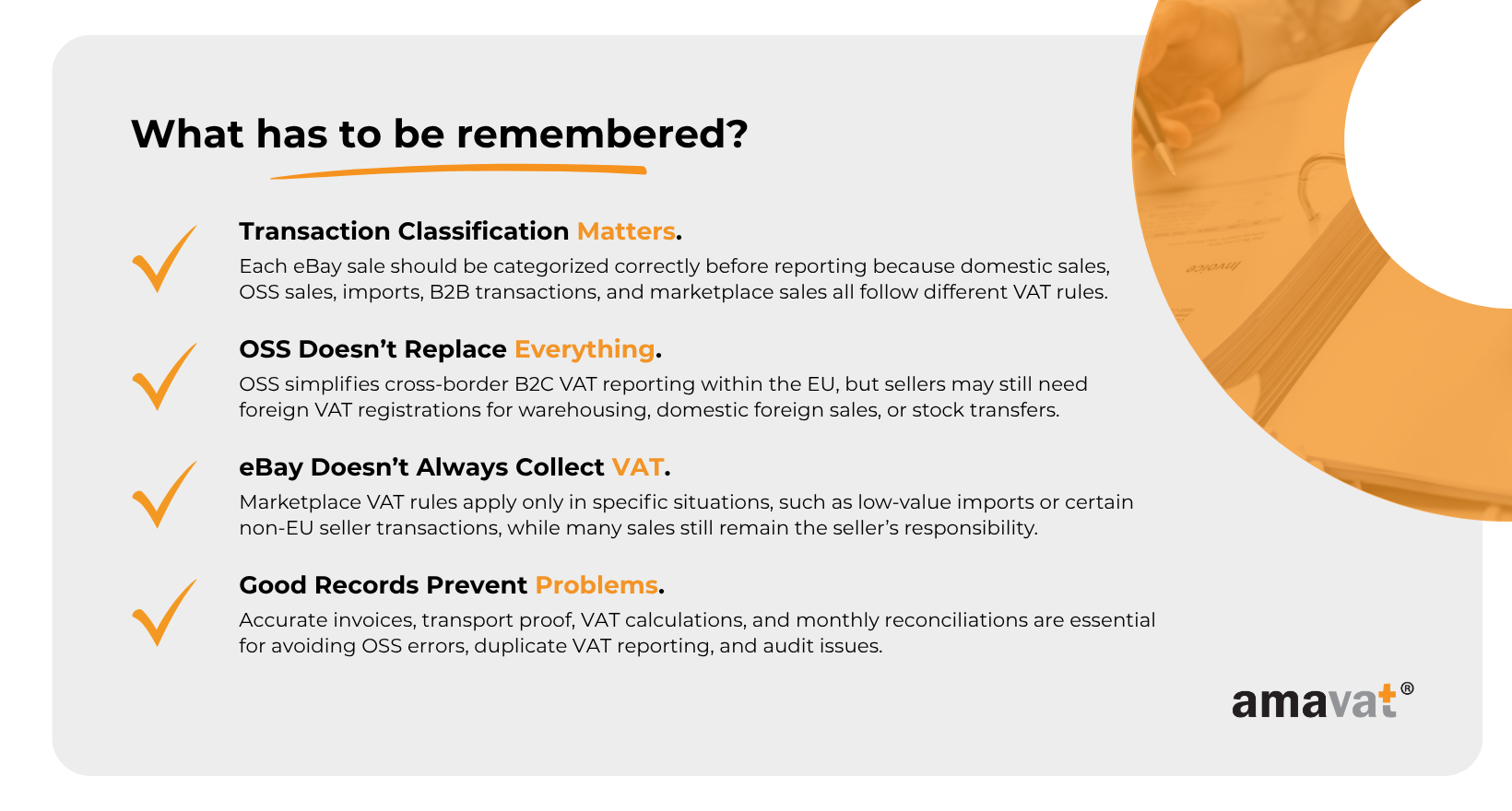
Most VAT errors on eBay are not caused by difficult calculations themselves, but by incorrect transaction classification, misunderstanding marketplace rules, mixing OSS and domestic sales, and poor reconciliation between systems. Businesses that understand the legal structure behind each transaction usually avoid the majority of serious VAT problems long before tax authorities or marketplaces become involved.
Ignoring the €10,000 Threshold
The €10,000 intra-EU threshold is one of the most discussed parts of the EU ecommerce VAT reforms, yet it remains one of the most commonly misunderstood areas in practical ecommerce operations. Many small businesses continue charging domestic VAT rates long after destination-country VAT rules should already apply. In some cases, sellers are simply unaware that the threshold exists. In others, they misunderstand how it is calculated and incorrectly assume it applies separately for each country or for each marketplace they sell through. In reality, the threshold generally applies to the combined value of eligible cross-border B2C sales and relevant TBE services across all sales channels based on the current and previous calendar year.
Another important detail is that the €10,000 threshold only applies where the seller is established in one EU Member State. Businesses established in multiple Member States or using more complex warehousing structures may already fall outside the simplified threshold framework entirely. Sellers also frequently overlook that the threshold calculation includes combined turnover across eBay, Shopify, Amazon, Etsy, and their own ecommerce websites rather than treating each platform separately. This creates problems especially for growing ecommerce businesses because turnover may exceed the threshold much faster than expected once several sales channels begin generating cross-border orders simultaneously.
Once the threshold is exceeded, sellers generally need to apply destination-country VAT rates to eligible cross-border B2C sales. If they continue using their domestic VAT rate after crossing the threshold, they may under-report VAT in customer countries without realizing it immediately. Because VAT rates differ across Member States, the financial impact can grow quickly once transaction volume increases. Ecommerce businesses expanding rapidly into Germany, France, Italy, or Spain often discover these issues only months later during bookkeeping reviews or OSS registration processes. By that stage, correcting the problem may require recalculating historical transactions, amending VAT reports, and paying additional VAT liabilities retroactively.
Retroactive corrections can become especially painful because tax authorities may also apply penalties and interest in addition to the unpaid VAT itself. In practice, the longer sellers continue using incorrect VAT treatment after crossing the threshold, the harder the reconciliation process becomes. Businesses that operate through multiple marketplaces or webshops face even higher risks because turnover data is often fragmented across several systems. This is why monitoring the threshold continuously is much safer than checking it only occasionally at year-end. Sellers also need to remember that it is possible to voluntarily apply destination-country VAT and use OSS even below the threshold, which some growing ecommerce businesses choose in order to maintain one consistent VAT structure from the beginning.
Incorrect OSS Configuration in eBay
Registering for OSS is only one part of the process. Sellers also need to ensure that their ecommerce operations, pricing logic, and marketplace configuration actually reflect how VAT should be handled under destination-country rules. Many businesses complete OSS registration correctly with their local tax authority but fail to update operational settings inside eBay or their accounting systems. As a result, transactions may still use incorrect VAT rates, display inaccurate pricing, or generate inconsistent invoice data even though the seller technically joined OSS already.
One of the biggest problems is assuming that eBay automatically manages OSS calculations simply because a seller entered VAT information into their account settings. In reality, eBay provides only limited VAT configuration functionality, and the seller remains responsible for ensuring VAT treatment is legally correct. Incorrect setup can lead to situations where domestic VAT rates continue being applied to cross-border B2C sales even after destination-country taxation should already apply. Incorrect VAT rates assigned to specific product categories are also one of the most common OSS reporting mistakes, especially for sellers operating across multiple EU markets with different national VAT rules.
Another practical issue involves marketplace compliance itself. Missing or inconsistent VAT information can trigger warnings, listing limitations, or requests for additional business verification from eBay. This becomes especially common for sellers operating internationally through multiple warehouses or several VAT registrations. In some situations, listings may even become temporarily restricted until VAT details are corrected. Operationally, this creates a serious problem because VAT compliance failures can begin affecting product visibility and sales performance directly rather than remaining only an accounting issue in the background.
Incorrect OSS configuration also creates reconciliation problems between eBay transaction data, accounting systems, and quarterly OSS filings. Sellers may accidentally mix domestic sales with OSS transactions, include marketplace-facilitated sales incorrectly, or apply inconsistent VAT rates across different countries. These mismatches often remain hidden until quarterly reporting begins or external accountants attempt to reconcile transaction-level data against marketplace exports. By that stage, fixing the reporting structure usually requires significant manual correction work, especially for businesses processing high order volumes across several EU countries simultaneously.
Double-Charging VAT on Imports
Import VAT problems remain one of the most frustrating issues both for ecommerce sellers and for buyers ordering products internationally. In theory, IOSS was designed to prevent customers from paying VAT twice by allowing VAT to be collected during checkout before the goods enter the EU. In practice, however, problems still appear regularly when customs systems, carriers, or shipment documentation do not process IOSS information correctly. The result is often a situation where the buyer already paid VAT during purchase on eBay but still receives an additional VAT charge from the courier during import clearance.
One of the most common causes is missing or incorrect transmission of the IOSS number during customs processing. Even when eBay acts as the deemed supplier and collects VAT correctly during checkout, the customs declaration still needs to contain the correct information so authorities recognize that import VAT has already been accounted for. If carriers fail to transmit the IOSS data correctly or shipment documentation contains inconsistencies, customs systems may treat the package as unpaid for VAT purposes. The customer then receives another request for import VAT together with customs handling fees before the parcel can be delivered.
Another important issue is the misuse of IOSS numbers themselves. Sellers should never use eBay’s IOSS number outside transactions where eBay acted as the deemed supplier and collected VAT directly from the customer. Incorrect IOSS usage can create customs mismatches, shipment delays, duplicate VAT charges, and broader compliance problems. This becomes particularly risky for businesses operating through multiple marketplaces or using their own IOSS registration separately from eBay transactions. Once shipments begin moving through different logistics providers and customs intermediaries, small documentation mistakes can quickly escalate into large operational problems.
Double-VAT situations also damage customer trust very quickly. Buyers generally expect the checkout price displayed on eBay to represent the final amount payable. When additional import charges appear unexpectedly after purchase, customers often blame the seller directly even if the issue originated during customs processing. For ecommerce businesses focused on reputation, reviews, and repeat purchases, these import VAT problems can therefore become both a compliance issue and a customer-experience problem at the same time.
Poor Record Keeping
Poor record keeping is one of the main reasons why relatively small VAT mistakes turn into major compliance problems later. Many ecommerce businesses focus heavily on making sales and scaling operations while treating accounting documentation as something that can be organized retroactively at the end of the quarter or year. Unfortunately, cross-border VAT reporting does not work well that way. Once sellers begin operating across several EU countries, using OSS, handling imports, or selling through marketplaces with deemed-supplier rules, transaction complexity increases too quickly for incomplete records to remain manageable.
One of the biggest practical problems is the inability to reconcile marketplace data properly. eBay payouts rarely match raw sales totals because the platform deducts fees, shipping adjustments, refunds, promotional costs, and sometimes VAT collected directly by the marketplace itself. Sellers who rely only on payout amounts often struggle to determine which VAT was charged by them, which VAT was handled by eBay, and which transactions belong inside OSS returns versus domestic VAT reporting. VAT reporting should always follow the actual tax point connected to the transaction itself, such as dispatch or delivery timing, rather than relying on payout or settlement dates generated by the marketplace.
Poor documentation also creates serious audit exposure. Tax authorities increasingly expect ecommerce businesses to maintain detailed digital transaction records, especially for OSS reporting. Sellers may need to demonstrate where the customer was located, how VAT was calculated, whether transport evidence existed, and why a transaction was classified under a specific VAT treatment. Under OSS rules, businesses are generally expected to retain records for ten years and maintain at least two non-contradictory pieces of evidence confirming customer location. Missing invoices, incomplete shipping confirmations, or inconsistent transaction logs can weaken a seller’s position even if the original VAT treatment itself was technically correct.
Another issue is that inconsistent records make it almost impossible to detect reporting mistakes early. Businesses with weak accounting structures often discover VAT problems only after external accountants, tax authorities, or marketplaces identify inconsistencies. By that point, the corrections may involve several reporting periods, multiple EU countries, and complicated recalculations of historical transactions. In practice, strong record keeping is not just about surviving audits — it is what allows ecommerce businesses to scale internationally without losing control of their VAT reporting structure entirely.
Best Practices for Error-Free eBay VAT Reporting
Cross-border VAT compliance becomes much easier when sellers build good reporting habits early instead of trying to repair problems later after transaction volume has already grown. Most ecommerce VAT issues do not appear because the rules themselves are impossible to understand, but because businesses scale faster than their accounting structure. A seller processing ten international orders per month can often manage VAT manually without major problems, but once the business expands across several EU countries and sales channels simultaneously, small inconsistencies quickly turn into reporting errors that affect OSS filings, domestic VAT returns, and marketplace reconciliation. Creating a stable reporting process from the beginning is therefore one of the most valuable investments an ecommerce business can make.
One of the most important habits is reconciling eBay payouts against accounting records every month rather than waiting until quarterly or annual reporting deadlines. Marketplace payouts should never be used as the primary basis for VAT reporting because they do not reflect transaction-level VAT treatment accurately. eBay payouts include fees, refunds, shipping adjustments, promotional costs, and sometimes VAT collected directly by the marketplace itself before funds are transferred to the seller. VAT reporting should always be based on the actual tax point connected to the transaction, such as dispatch or delivery timing, rather than payout or settlement dates generated by the marketplace. Businesses that rely only on bank deposits often lose visibility over how VAT was actually handled at transaction level. Monthly reconciliation makes it much easier to identify inconsistencies early, especially when comparing marketplace exports against OSS reports, accounting entries, and domestic VAT filings.
Another essential practice is separating marketplace VAT from seller-reported VAT inside accounting systems. Transactions where eBay acted as the deemed supplier should never be mixed together with ordinary seller-reported OSS sales or domestic VAT liabilities. Even though the VAT itself is generally not reported as the seller’s output VAT, those transactions still remain relevant for accounting records, turnover reconciliation, and audit documentation. Businesses that fail to maintain this separation often accidentally duplicate VAT inside OSS declarations or local VAT returns. Once transaction volume increases across multiple EU countries, untangling those mistakes retroactively becomes extremely difficult.
Continuous threshold monitoring is equally important, particularly for smaller ecommerce businesses that are still growing internationally. The €10,000 threshold applies to the combined value of eligible cross-border B2C sales and relevant TBE services across all sales channels, not only to eBay transactions individually. This rule generally applies where the seller is established in one EU Member State. Sellers using Shopify, Amazon, Etsy, or their own webshop alongside eBay therefore need visibility across all channels simultaneously. Waiting until year-end bookkeeping to check whether the threshold was exceeded creates unnecessary risk because destination-country VAT obligations may already have started months earlier. Businesses that monitor threshold exposure continuously can react much faster and avoid retroactive VAT corrections later.
As operations become more complex, accounting software integrations also become increasingly valuable. Manual spreadsheet reporting may work for very small businesses initially, but once sellers begin managing OSS filings, multiple VAT rates, foreign warehouse stock, and marketplace-facilitated transactions simultaneously, automation becomes much more reliable operationally. Good ecommerce accounting systems help classify transactions correctly, separate marketplace VAT from seller VAT, and maintain audit-ready transaction records across multiple platforms. At the same time, sellers should remember that automation only works properly if the underlying VAT logic and transaction setup are configured correctly. Incorrect configuration inside automated systems can scale errors very quickly across large transaction volumes and multiple countries at the same time.
Another good practice is ensuring that OSS filings remain fully aligned with underlying eBay transaction data. OSS returns should reflect actual destination-country sales values, customer locations, and VAT amounts rather than estimated figures or payout summaries. Errors often arise from incorrect country allocation or applying the wrong VAT rate to a specific product category inside a destination country. Sellers should therefore compare OSS reports regularly against detailed transaction exports to confirm that country-level reporting remains consistent. Customer location must also be supported by reliable evidence such as billing information, delivery addresses, or IP-related transaction data because OSS reporting obligations require sellers to maintain supporting proof of where the customer was located at the time of sale.
Businesses using foreign warehouses or local stock locations should also remember that OSS does not replace all foreign VAT obligations automatically. Domestic sales from local warehouse stock, stock transfers between Member States, and some local reporting obligations may still require foreign VAT registrations alongside OSS. This is why VAT compliance becomes increasingly operational rather than purely theoretical once ecommerce businesses scale internationally. The accounting system, logistics structure, warehouse network, marketplace settings, and VAT registrations all need to remain aligned with each other continuously.
Finally, VAT settings and reporting workflows should always be reviewed after expanding into new countries or changing operational structure. Many ecommerce businesses start domestically and gradually add foreign customers, additional marketplaces, fulfillment centers, or international logistics providers without updating their VAT setup accordingly. What worked operationally for one-country sales often becomes insufficient once foreign stock locations, destination-country VAT rules, or marketplace-facilitated imports enter the picture. Sellers who treat VAT configuration as an ongoing operational process rather than a one-time setup task usually avoid the majority of serious compliance problems before they become expensive to correct. OSS records must generally be retained for ten years and remain available to EU tax authorities if requested during future audits or compliance reviews.
A few operational principles consistently separate businesses with stable VAT compliance from those constantly correcting reporting problems later. Every transaction should be classified before reporting begins, marketplace VAT should always remain separated from seller VAT, and reconciliation should happen monthly rather than quarterly. Sellers should never rely solely on eBay reports as tax records, should always monitor the €10,000 threshold continuously across all channels, and should base VAT reporting on the transaction date rather than payout timing. Businesses that maintain strong documentation, accurate transaction classification, and consistent reconciliation workflows usually find cross-border VAT reporting far more manageable even as international sales volume continues growing.

Conclusion
VAT reporting on eBay in Europe has become significantly more complex than it was only a few years ago. The introduction of the EU ecommerce VAT reforms changed the way cross-border sales are taxed and created a system where VAT responsibility is often shared between the seller and the marketplace itself. In some situations, eBay becomes the deemed supplier and collects VAT directly from the customer, particularly for low-value imports and certain transactions involving non-EU sellers. In many other cases, however, the seller remains fully responsible for charging the correct VAT rate, reporting transactions properly, and maintaining compliant accounting records across multiple EU markets.
For ecommerce businesses selling internationally, understanding the difference between OSS and IOSS is now essential rather than optional. OSS simplifies reporting for eligible intra-EU B2C sales once destination-country VAT rules apply, while IOSS was introduced to simplify VAT collection for low-value imports entering the EU. At the same time, neither system removes the need for proper transaction classification, accurate VAT treatment, or strong operational controls. Many VAT problems appear not because sellers fail to pay VAT intentionally, but because they misunderstand which transactions belong inside OSS, which remain domestic sales, and which are already handled by eBay under marketplace facilitator rules.
Correct transaction classification is ultimately what prevents most expensive reporting mistakes. Every ecommerce transaction should be evaluated based on the location of the goods, the location of the customer, the seller’s establishment status, and whether the marketplace acted as the deemed supplier. Businesses that mix domestic sales, OSS transactions, imports, B2B sales, and marketplace-facilitated supplies together inside one reporting structure usually create reconciliation problems sooner or later. Once those inconsistencies spread across several countries and reporting periods, correcting them retroactively becomes both time-consuming and expensive.
Strong record keeping remains the foundation of long-term VAT compliance. Detailed transaction logs, invoice records, transport documentation, payout reconciliations, and OSS evidence requirements all play a critical role during audits and reporting reviews. Ecommerce businesses that maintain organized accounting structures from the beginning generally scale internationally much more smoothly than sellers trying to reconstruct VAT data after problems already appear. This becomes especially important for businesses using foreign warehouses, multiple marketplaces, or cross-border logistics networks where reporting obligations quickly become more complex.
As ecommerce operations expand across Europe, VAT compliance gradually becomes less about individual tax calculations and more about building reliable operational systems around transaction reporting, reconciliation, and documentation. Businesses selling in multiple EU countries or storing inventory abroad should strongly consider consulting a VAT specialist or experienced ecommerce tax adviser to ensure their reporting structure remains aligned with both marketplace rules and local VAT obligations.