VAT for marketplace sellers in the EU – all obligations in one place
Spis treści
For marketplace sellers, VAT is no longer just a local accounting issue handled once a quarter with the help of a bookkeeper. The moment products start moving between EU countries, warehouses, fulfillment centers, and marketplaces, tax obligations become much more complicated. Many sellers discover this only after receiving questions from accountants, marketplace notifications, or even letters from foreign tax offices. Suddenly, terms like OSS, IOSS, DAC7, distance selling thresholds, or deemed supplier rules start appearing everywhere, even though most small business owners simply want to focus on growing their brand and shipping products to customers on time.
A major reason for this complexity is the EU e-commerce VAT reform introduced on 1 July 2021. The reform completely changed the way VAT works for cross-border B2C sales inside the European Union. Old national thresholds disappeared, new reporting systems were introduced, and marketplaces were given additional tax responsibilities in certain situations. The reform was designed to simplify VAT reporting and close loopholes used by some sellers outside the EU, but for many small businesses it also created a completely new compliance environment that still feels difficult to navigate several years later.
Today, marketplace sellers need to understand much more than basic VAT registration in their home country. They need to know when the OSS system is enough and when local VAT registration is still required. They need to understand how IOSS works for imported goods, which VAT rates apply in different EU countries, and why storing inventory abroad can trigger additional obligations even if sales remain relatively small. On top of that, sellers increasingly need to pay attention to DAC7 reporting requirements and upcoming changes connected to the EU’s ViDA package, which will once again reshape digital VAT compliance in the coming years.
The problem is that most information online explains these topics separately. One article talks about OSS, another focuses on Amazon FBA registrations, while another only discusses DAC7 or marketplace liability. For small e-commerce businesses, this often creates even more confusion because the real challenge is understanding how all these rules connect with each other in practice. A seller using Amazon warehouses in Germany while importing products from outside the EU and selling to customers across Europe may be affected by several completely different VAT systems at the same time.
This guide is designed to bring all of those obligations together in one place and explain them in a practical, understandable way. Instead of focusing only on legal definitions or tax jargon, the goal is to show how EU VAT rules actually affect everyday marketplace sellers and what business owners need to pay attention to as their stores grow across Europe.
Why EU VAT Rules Changed
For years, VAT rules for e-commerce in the European Union were built around a system that no longer matched the reality of online selling. Businesses could easily reach customers in multiple EU countries, but the tax framework was still heavily based on national borders and older retail models. This created confusion not only for small online stores, but also for tax authorities trying to monitor rapidly growing cross-border sales. Different countries applied different distance-selling thresholds, imported goods often entered the EU under special exemptions, and many sellers struggled to understand where VAT should actually be reported and paid.
To address these issues, the European Union introduced a major e-commerce VAT reform on 1 July 2021. The reform changed the way VAT works for many cross-border B2C transactions inside the EU and introduced new systems such as OSS and IOSS. One of the biggest changes was the replacement of separate national distance-selling thresholds with a single EU-wide threshold of €10,000 for relevant intra-EU B2C distance sales and digital services. Once sellers exceed that limit, they generally need to charge VAT based on the customer’s country instead of their own domestic VAT rate. For many small e-commerce businesses, this was the moment when VAT compliance started becoming much more international than before.
The reform was designed with several goals in mind. One important objective was closing VAT loopholes connected to imported e-commerce goods and cross-border marketplace sales. Another was simplifying compliance for businesses selling to customers across multiple EU countries. Before 2021, sellers often needed to monitor different VAT thresholds in every country where they sold products, which quickly became difficult as stores expanded internationally. The EU also wanted to create fairer competition between EU and non-EU sellers by reducing situations where imported products benefited from lighter VAT treatment.
A major example of this change involved low-value imports. Before the reform, imported consignments worth up to €22 could enter the EU without VAT being charged. This exemption was removed on 1 July 2021, meaning VAT now generally applies to imported goods regardless of value. To help manage these transactions, the EU introduced the Import One-Stop Shop, known as IOSS, for consignments worth up to €150. The reform also increased the role of online marketplaces in VAT collection. In certain situations, marketplaces are treated as “deemed suppliers,” meaning the platform itself becomes responsible for collecting and remitting VAT on specific B2C sales facilitated through the marketplace.
The changes affected far more than just online sellers. Marketplace operators, customs authorities, courier companies, payment providers, accountants, and consumers all had to adapt to the new system. For customers, this often meant fewer surprise VAT charges during delivery for imported products. For sellers, however, the reform introduced a much more structured compliance environment where cross-border transactions became easier for tax authorities to monitor and verify.
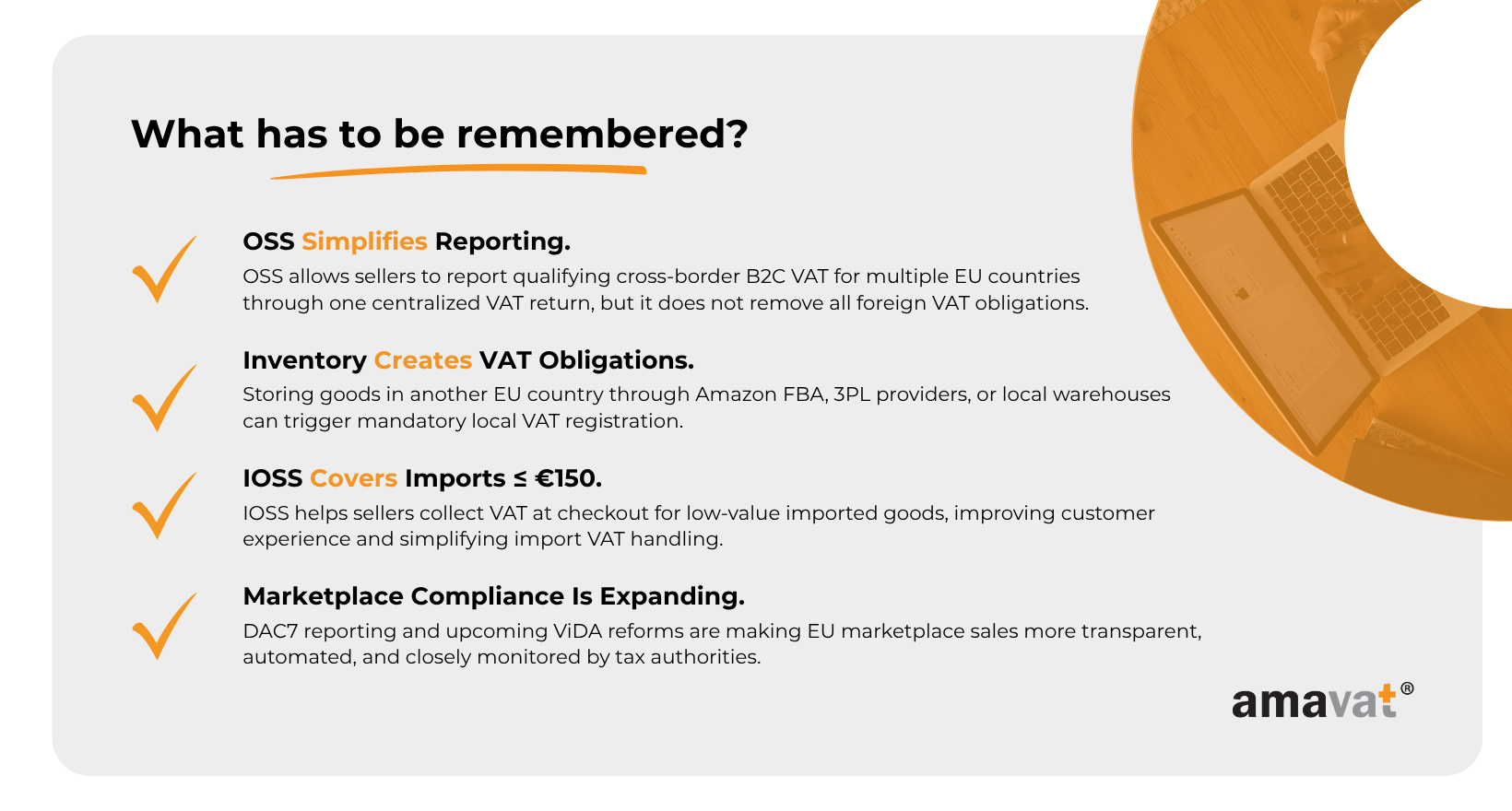
The scale of the system is already significant. More than €33 billion was declared and collected through EU e-commerce VAT systems and OSS-related schemes in 2024 alone, showing how central these mechanisms have become for cross-border online trade in Europe. At the same time, many marketplace sellers quickly discovered that OSS does not completely eliminate foreign VAT obligations. While the system simplifies reporting for many B2C sales, businesses storing inventory in another EU country may still need local VAT registrations there. This is especially relevant for sellers using fulfillment services such as Amazon FBA, where stock can be moved between warehouses in multiple EU countries automatically.
The €10,000 EU Cross-Border Sales Threshold
One of the biggest changes introduced by the EU VAT reform in 2021 was the replacement of separate national distance-selling thresholds with a single EU-wide threshold for certain cross-border B2C sales within the EU, including intra-EU distance sales of goods and certain digital services. Before these rules changed, online sellers had to monitor different VAT thresholds in each EU country where they shipped products. A business could have one threshold for Germany, another for France, and completely different limits for Italy, Spain, or the Netherlands. For growing e-commerce brands, especially smaller businesses selling through marketplaces, this often created unnecessary complexity and made international expansion harder to manage.
Since 1 July 2021, sellers generally work with one common threshold of €10,000 per year for qualifying cross-border B2C sales and services within the EU. The threshold is cumulative across all eligible sales to consumers in other Member States rather than applying separately to each country. This means a seller established in Poland, for example, must look at the combined value of relevant sales to customers across the EU instead of tracking Germany, France, or Austria individually. The threshold mainly applies to businesses established in only one EU Member State and without fixed establishments in other Member States, which is an important detail often missed in simplified explanations of the rules.
If annual qualifying sales remain below €10,000, the place of supply generally remains in the seller’s Member State of establishment. In practice, this means the seller may continue applying the VAT rules and VAT rate of their home Member State unless they voluntarily opt into OSS and destination-country taxation earlier. Some businesses choose to use OSS even before reaching the threshold because they prefer to apply destination-country VAT from the beginning, especially if they already expect rapid international growth or want to maintain consistent pricing across EU markets.
The situation changes once the threshold is exceeded. The transaction that causes the threshold to be exceeded — and subsequent qualifying sales — generally become taxable in the customer’s Member State. A seller based in Spain shipping products to Germany, France, or the Czech Republic must therefore start charging VAT according to the customer’s country rather than using Spanish VAT rates. For many marketplace sellers, this is the point where VAT compliance becomes significantly more international and operationally demanding because the business suddenly needs to apply multiple VAT rates, maintain more detailed records, and correctly report foreign VAT obligations.
This is exactly why the One-Stop Shop system, usually called OSS, became such an important part of the 2021 reform. Without OSS, sellers exceeding the threshold could potentially need separate VAT registrations in multiple EU countries where customers are located. OSS simplifies this process by allowing eligible businesses to report qualifying cross-border B2C sales for multiple Member States through a single VAT return filed in one Member State. For small and medium-sized e-commerce businesses, this significantly reduces the administrative burden connected to international expansion.
At the same time, it is important to understand that OSS does not eliminate all foreign VAT registration obligations. Businesses storing inventory in other EU countries may still need local VAT registrations there, even if they already use OSS for cross-border sales reporting. This is particularly relevant for sellers using fulfillment networks such as Amazon FBA, where stock may be transferred between warehouses in different EU countries automatically. In practice, many marketplace sellers end up using OSS while also maintaining one or more local VAT registrations connected to inventory storage or domestic transactions.

OSS: The Main VAT Tool for EU Marketplace Sellers
One of the most important systems introduced during the 2021 EU VAT reform was the One-Stop Shop, usually shortened to OSS. For marketplace sellers operating across multiple EU countries, OSS has become one of the central tools for handling cross-border VAT obligations without turning tax compliance into a full-time administrative burden. While the system does not completely remove all VAT complexity, it significantly simplifies the reporting process for many online businesses selling to consumers throughout the European Union.
In simple terms, OSS is a special VAT reporting mechanism that allows businesses to declare eligible cross-border B2C sales for multiple EU countries through a single electronic VAT return. Instead of registering separately for VAT in every country for qualifying cross-border B2C transactions, sellers can submit one OSS return through their Member State of identification. The tax authority in the Member State of identification then forwards the reported VAT to the relevant Member States of consumption. For small e-commerce brands trying to scale internationally, this creates a much more manageable system compared to the older framework that often required several separate foreign VAT registrations once cross-border sales expanded.
Without OSS, international marketplace selling inside the EU would become significantly more complicated for many businesses. Once the €10,000 threshold is exceeded, qualifying sales generally become taxable in the customer’s Member State. Without a simplified reporting mechanism, sellers could potentially need separate VAT registrations in multiple destination countries where taxable sales take place. A business selling products to customers in Germany, France, Italy, and Sweden could therefore face multiple VAT filings, different reporting systems, varying administrative rules, and communication with several foreign tax authorities at the same time. For smaller businesses without dedicated accounting teams, this quickly becomes difficult and expensive to manage.
The OSS framework was designed to reduce exactly this type of administrative pressure. At the same time, it is important to understand that OSS is not one universal system covering every type of transaction. The framework is divided into different schemes depending on where the seller is established and what kind of sales are being made. The version most commonly used by EU marketplace sellers is the Union OSS scheme. This applies mainly to businesses established within the EU that make eligible intra-EU distance sales of goods or certain services supplied to consumers in other Member States. For many growing e-commerce brands, Union OSS becomes the main method for reporting cross-border B2C sales after the €10,000 threshold has been exceeded.
The second category is the Non-Union OSS scheme, which is designed mainly for businesses established outside the European Union that supply certain B2C services to consumers inside the EU without having an EU establishment. The Non-Union OSS scheme applies only to qualifying services rather than goods. While this part of the framework is less relevant for many smaller EU marketplace sellers, it remains an important element of the broader EU VAT system because it allows non-EU service providers to simplify VAT reporting across multiple Member States through a single registration.
The third scheme is the Import One-Stop Shop, better known as IOSS. Although technically separate from standard OSS, IOSS forms part of the same e-commerce VAT reform package and is especially important for imported online sales. IOSS applies to distance sales of imported goods in consignments valued at no more than €150. The scheme does not cover excise goods. Under IOSS, VAT is collected at the moment of purchase rather than during importation or delivery, helping create a smoother customer experience and reducing the risk of unexpected charges when parcels arrive. For businesses importing products from outside the EU directly to European consumers, this can significantly simplify VAT handling and reduce customs-related delays.
Another important practical detail is that OSS and IOSS do not follow identical reporting schedules. Union OSS and Non-Union OSS returns are generally filed quarterly, while IOSS returns are usually submitted monthly. For sellers managing both imported goods and intra-EU cross-border sales, this creates an additional layer of compliance that still requires careful monitoring despite the simplifications introduced by the system.
Even though OSS dramatically reduces the number of VAT registrations needed for many cross-border B2C transactions, sellers should remember that it does not replace every foreign VAT obligation. Businesses storing stock in warehouses located in other EU countries may still require local VAT registrations there, especially when using fulfillment services such as Amazon FBA or pan-European logistics networks where inventory is transferred between Member States automatically. In practice, many growing marketplace sellers use OSS together with one or more local VAT registrations depending on how their inventory, warehousing, and fulfillment operations are structured across Europe.
When OSS Is Not Enough: Local VAT Registration
For many marketplace sellers, OSS creates the impression that one VAT registration is enough to cover the entire European Union. In reality, the situation is more complicated. While OSS significantly simplifies the reporting of qualifying cross-border B2C transactions, it does not eliminate every foreign VAT registration obligation. This is one of the most common misunderstandings among growing e-commerce businesses, especially among sellers expanding through marketplace fulfillment networks and international warehouse systems.
The key issue is inventory storage. Once a business stores physical goods in another EU country, that activity can create local VAT obligations there regardless of whether the seller already uses OSS. Tax authorities generally treat locally stored inventory as a taxable connection sufficient to trigger VAT registration obligations. This means that even if a seller reports qualifying cross-border B2C sales through OSS, they may still need separate VAT numbers in countries where their inventory is physically located. For many small marketplace businesses, this is the moment when VAT compliance becomes operational rather than purely sales-based.
This situation appears very frequently with Amazon FBA and similar fulfillment systems. Sellers using Fulfillment by Amazon often send inventory to one warehouse, but Amazon may later redistribute that stock between several EU countries automatically in order to improve delivery speed and logistics efficiency. A seller that originally intended to store products only in Poland, for example, may later discover that inventory has been moved to warehouses in Germany, France, Italy, Spain, or the Czech Republic. From a VAT perspective, transfers of a seller’s own goods between EU countries are often treated as intra-Community stock transfers, which may trigger local reporting and VAT registration obligations in the countries involved.
The issue becomes even more important under Pan-European FBA programs, where inventory is intentionally distributed across multiple fulfillment centers inside the EU. These systems can improve delivery performance and marketplace visibility, but they also create a much broader VAT footprint for the seller. In practice, businesses participating in pan-European logistics structures frequently require several local VAT registrations because stock is physically stored in multiple Member States at the same time. OSS may still be used for qualifying cross-border B2C sales reporting, but it operates alongside these local registrations rather than replacing them entirely.
The same principle applies outside Amazon as well. Businesses using third-party logistics providers, independent warehouses, or their own storage facilities in another EU country may also trigger local VAT registration obligations. Even relatively small e-commerce brands can encounter this situation once they begin outsourcing fulfillment internationally to reduce shipping costs or improve delivery times. A seller established in one Member State but storing inventory in Germany, for example, may need a German VAT registration simply because products are physically located there before being sold.
In addition, sales made domestically from stock already located inside a Member State are generally outside the scope of OSS and may require local VAT reporting. This is another important reason why OSS alone is not always sufficient. If goods are stored in Germany and sold to customers located in Germany, those transactions are typically treated as domestic German sales rather than cross-border supplies reported through OSS. Many marketplace sellers overlook this distinction when they first expand internationally because they naturally focus on customer locations rather than warehouse structures.
Germany is often one of the first countries where marketplace sellers encounter these obligations in practice because it remains one of the largest logistics and fulfillment hubs in Europe. Many marketplace networks and third-party logistics providers use German warehouses due to their central location and developed transport infrastructure. As a result, sellers frequently discover German VAT obligations relatively early, particularly when inventory movements happen automatically through marketplace logistics systems. Similar issues can also arise in countries such as Poland, France, Italy, Spain, or the Netherlands depending on how a seller’s fulfillment network is organized.
Another important detail is that foreign VAT obligations are not always connected directly to sales volume. A business may remain below certain reporting thresholds for cross-border B2C sales while still triggering local VAT obligations because inventory is held abroad. This often surprises smaller entrepreneurs who assume VAT exposure only increases after reaching higher turnover levels. In practice, warehouse structure and inventory movement can become just as important as revenue when determining where VAT registrations are required.
For marketplace sellers, this means VAT planning cannot focus only on customer locations or OSS reporting. Inventory flows, fulfillment settings, warehouse locations, and logistics agreements all influence where VAT obligations arise inside the EU. Many businesses only fully understand this after expanding into international fulfillment systems, which is why learning how stock-related VAT rules work early can prevent expensive compliance problems later.
Note that since January 2026, Amazon’s Pan-EU FBA programme requires participation in a minimum of five EU countries. Sellers joining or continuing in Pan-EU FBA should therefore plan for VAT registrations in at least five Member States alongside their OSS reporting obligations
IOSS for Imports up to €150
One of the most important changes introduced by the 2021 EU VAT reform was the creation of the Import One-Stop Shop, usually called IOSS. The system was designed mainly for e-commerce businesses selling imported goods directly to consumers inside the European Union. For marketplace sellers working with suppliers outside the EU, especially businesses using dropshipping models or importing products from countries such as China, the United Kingdom, or the United States, IOSS quickly became an important part of cross-border VAT compliance.
IOSS applies to distance sales of imported B2C goods in consignments with an intrinsic value not exceeding €150. In simple terms, this means the system can generally be used when products are shipped from outside the EU directly to consumers inside the EU and the value of the shipment remains within the €150 limit. The scheme was introduced together with the removal of the old VAT exemption for low-value imports. Before 1 July 2021, consignments valued at up to €22 could enter the EU without import VAT being charged. This exemption was widely criticized because it created unfair competition between EU and non-EU sellers and also encouraged the undervaluation of imported goods.
After the reform, import VAT generally became due on commercial goods regardless of value. At the same time, it is important to remember that VAT and customs duties are separate mechanisms, and customs duty exemptions may still apply independently for certain lower-value consignments. Instead of allowing low-value imports to enter VAT-free, the EU introduced IOSS as a simplified VAT collection system for eligible transactions. Under IOSS, VAT is collected at the moment the customer places the order rather than during customs clearance or final delivery. This changes the buying experience significantly because customers see the full tax-inclusive price during checkout instead of facing additional VAT charges or handling fees when the parcel arrives.
For marketplace sellers, this can improve customer satisfaction and reduce operational issues connected to refused deliveries, delayed parcels, or customs-related disputes. From a logistics perspective, IOSS can also help speed up customs processing because VAT information is submitted electronically as part of the import procedure. Use of IOSS is optional, but many businesses choose to adopt the system because it creates a smoother purchasing experience and simplifies VAT handling for low-value imports.
In many cases, non-EU businesses must appoint an EU-established IOSS intermediary in order to use the scheme. The intermediary acts as a type of fiscal representative responsible for certain compliance functions connected to the IOSS registration. This requirement is particularly important for businesses located outside the European Union that want to continue selling directly to EU consumers using low-value imported consignments.
At the same time, the scope of IOSS is limited and sellers should understand where the system stops applying. IOSS cannot be used for imported consignments exceeding €150 in intrinsic value. Once the shipment value goes above that threshold, normal import VAT procedures generally apply instead. In addition, the scheme does not apply to excise goods such as alcohol or tobacco products. For higher-value imports, VAT and customs duties may still need to be settled during importation depending on the structure of the transaction and the destination country involved.
Another important distinction is that IOSS mainly simplifies VAT collection for imported distance sales, but it does not remove every import-related compliance obligation. Sellers still need to maintain proper records, ensure accurate customs declarations, and apply the correct VAT treatment depending on the destination Member State. Marketplace structures can also affect how VAT liability works in practice because, in certain qualifying marketplace transactions, the platform itself may become responsible for collecting and remitting VAT under the deemed supplier rules introduced by the EU reform.
For smaller e-commerce businesses, IOSS is often most useful during the early stages of international expansion when products are shipped directly from suppliers outside the EU to European consumers. However, once a business begins storing inventory inside the EU through local warehouses or fulfillment networks, additional VAT rules and local VAT registration obligations may start applying alongside IOSS. This is why understanding the distinction between imported distance sales and inventory already located inside the EU becomes increasingly important as marketplace operations grow across Europe.
Important update as of 1 July 2026: The EU abolished the €150 customs duty exemption for low-value imports. From 1 July 2026, a temporary flat-rate customs duty of €3 per item applies to all e-commerce consignments valued at €150 or less imported from outside the EU, including those reported through IOSS. This duty applies in addition to import VAT and will remain in place until 1 July 2028, when the broader EU Customs Reform takes effect. As a result, using IOSS alone no longer guarantees a fully tax-inclusive checkout experience for customers — sellers now need to factor in this additional customs charge.

Which VAT Rate Should Marketplace Sellers Charge?
One of the most confusing parts of EU VAT compliance for marketplace sellers is determining which VAT rate should actually be charged to customers. Many entrepreneurs assume that VAT works similarly across the entire European Union because the system is harmonized under EU law. In practice, however, VAT rates still differ significantly between Member States. Each country applies its own standard rate and decides which categories of products or services qualify for reduced treatment within the limits allowed under EU VAT rules. For businesses selling internationally through marketplaces, this means VAT compliance is not only about registration and reporting, but also about correctly identifying the applicable rate for each transaction.
The situation becomes especially important once the €10,000 threshold for qualifying cross-border B2C sales is exceeded. After that point, qualifying sales generally become taxable in the customer’s Member State rather than the seller’s Member State of establishment. This means a seller based in Poland shipping products to Germany, France, Italy, or Sweden may need to apply different VAT rates depending on where the customer is located. Even when the same product is sold through the same marketplace, the VAT treatment may vary between countries because each Member State maintains its own VAT rate structure and product classifications.
Under EU rules, standard VAT rates cannot normally be lower than 15%, although most Member States apply considerably higher rates in practice. In addition to standard rates, many countries also use reduced VAT rates for selected categories of goods and services considered socially or economically important. These may include products such as books, food items, pharmaceutical products, passenger transport, or certain cultural services. In some sectors, VAT treatment may depend heavily on how products are classified under local rules. This can become particularly important for marketplace sellers operating in categories such as cosmetics, food supplements, digital products, or medical-related goods, where small differences in classification may affect the applicable VAT rate significantly.
In limited cases, some Member States may also apply zero rates or equivalent highly reduced treatments to certain qualifying products or services. Some countries additionally retain special transitional VAT treatments for specific categories under older EU arrangements. Although many smaller marketplace sellers may never deal directly with every VAT rate category in practice, businesses operating across several EU markets still need to understand that VAT treatment can vary considerably depending on the destination country and the nature of the product being sold.
This complexity has become even more relevant after EU VAT rate reforms adopted in 2022 gave Member States greater flexibility in applying reduced VAT rates to certain categories of goods and services. The reforms were designed to modernize the VAT framework and allow countries more freedom in responding to local economic or social priorities. Even with this increased flexibility, Member States must still apply reduced rates within the limits permitted under EU VAT law. For marketplace sellers, however, the practical result is clear: VAT rate structures across Europe may continue evolving, and businesses selling internationally need to monitor these changes regularly rather than treating VAT settings as a one-time configuration.
One important misconception is that OSS automatically solves VAT rate selection. In reality, OSS simplifies reporting, not the determination of the correct VAT rate itself. Sellers using OSS still remain responsible for applying the correct destination-country VAT rate to qualifying transactions. The system allows businesses to report foreign VAT through one centralized return, but it does not determine whether a product should be taxed at 19%, 21%, 7%, 5%, or another applicable rate in the customer’s Member State. Correct VAT treatment still depends on the product category, the destination country, and the applicable national VAT rules.
In practice, many e-commerce businesses rely heavily on marketplace automation tools, accounting software, and tax integrations to manage VAT calculations across multiple EU countries. Even so, sellers should not assume that marketplace systems always apply the correct VAT treatment automatically. Product mapping errors, outdated VAT settings, or differences in national interpretation can still create compliance risks. For businesses scaling internationally, understanding how VAT rates work across different Member States becomes just as important as understanding OSS, VAT registration, or fulfillment logistics.




Marketplace Deemed Supplier Rules
One of the biggest changes introduced by the EU e-commerce VAT reform was the expansion of the so-called deemed supplier rules for online marketplaces. These rules changed how VAT liability works for certain marketplace transactions and made large platforms much more involved in VAT collection than before. For many marketplace sellers, especially businesses importing goods from outside the EU or selling internationally through platforms such as Amazon, eBay, or AliExpress, understanding these rules is essential because the party legally responsible for VAT is not always the seller anymore.
In simple terms, a deemed supplier arrangement means that, for VAT purposes, the marketplace platform is treated as if it purchased the goods from the seller and then resold them to the final customer itself. Even though the physical movement of goods may still happen directly between the original seller and the consumer, EU VAT law creates a special two-step legal fiction for qualifying transactions. The first deemed supply is treated as a transaction from the seller to the marketplace, while the second deemed supply is treated as a transaction from the marketplace to the customer. Under the deemed supplier mechanism, the first deemed supply between the seller and the marketplace often receives special VAT treatment under EU rules.
The deemed supplier rules mainly apply in two important scenarios. The first involves distance sales of imported goods in consignments with an intrinsic value not exceeding €150 when those sales are facilitated through an electronic marketplace or platform. In these situations, the marketplace can become treated as the supplier for VAT purposes and therefore responsible for VAT collection and reporting. The second major scenario concerns certain supplies of goods already located within the EU made by non-EU sellers through electronic marketplaces. In both cases, the rules were designed to improve VAT collection efficiency and reduce compliance gaps connected to cross-border e-commerce transactions.
A practical example helps explain how this works in reality. Imagine a seller established outside the EU listing products on Amazon.de and selling directly to customers in Germany. If the transaction falls within the scope of the deemed supplier rules, Amazon can become treated as the supplier for VAT purposes and therefore responsible for charging and remitting VAT connected to those sales. From the customer’s perspective, the purchase process may look completely normal, but legally the VAT treatment changes because the marketplace rather than the original seller becomes responsible for the VAT side of the transaction.
At the same time, it is important not to assume that marketplaces automatically become responsible for VAT in every transaction. The deemed supplier rules apply only in specific qualifying situations defined under EU VAT law. In many ordinary marketplace transactions, the seller still remains fully responsible for VAT registration, VAT calculation, invoicing obligations, and reporting requirements. This is particularly common where the seller is established within the EU and sells goods already located inside the EU outside the specific deemed supplier scenarios covered by the reform.
The distinction becomes especially important for businesses using fulfillment warehouses or storing inventory inside multiple EU countries. Even when a marketplace handles VAT collection for certain qualifying transactions, sellers may still retain separate VAT obligations connected to stock transfers, domestic sales, or local VAT registrations. This means the deemed supplier system does not completely remove VAT compliance responsibilities for marketplace businesses. Instead, it changes who becomes responsible for VAT in carefully defined transaction categories. Sellers must still ensure that marketplace account settings, inventory locations, and transaction classifications are configured correctly because errors in these areas can still create compliance problems.
Even where the marketplace becomes responsible for VAT collection, separate customs and import compliance obligations may still apply depending on how the transaction is structured. This is particularly relevant for imported goods moving into the EU through cross-border fulfillment networks or marketplace logistics systems.
For smaller e-commerce sellers, the rules can initially feel confusing because the marketplace may appear to handle VAT automatically in some situations while the seller remains responsible in others. In practice, this creates a mixed compliance environment where sellers still need to understand when VAT obligations remain their responsibility despite using large marketplace platforms. As marketplaces continue expanding their role in tax collection and reporting across Europe, understanding how deemed supplier rules operate becomes increasingly important for any business selling internationally through online platforms.

DAC7: Seller Data Reporting on Marketplaces
In recent years, VAT compliance has become only one part of the broader transparency rules affecting online sellers in the European Union. Another major development is DAC7, a reporting framework designed to improve the exchange of information between digital platforms and tax authorities across EU Member States. While many marketplace sellers initially assumed DAC7 only affected large platforms such as Amazon, eBay, Etsy, or Airbnb, the rules also directly affect individual sellers because marketplaces are now required to collect and report significant amounts of seller data.
DAC7 forms part of the EU Directive on Administrative Cooperation and focuses on improving tax transparency in the digital economy. The main legal obligation falls on platform operators rather than individual sellers themselves. Online marketplaces and digital platforms facilitating certain activities must identify reportable sellers, collect specific information about them, and submit annual reports to tax authorities. These reports are then exchanged between EU Member States, allowing tax administrations to compare marketplace activity with declared income, VAT filings, and other tax reporting obligations. Although DAC7 applies to several categories of platform activity, marketplace sellers are among the groups most directly affected in e-commerce.
Even though the formal reporting duty mainly applies to the platforms, marketplace sellers still need to take DAC7 seriously because the system directly affects how platforms manage seller accounts and compliance checks. In practice, marketplaces now collect significantly more information from sellers than before and regularly request additional verification documents. Sellers who ignore these requests or fail to provide accurate information may quickly encounter operational problems on the platform itself long before any direct contact with tax authorities occurs.
Under DAC7, platforms must identify and report certain sellers operating through their marketplaces. In limited cases, some small-scale sellers of goods may fall outside reporting requirements if they complete fewer than 30 transactions and receive less than €2,000 in total consideration during the calendar year. The exclusion generally applies only where both conditions are met at the same time. Once marketplace activity exceeds those limits, platforms are more likely to treat the seller as reportable under DAC7 reporting procedures.
To comply with these obligations, marketplaces may collect a wide range of seller information. This often includes the seller’s legal name, address, date of birth for individuals, tax identification number, VAT number, business registration number, and bank account or IBAN details where required for reporting purposes. Platforms may also collect information about the seller’s country of tax residence together with the total annual consideration received through the marketplace during the reporting year. For many smaller businesses, this represents a major shift compared to earlier marketplace models where onboarding requirements were often far less detailed.
The reporting process follows an annual timeline. In general, platform operators must submit DAC7 reports by 31 January for the previous calendar year. This means marketplaces increasingly perform seller verification checks throughout the year to ensure they hold complete and accurate information before reporting deadlines arrive. As a result, many sellers now receive periodic compliance notifications requesting updated documentation, identity verification, or tax-related confirmations even if their businesses are relatively small.
For marketplace sellers, one of the most important practical points is that DAC7 compliance issues can quickly affect day-to-day operations on the platform itself. If requested information is missing, inconsistent, or cannot be verified properly, marketplaces may impose restrictions on seller accounts. Depending on the platform’s internal compliance procedures, this can lead to temporary selling limitations, delayed payouts, withheld funds, account deactivation, or other operational restrictions until the required verification steps are completed. In practice, sellers often experience DAC7 first as a marketplace compliance issue rather than as direct communication from a tax authority.
It is also important to understand that DAC7 does not create a new tax itself. The rules are primarily focused on reporting and transparency rather than introducing additional VAT rates or separate marketplace taxes. Being reported under DAC7 does not automatically mean that a seller has unpaid taxes or VAT liabilities. However, because tax authorities now receive much more detailed marketplace data automatically, inconsistencies between platform activity and tax filings may become easier to identify. For growing e-commerce businesses operating across several marketplaces or EU countries, maintaining accurate records and consistent reporting is becoming increasingly important as digital transparency rules continue expanding across Europe.
ViDA: VAT in the Digital Age from 2028
Just as many marketplace sellers are finally becoming familiar with OSS, IOSS, and the post-2021 VAT framework, the European Union is already preparing another major reform package known as ViDA, short for “VAT in the Digital Age.” The initiative represents the next large-scale modernization of EU VAT rules and is expected to reshape how cross-border digital commerce, platform reporting, and VAT collection operate over the coming years. For e-commerce businesses selling through marketplaces, ViDA is important because it signals that EU VAT systems are moving toward even greater automation, transparency, and digital control.
The ViDA package has progressed through the EU legislative process in recent years, with EU institutions reaching political agreement on major parts of the reform in 2025. The ViDA deemed supplier extension — applying from 1 July 2028 (voluntarily) and mandatorily from 1 January 2030 — specifically concerns platforms facilitating short-term accommodation rentals (up to 30 nights) and passenger transport by road. This is a separate development from the existing deemed supplier rules for goods marketplaces already in force since 2021. For marketplace sellers of physical goods, the more relevant ViDA milestones are the OSS expansion to all B2C supplies and own-goods stock transfers (1 July 2028) and mandatory digital reporting requirements replacing EC Sales Lists (1 July 2030). The broader objective of the reform is to modernize digital VAT reporting, reduce cross-border VAT fraud, strengthen transaction transparency, and adapt EU tax systems to the realities of platform-based commerce and international e-commerce supply chains. ViDA also includes broader reforms connected to digital reporting requirements, e-invoicing, and platform economy VAT rules beyond imported e-commerce goods.
One of the areas expected to face increasing scrutiny under ViDA is imported e-commerce goods sold into the European Union by non-EU businesses. EU authorities have become increasingly focused on undervaluation practices connected to low-value imports, particularly where imported consignments are declared below the €150 IOSS threshold in order to reduce VAT or customs exposure artificially. As a result, future VAT systems are expected to rely more heavily on automated data matching between marketplaces, customs declarations, payment systems, and tax authorities in order to identify inconsistencies more efficiently.
EU policy developments increasingly favor centralized digital VAT collection systems such as IOSS for qualifying imported B2C sales. While IOSS itself is not becoming universally mandatory, the reform package significantly increases pressure on non-EU businesses to adopt centralized VAT reporting mechanisms by making alternative structures less practical and potentially more administratively burdensome. For businesses shipping low-value goods directly to EU consumers, this means IOSS will likely become even more important as marketplaces and logistics providers continue adapting their systems to future compliance expectations.
Non-EU sellers may also continue facing local VAT registration obligations in certain structures despite broader VAT simplification efforts. Depending on how goods are imported, where inventory is stored, and how marketplace transactions are structured, businesses may still need VAT registrations in destination Member States alongside broader EU reporting systems. Tax representative requirements may also remain relevant in some Member States and transaction structures involving non-EU businesses, particularly where sellers operate outside jurisdictions covered by administrative cooperation agreements with the EU.
Another important direction under the reform involves reducing reliance on fragmented import collection mechanisms outside centralized systems such as IOSS. The EU has discussed moving away from certain Special Arrangements where VAT could previously be collected during delivery by postal operators or couriers. Instead, the long-term policy direction favors VAT collection earlier in the transaction process, particularly at the point of sale through more integrated digital reporting structures. For marketplace sellers, this indicates a future environment where VAT reporting may become more streamlined technically, but also far more transparent for tax authorities.
The reform is also expected to strengthen digital verification and transaction monitoring across cross-border e-commerce. Marketplace data, customs declarations, VAT returns, payment flows, and import records are likely to become increasingly interconnected through automated compliance systems. This means discrepancies involving import values, transaction records, or VAT declarations may become easier for authorities to detect automatically. Businesses relying on inconsistent reporting or aggressive undervaluation strategies may therefore face significantly higher compliance risks as EU digital tax systems continue evolving.
For marketplace sellers, the most important message is that ViDA should not be treated as a distant future issue affecting only large multinational companies. Many of the operational trends connected to the reform are already visible today through tighter customs checks, expanding platform reporting obligations, and increasing automation of VAT compliance systems. Businesses that build transparent VAT processes early, maintain accurate import and inventory records, and understand how OSS, IOSS, local VAT registrations, and marketplace liability rules interact will likely adapt far more easily as the next phase of EU VAT modernization gradually takes effect from 2028 onward.
Practical VAT Checklist for Marketplace Sellers
After looking at OSS, IOSS, local VAT registrations, deemed supplier rules, DAC7, and the upcoming ViDA reforms, one thing becomes very clear: EU VAT compliance for marketplace sellers is no longer something that can be handled only once a year during accounting season. For many e-commerce businesses, VAT now affects daily operational decisions connected to pricing, warehousing, imports, fulfillment, marketplace settings, and even customer experience. The good news is that most compliance problems can be avoided if sellers understand the key areas that need regular monitoring as their business grows across Europe.
One of the first things every marketplace seller should monitor is annual cross-border EU turnover. Once qualifying intra-EU B2C sales exceed the €10,000 threshold, destination-country VAT rules generally begin applying to those transactions. Many small businesses cross this threshold faster than expected after expanding to multiple marketplaces or launching successful advertising campaigns in neighboring countries. Tracking cross-border sales early helps avoid situations where businesses accidentally continue charging domestic VAT rates after foreign VAT obligations have already started applying.
For sellers making qualifying B2C sales across multiple EU countries, OSS usually becomes the main reporting tool. Registering for OSS allows businesses to declare eligible cross-border VAT through one centralized return instead of filing separate VAT returns in every destination country for those specific transactions. At the same time, sellers should remember that OSS simplifies reporting but does not automatically determine the correct VAT rate or remove every foreign VAT obligation connected to warehousing and domestic sales.
Businesses importing low-value goods from outside the EU should also evaluate whether IOSS makes sense for their structure. For consignments valued at no more than €150, IOSS can simplify VAT collection and improve the customer experience by collecting VAT during checkout instead of at delivery. Many marketplaces and logistics providers increasingly expect sellers handling imported B2C shipments to use more centralized digital VAT collection systems, particularly as EU reporting requirements continue evolving.
Another area that requires constant attention is inventory storage. Marketplace sellers should always know where their stock is physically located because storing goods in another EU country can create local VAT registration obligations even when OSS is already being used. This is especially important for businesses using Amazon FBA, pan-European fulfillment programs, third-party logistics providers, or international warehouse networks where inventory may be transferred automatically between Member States.
Sellers should also regularly review whether marketplace deemed supplier rules apply to their transactions. In some qualifying cases, the marketplace rather than the seller becomes responsible for VAT collection and reporting. However, this does not happen automatically for every sale, and sellers still remain responsible for many other VAT obligations connected to stock movements, domestic transactions, or account configuration settings. Understanding exactly when the platform becomes liable is an important part of avoiding reporting mistakes.
DAC7 compliance has also become a normal part of marketplace selling inside the EU. Platforms increasingly request tax data, identity verification, VAT numbers, bank account information, and business registration details from sellers operating on their systems. Ignoring these requests can create immediate operational problems such as payout delays, restricted accounts, or marketplace deactivation. Even relatively small sellers now operate in a much more transparent reporting environment than a few years ago.
Another essential task is making sure the correct destination-country VAT rate is applied to qualifying transactions. This remains the seller’s responsibility even when OSS is used for reporting. Different EU countries continue applying different VAT rates and reduced-rate categories, which means marketplace sellers need reliable systems for product classification and VAT calculation across multiple jurisdictions.
Finally, businesses selling internationally should already start paying attention to ViDA and the broader direction of EU VAT modernization. Many of the trends connected to the reform — including stronger digital reporting, greater transparency, and increased scrutiny of imports and marketplace activity — are already visible today. Sellers that organize their VAT processes early and maintain accurate records will likely find it much easier to adapt as the EU continues tightening digital tax compliance systems over the coming years.

Conclusion
Selling through online marketplaces in the European Union has created enormous opportunities for small e-commerce businesses, but it has also transformed VAT compliance into a much more international and operational issue than many sellers initially expect. Today, VAT obligations depend not only on where a business is established, but also on where customers are located, where inventory is stored, how goods are imported, and whether the marketplace itself becomes responsible for VAT under deemed supplier rules.
The introduction of OSS made cross-border B2C reporting significantly easier for many EU sellers by allowing qualifying transactions to be declared through one centralized return instead of multiple foreign registrations. IOSS introduced a similar simplification for low-value imported goods by moving VAT collection to the point of sale and reducing customs-related friction for consumers. At the same time, however, many marketplace businesses still require local VAT registrations when inventory is stored in other EU countries through fulfillment programs or warehouse networks.
The compliance environment has also become much more transparent. DAC7 reporting rules now give tax authorities greater visibility into marketplace activity across the EU, while platforms themselves increasingly perform identity verification and tax compliance checks directly on sellers. Looking ahead, ViDA will continue pushing EU VAT systems toward more automation, digital reporting, and integrated cross-border compliance controls.
For marketplace sellers, the most important takeaway is that VAT should no longer be treated as a purely administrative afterthought. As businesses scale internationally, VAT becomes closely connected to logistics, pricing, imports, marketplace setup, and operational planning. Taking time to review warehouse locations, transaction structures, marketplace settings, VAT registrations, and reporting systems now can prevent far more expensive problems later. For many growing e-commerce brands, a regular VAT audit of their EU setup is becoming just as important as reviewing advertising performance, inventory levels, or shipping costs.